



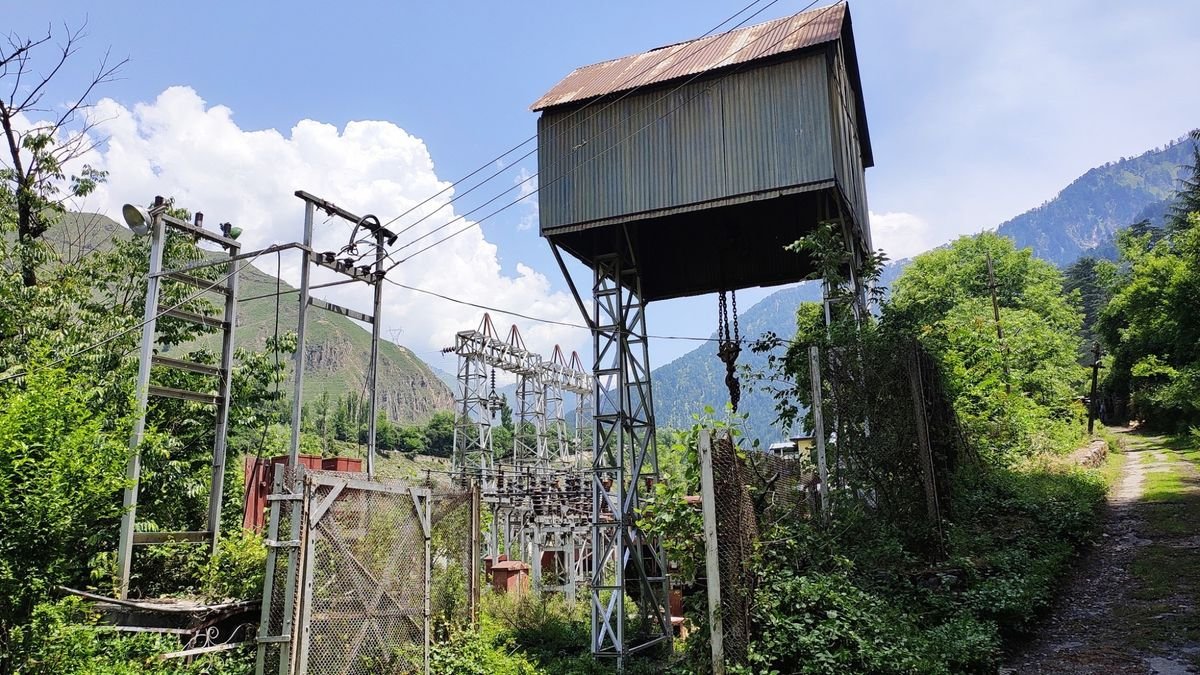
Srinagar, Oct 19: The Jammu and Kashmir government has reduced the capacity of the 125-year-old Mohra Hydroelectric Power Project in north Kashmir’s Uri area from 9 megawatts (MW) to 6 MW due to limited water availability, even as the restoration plan for the historic project has been finalised.
Rahul Yadav, Managing Director of the Jammu and Kashmir State Power Development Corporation (JKSPDC), told Rising Kashmir that the Detailed Project Report (DPR) prepared by IIT Roorkee was ready and the corporation was awaiting approval from higher authorities to initiate the tendering process.
“The capacity has been reduced because of the limited water available to us. Currently, the water of the Jhelum is being utilised by NHPC’s ongoing Uri-I stage-II project, while we will be using water from Boniyar nallah for the Mohra power project,” Yadav said.
He said the heritage project would be restored under the Public-Private Partnership (PPP) model.
“The final DPR for its restoration has been prepared by IIT Roorkee. We are awaiting government approval so that the tendering process can begin,” he said.
The latest development marks a significant step towards reviving one of Kashmir’s oldest hydropower installations, which has remained defunct since the devastating floods of 1992.
The government has renewed efforts to renovate, modernise and upgrade the project, with the JKSPDC Board of Directors earlier deciding to engage a transaction adviser to take the restoration process forward.
In May this year, a team from IIT Roorkee visited the project site in Uri following suggestions for changes to its design. The updated DPR was intended to establish the technical requirements, estimated costs and implementation framework for the restoration.
The project had earlier been considered under the Prime Minister’s Development Package for small hydropower development.
In a reply to the Assembly in March 2025, the government had said IIT Roorkee, following a feasibility assessment conducted through the Ministry of New and Renewable Energy (MNRE), had recommended a 10.5 MW project for central financial assistance.
The estimated project cost was Rs 135.02 crore at 2022 price levels, while the proposal for financial assistance was under appraisal with the Centre, the government had informed the House.
Commissioned in 1905, the Mohra Hydroelectric Project played a pioneering role in bringing electricity to Srinagar when hydropower generation was still in its early stages in the region.
One of its distinctive engineering features was an approximately 11-kilometre-long wooden flume that carried water from the upper reaches to the powerhouse to drive its turbines. The water-conductor system reflected the engineering challenges of the mountainous terrain and also served local irrigation needs.
The project initially had an installed capacity of around 4 MW, which was subsequently enhanced. A 9 MW powerhouse was commissioned in 1962, while the project’s capacity was later reported at 10.5 MW.
However, the devastating floods of 1992 severely damaged its infrastructure, eventually bringing power generation to a halt.
For residents of Uri, the proposed restoration carries significance beyond electricity generation. The revival could help preserve a landmark of Kashmir’s industrial and technological history while opening up opportunities for heritage tourism and local employment.
