



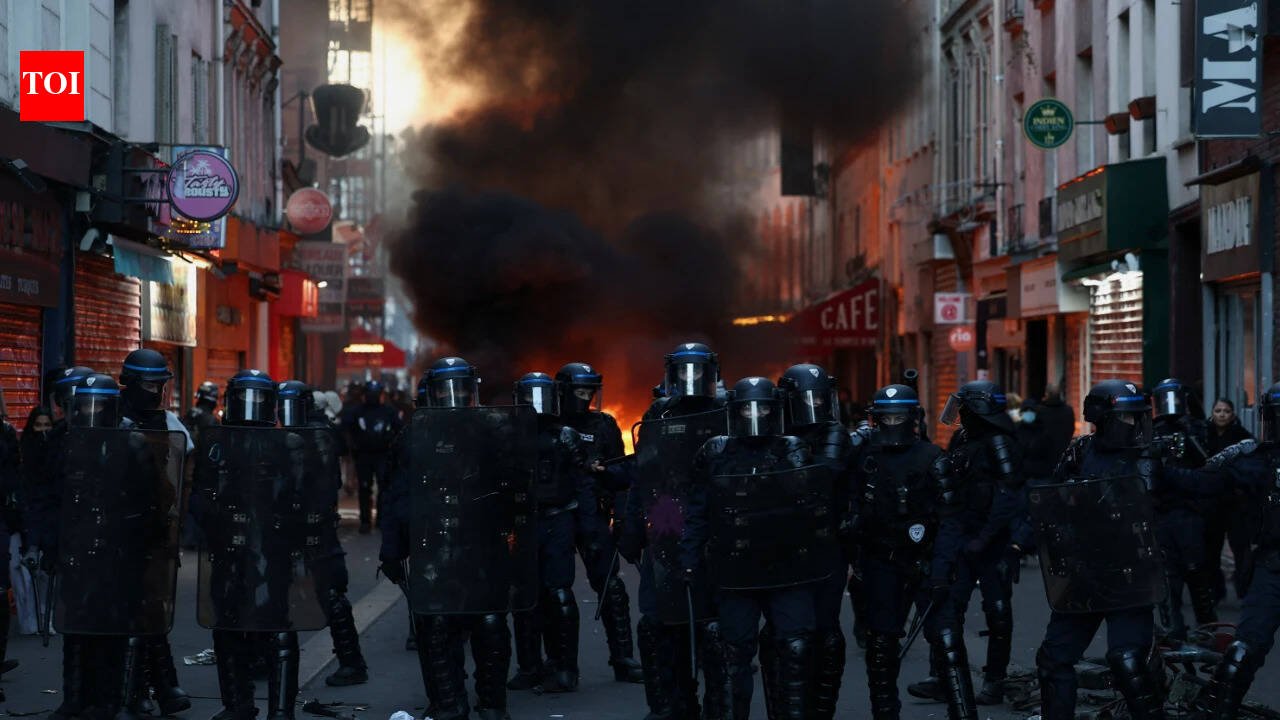
France is tightening security measures after a weekend of violent protests over rising living costs and deteriorating public services escalated into rioting, arson and looting across several cities.French Prime Minister Sébastien Lecornu said on Monday that he had asked local authorities to impose limited, localised curfews to prevent further violence, while President Emmanuel Macron ordered a review of security failures and rejected the resignation of interior minister Laurent Nuñez.Authorities reported that more than 2,400 people were arrested nationwide over the weekend, with hundreds of businesses looted or damaged and public buildings targeted.The government has acknowledged shortcomings in anticipating the unrest, while promising changes to policing and investigations to identify those responsible. European governments have also issued travel advisories urging their citizens in France to avoid demonstrations and large gatherings.
French PM orders localised curfews
Prime Minister Sébastien Lecornu said on Monday that he had asked some municipalities to introduce partial curfews following the weekend’s violent protests.According to the news agency Associated Press (AP), Lecornu instructed prefects to impose “very limited” and “localized” curfews in cities to prevent further rioting and looting.Speaking after an emergency meeting with senior government officials, Lecornu said: “On Saturday, despite scenes of severe violence and extensive property damage, no one was killed, and that is a miracle.”He defended the work of police officers who faced violent groups and said he was fully resolved to restoring public order.Lecornu also said that furlough measures would be available to businesses affected by the protests from Tuesday onwards. He added that the government had no plans to cancel the Paris Saint-Germain-Barcelona football match scheduled for Tuesday.The prime minister said a state of emergency remained an option if the situation warranted it: “If declaring a state of emergency is deemed necessary, we would do so.”
Macron rejects interior minister’s resignation
President Emmanuel Macron has rejected interior minister Laurent Nuñez’s resignation following the violence, saying continued leadership of law enforcement was necessary during the current situation.Nuñez offered to resign over the weekend’s rioting and looting but Macron refused, according to a statement from the French presidency.The president instructed Nuñez to “take all necessary steps to ensure full transparency about the failures in planning and intelligence-gathering that led to the violence”.Macron also called for “new policing tactics on the ground as quickly as possible” to prevent further violent incidents.Nuñez acknowledged shortcomings in the authorities’ preparations, saying there had been a “lack of anticipation” in deploying security forces. He said the police response needed to adapt to “extremely mobile groups” of rioters.“I submitted my resignation because I am responsible for everything that is happening,” Nuñez said on France Inter radio on Monday.He added, “Now, the real issue is ensuring that this doesn’t happen again. … We obviously need to be better at anticipating the kind of mobilization that is unfolding.”Nuñez also acknowledged that police had lost control in some major cities on Saturday, telling the broadcaster: “You can’t look shopkeepers in the eye when hundreds of businesses have been looted and say we haven’t lost control in some of these major cities. Obviously.”
More than 2,400 arrested
The unrest affected Paris, Marseille, Lyon, Limoges and other French cities, with groups of people setting fires, looting shops and targeting public buildings.Authorities said demonstrators and groups of rioters attacked city halls and other public offices.People set fire to rubbish bins, bicycles and other objects in Paris on Sunday, while businesses were looted in several cities.In Limoges, flames engulfed the 19th-century City Hall, causing its roof to collapse and nearly destroying the building. In Marseille, some protesters briefly forced their way into the City Hall lobby, while a police station was damaged. A fire also broke out inside a tourist office in Lyon.More than 2,400 people were arrested nationwide, according to figures reported by AP. Justice minister Gérald Darmanin put the number taken into police custody over the weekend at more than 2,330, with around 70% of them adults.Paris Mayor Emmanuel Grégoire said around 30 shops had been targeted in the capital on Sunday, describing the scenes as “unbearable”. More than 2,000 shops were expected to have been affected across France, with damage estimated at hundreds of millions of euros, according to Alain Di Crescenzo, president of the chamber of commerce.The unrest also caused injuries. Almost 1,000 members of the security forces were injured. A 17-year-old girl lost an eye during protests in eastern France, while another young demonstrator lost a hand in Saint-Étienne.Police use of grenades and other crowd-control weapons has also come under scrutiny.
Marseille bans public gatherings
Authorities in Marseille imposed a ban on public gatherings and demonstrations from noon to 8 pm local time on Monday following violent protests and looting over the weekend.The measure was announced by the local administration.Olympique de Marseille said its official store on La Canebière, the city’s historic main avenue, had been looted during the unrest. The Ligue 1 club condemned the incident and expressed solidarity with Puma, its partner operating the store.“These events have caused significant property damage, forcing the club to temporarily close this store to the public,” the club said in a statement, adding that supporters could continue visiting its other official stores in Marseille.The planned visit to Marseille by Nuñez on Monday was also cancelled, according to Reuters, citing his entourage.Meanwhile, Darmanin said the unrest had exposed weaknesses in how security services dealt with threats posed by far-left protesters.“The security services are very good at dealing with threats from terrorists and organised crime groups, but less so regarding such far-left protesters,” he said, according to Reuters.“Clearly, it is not tackling the far-left effectively,” Darmanin told France 2 television.Government officials have blamed much of the violence on far-left activists and groups of looters. However, the reports provided no official link between immigrants and the rioting.
Paris police set up special task force to identify those involved
The Paris Police Prefect has announced a dedicated task force to investigate violence and vandalism in the Paris metropolitan area.The task force was ordered by Paris Police Prefect Patrice Faure and became operational on Monday. It brings together investigators from four territorial police forces.The team will examine reports and available footage from surveillance cameras, shop cameras and social media to identify those involved in the violence.“Their mission: to comb through all reports and all available images, whether they come from video surveillance, shop cameras, or social media networks,” the police prefect’s account said in a post on X.Faure said the response would focus on maintaining a visible police presence, arresting people caught committing offences and pursuing follow-up investigations under the authority of prosecutors.“I say it clearly to the vandals: our investigators will mobilize all the technical means at their disposal to identify and track you down,” the statement said.The prefect also urged witnesses to send police videos that could help identify those responsible.Separately, French Senate President Gérard Larcher expressed solidarity with police officers, firefighters, municipal workers and shopkeepers affected by the violence. He called for answers on the failures that allowed the unrest to escalate.
European governments issue travel warnings for France
Several European governments on Monday advised their citizens travelling to France to avoid demonstrations and large gatherings, warning of a deterioration in security conditions following the weekend’s violence.The advisories urged travellers to exercise caution and follow instructions issued by local authorities.
- Italy: Advised citizens to avoid large crowds, exercise extreme caution and register their presence in France through a website or app so they could be located if necessary.
- Germany: Warned that further riots could not be ruled out and urged citizens to follow police instructions. It also cautioned that people could face fines or claims for damages if they failed to leave unauthorised demonstrations when ordered to do so.
- Czech Republic: Advised citizens to avoid demonstrations, marches and public gatherings, with the foreign ministry warning that the security situation had deteriorated.
- Poland: Told visitors to avoid areas where demonstrations were taking place, although its overall travel guidance for France remained unchanged.
- Netherlands: Its travel advisory, last updated on October 7, warned visitors to avoid protests.
- Nordic countries: Denmark, Sweden, Finland and Norway issued advisories urging their citizens in France to avoid demonstrations and follow local authorities’ guidance.
The European Union also said the right to peaceful protest must be protected, while describing arson, looting and attacks in France as unacceptable.
Macron faces criticism as political leaders trade accusations
The violence has triggered criticism of the government’s handling of public order, with political leaders trading accusations over the unrest.Macron, in a televised address on Sunday, condemned what he described as “unrestrained violence” by “insurrectionist elements from radical far-left groups, joined by numerous criminals”.“Those who looted will have to pay for the damage, and those who sought to bring down the Republic will be held accountable,” he said.The president said local authorities would be able to ban certain rallies in the coming days if necessary, while instructing prefects to work with mayors to protect public buildings and businesses.Far-right leader Marine Le Pen criticised Macron’s government as “exhausted, disoriented and seemingly incapable of doing anything other than commenting on its own powerlessness”.Far-left leader Jean-Luc Mélenchon accused Lecornu of “playing with fire”, but also said those who supported the movement had no place in looting or destruction.The protests followed calls from labour unions, student organisations and activists seeking to revive the “Yellow Vest” movement, which emerged in 2018 over social injustice.Authorities estimated that around 550,000 people took part in Saturday’s demonstrations, while organisers put the turnout at 800,000.
Macron begins Gulf tour to secure oil and diesel supplies
Amid the domestic unrest over the cost of living, Macron began a Gulf tour on Monday aimed at securing oil and diesel supplies and strengthening economic and defence partnerships.Macron arrived in Kuwait, where he was welcomed by Emir Sheikh Mishal Al-Ahmad Al-Jaber Al-Sabah. He is also scheduled to visit the United Arab Emirates, Bahrain and Qatar by Wednesday.Before departing, Macron said the trip was needed to “secure our supplies”, pointing to demonstrators’ concerns about fuel prices.The French presidency said the aim was to secure commitments on oil and diesel volumes. Macron is accompanied by senior executives from French energy companies TotalEnergies and Engie.The visit comes amid disruption to energy supplies linked to the US-Iran war and the blockade of the Strait of Hormuz, a major route for global oil and liquefied natural gas shipments. Macron would discuss securing maritime shipments and finding alternative routes for energy exports with Gulf leaders, as per news agency AFP.France and Britain have also assembled an international mission intended to help reopen the Strait of Hormuz, primarily through demining operations, once the United States and Iran reach an agreement on the waterway.Macron’s tour also includes discussions on defence cooperation, following Iranian missile and drone attacks on Gulf countries.
