



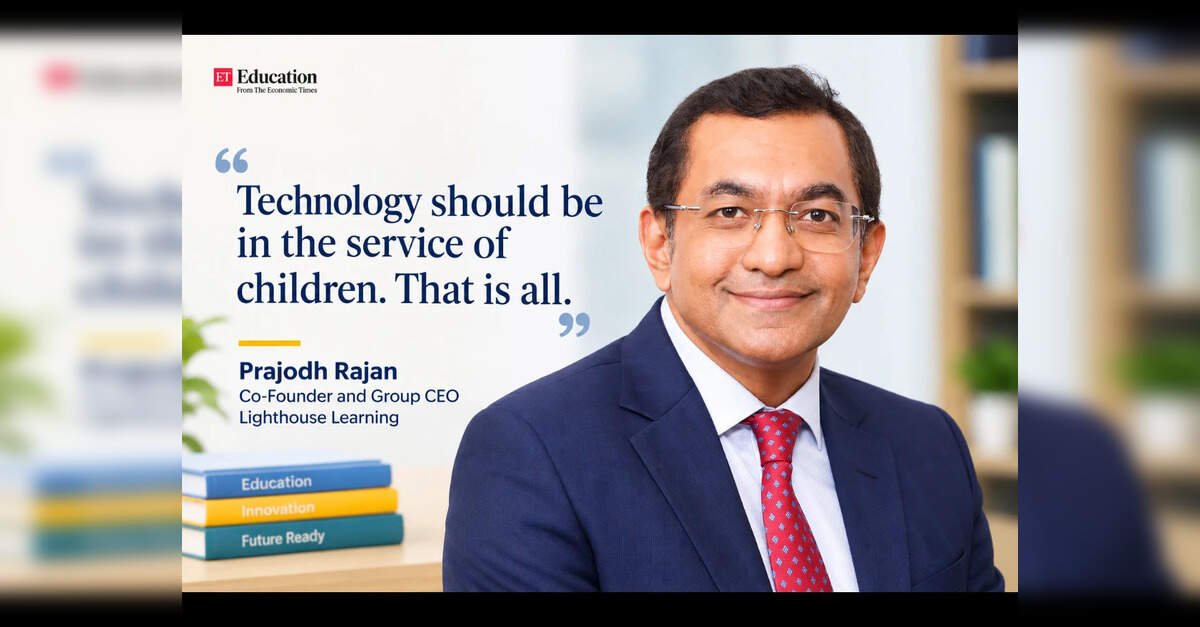
Running a large school network involves a challenge that goes beyond expanding the number of campuses: how to maintain educational quality across different brands, curricula and communities without making every school operate in exactly the same way.
For Prajodh Rajan, Co-Founder and Group CEO of Lighthouse Learning, the answer lies in combining brand-level identities with capabilities that can be shared across the network, from teacher development and curriculum to student well-being, technology and safety.
Lighthouse Learning operates more than 2,000 preschools and 61 K-12 schools, according to figures cited by Rajan. Its multi-brand portfolio includes EuroKids, EuroSchool, Billabong High, Centre Point and Heritage Xperiential. The group is also pursuing international collaborations, including a partnership with British independent school Clifton College, with the stated aim of bringing institutions together for mutual learning rather than simply replicating one education model in another country.
In this conversation with ETEducation, Rajan discusses how Lighthouse approaches quality at scale, maintains the identities of its school brands, responds to changing parental expectations and prepares children for a world increasingly shaped by technology.
Q. You now lead more than 60 K-12 schools across multiple brands. What does quality at this scale really mean to you?
Prajodh Rajan: When we think about our schools, they run different boards. We have CBSE, ICSE, Cambridge-affiliated schools and IB schools.
Ultimately, outcomes are what is important. When I think about outcomes, it is not just about learning outcomes related to academics. It is about broad-based outcomes, and that is really what all our schools strive for.
Many families think about schools only as places for academic outcomes. That has largely been the case in India. But we think about outcomes more broadly, including how children show up in the world.
Of course, getting into a university of their choice is important. At the same time, learning about values and ethics, how to work with each other, and collaboration are all important to us.
When we think about quality, the question is: what kind of person will leave our schools and enter the world? We are preparing children for this world, and none of us really knows the world they will inherit. Those are the skills we want our children to develop. What I call balanced schooling is one of our key themes. That is really what we want to achieve.
Q. Lighthouse has brands such as EuroSchool, Billabong, Centre Point and Heritage Xperiential. How do you maintain their individual identities while ensuring consistent quality?
Prajodh Rajan: Lighthouse Learning is an educational platform serving early years and K-12, and we have a multi-brand strategy. We will always be brand-led. Each of our brands will have its own identity.
Whether it is EuroKids, Early Learning Village, Billabong or Heritage, each stands for what it believes in and has its own identity. As an educational platform, we have built certain capabilities over the years, and it is important for us to bring those capabilities to each of these brands.
For example, we have enhanced health and safety protocols. In India, I can tell you that we are the first and probably the only ones running audit and certification programmes for preschools and schools through third parties. TÜV NORD and Bureau Veritas are our current assessment partners.
We do this annually, so we have a strong health and safety practice.
Q. Is this common practice among Indian schools, or is it something Lighthouse is doing at its own level?
Prajodh Rajan: It does not happen commonly. We were the first to co-write the Safe School Protocol way back in 2015, and that has been an important part of our approach.
There are many other elements that the platform can bring to the brands. We have a central education team that works on pedagogy, curriculum and professional development for teachers.
We also have a well-developed Centre of Well-being that looks after children’s mental well-being and children with special needs. It is based in Mumbai, and we have a team of more than 100 people working on it.
These central capabilities can then be deployed across our brands. We also have a 105-member team at Lighthouse Digital Labs that takes care of technology. We develop several proprietary solutions for our network, including a learning management system and communication tools.
Q. KKR has been a partner in Lighthouse Learning since 2019 and has deepened its investment. What does this mean for the group’s next phase of growth and school strategy?
Prajodh Rajan: KKR has been our partner since 2019. There is a strong conviction in India and in the education sector, and a commitment to India.
The partnership enables us to double down on investments across our network. We are looking at growth through both greenfield development and partnerships with schools. This investment enables us to pursue those opportunities.
Q. How important are international collaborations for Indian school education, particularly at a time when British schools are establishing campuses in India?
Prajodh Rajan: I think India can benefit from global perspectives. India has a very diverse educational ecosystem, which is great, but sometimes we also need to be outward-looking.
Bringing the world’s best practices and global perspectives to India is important. The idea is not simply to replicate these brands in India. That is not the point. It is about learning from each other. There is a lot that India and the Indian education system can offer some of these British brands as well. The learning will be mutual.
This is about two good institutions coming together for the greater good.
Q. The school education space in India is increasingly uneven, with some schools struggling with enrolments while others have waiting lists. What are you seeing on the ground?
Prajodh Rajan: There will always be a supply-demand mismatch. But if you look at good schools, those that offer the highest educational quality will always have more applicants than seats to offer. That will always be the case.
One of our visions is to be the trusted choice for exceptional education. When you become a trusted choice for exceptional education, there will naturally be more people wanting to come in than the number of seats being offered.
Q. Parents today have different expectations and increasingly want to understand the return on investment in their children’s education. How do you see these expectations changing? Is this a positive development?
Prajodh Rajan: I think it is very good. Indian parents have always been demanding, and I do not see that stopping.
Their expectations of what a good school should offer, however, have changed. Earlier, the lens through which they viewed outcomes was narrow. A school was judged largely by its results and academic performance. I think that is giving way to a much broader perspective, which is very good for the Indian education ecosystem in general.
Q. Looking ahead five years, what will distinguish schools that thrive from those that struggle to remain relevant?
Prajodh Rajan: You heard Chris speak about what makes a good school. There are many ingredients that go into making one.
But it will always start with great people, as Chris also said. If you want to build a good school that remains relevant, I think it starts with people and the people you choose to partner with in that particular community.
Finding good teachers, getting them trained and ensuring that they stay for the long term is, if you ask me, the only secret recipe.
What is the recipe? The recipe is about good people.
Q. AI is being discussed and implemented in schools, but many educators are still trying to work out how to use it. How are you approaching AI, and what is your view of its role in school education?
Prajodh Rajan: I am a believer in technology, and I believe technology should be in the service of the young child.
I genuinely believe that many of our assumptions are changing. Earlier, it was only about information being available. Today, not only information but knowledge is also available.
It is important for us to realise that this is not going away. It is here to stay. If it is going to stay, how can we prepare our children for it? This is a big challenge facing educators across the globe. I cannot tell you that anyone has already figured it out. That is not possible. Everyone is still figuring things out.
But what we must realise is that technology should be in the service of children. That is all.
