



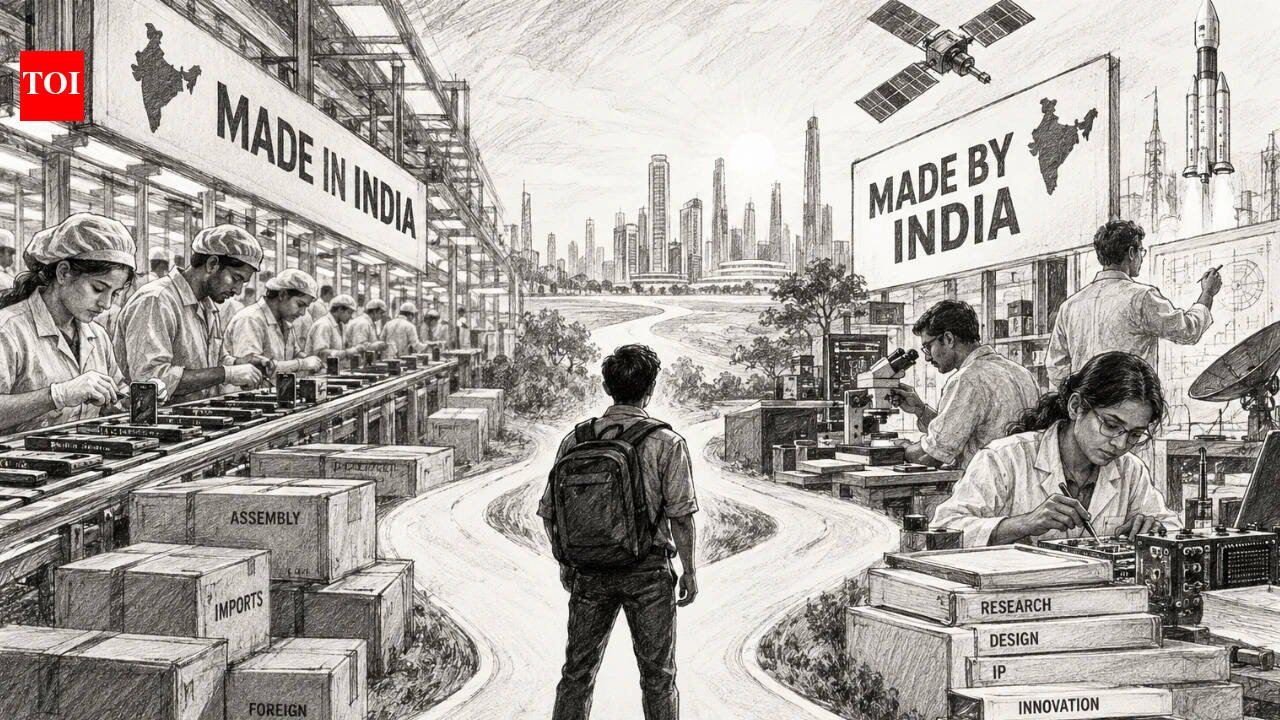
India needs to change its slogan. Across critical sectors, the ambition must move from Made in India to Made by India.The distinction may sound like a play on words, but it goes to the heart of what it means to become a technological power. Made in India tells us where a product was manufactured. Made by India tells us who invented it, who owns the intellectual property (IP), who controls the technology and who captures the value it creates.This isn’t an attempt to deny the importance of manufacturing. Factories create jobs, build industrial capabilities, enable supplier networks and reduce dependence on imported finished products. Assembling mobile phones at scale, developing the capacity to launch satellites or manufacturing sophisticated equipment are all milestones.But India must stop treating every new assembly line, every imported technology given a domestic label and every payload bought from elsewhere as evidence of having arrived, lest it wants to become a country that manufactures the future without owning it.
Parallax
Take smartphones, for example. India has made progress in becoming a manufacturing and export base for mobile phones. Yet in Aug 2026, MeitY secretary S Krishnan said domestic value addition in mobile phones is only at 22-23%. The figure shows the distance between assembling a finished product and developing the technologies and designs that go into it.The same principle applies to space. Buying a payload — like atomic clocks for instance — and operating it successfully can serve a legitimate strategic need (it’s another matter that India’s NavIC programme is dysfunctional). But acquiring technology is not the same as creating it. That experience must build the capacity to design, develop and improve technology independently.IP is not merely a legal certificate or a patent number. It’s an economic asset, and in strategic sectors, a source of leverage that determines who licenses technology, earns royalties and develops the next generation of a product.India needs both manufacturing muscle and intellectual ownership and it cannot afford to confuse the former with the latter.The semiconductor industry makes for a good case. India has a large pool of chip-design engineers, and the govt has recognised that talent through initiatives such as the Design Linked Incentive (DLI) scheme, which supports domestic companies and startups working on semiconductor design and IP.The goal should be to turn these capabilities into globally competitive designs, products and sustainable businesses. This won’t happen overnight. That’s precisely why the country needs a long-term strategy rather than a succession of announcements measured by investment commitments, factories inaugurated or projects launched.The broader research picture makes the case more pressing. India’s gross expenditure on R&D stood at about 0.8% of GDP in 2023-24, according to govt figures. India has a substantial scientific and engineering workforce, but its ability to translate research into internationally competitive products remains a critical challenge.India lacks an ecosystem that takes an idea from a lab to a patent, from a patent to a working prototype, and from a prototype to a product customers will buy. A patent by itself is not proof of commercial success.This is not an argument against foreign investment, collaboration or imported technology. It’s an argument against permanent dependence in strategic sectors. Partnerships should expand India’s capabilities, not leave essential design and ownership beyond its control.Nor should indigenous IP become an excuse for protectionism. Buying technology can be the right decision. So can licensing it or working with a foreign partner. The question is whether these choices help develop domestic capabilities or become a substitute for doing so.The govt must measure progress differently. Alongside factories, production volumes and exports, it should track Indian-owned technologies, commercialised research, licensing revenues and original products reaching global markets.Companies must invest in research, universities must strengthen industry links, and investors must recognise that deep technology often requires longer timelines.The public conversation needs to change, too. There’s nothing wrong with celebrating a factory opening or a successful mission. But celebrations should reflect the achievement, not inflate it into proof that the larger challenge has been overcome. When standards are set too low, incremental progress can be mistaken for the destination. The result is stagnation disguised as success.India’s ambition must be higher. It must aim not only to make products the world buys, but also to create the technologies the world needs. Building IP takes time. It demands patience, investment and a willingness to accept failure. It also requires resisting the temptation to declare victory at every intermediate milestone.India must learn to look at technological progress like a marathon runner, not a PR agency!The Parallax is simple: a product may be made in India without its technology being made by India. The real test is whether, when the next generation arrives, India can build it on its own terms.
