



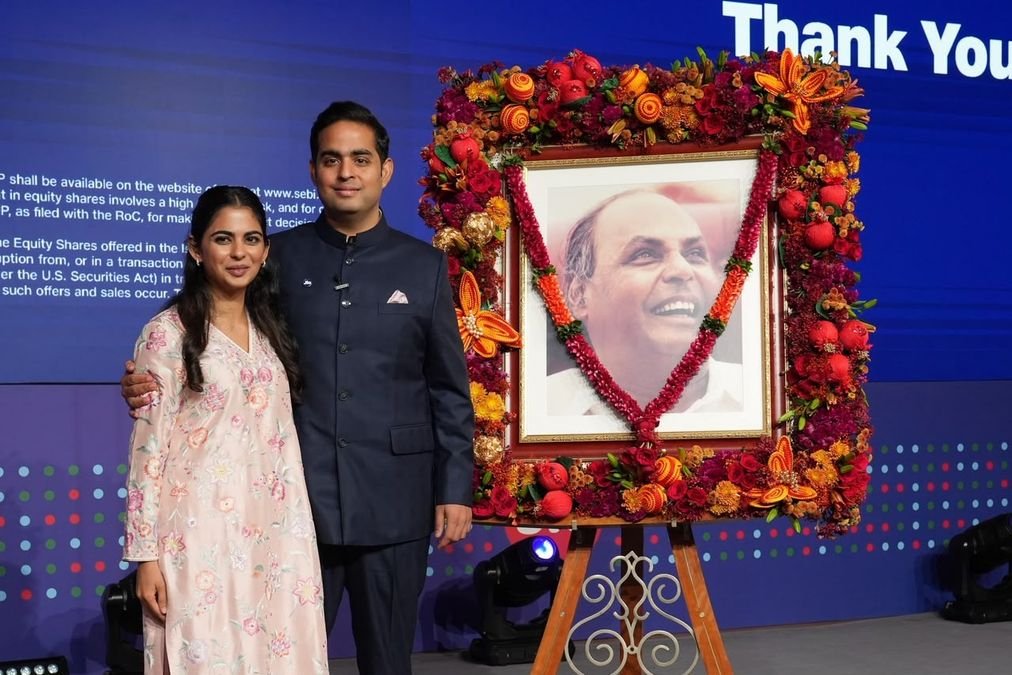
Mumbai, Oct 15: Jio Platforms Ltd. is positioning itself at the centre of India’s transformation into a “premier digital society”, Managing Director Akash Ambani said on Thursday, unveiling an ambitious growth blueprint that spans mobility, home broadband, enterprise services and the global export of its indigenous end-to-end technology stack.
Addressing a media meet ahead of the company’s much-anticipated initial public offering, Ambani said Jio’s mission is “simple” — to connect every Indian home, citizen and enterprise with the highest quality and most affordable digital services. He anchored the company’s vision in the government’s Digital India, Make in India and Viksit Bharat 2047 initiatives, describing Jio as “an able partner” in enabling India’s digital future.
“Today we stand at 53 crore Indians that have trusted us as their digital connectivity partner. All of this in just the last 10 years,” Ambani said, noting that the company had celebrated a decade of operations on September 6 this year.
FINANCIAL SCALE AND GROWTH
Ambani presented a string of financial metrics to underline Jio’s scale, reporting EBITDA of over Rs 76,000 crore accumulated over 10 years. The last three years, he said, saw EBITDA growth of 17.8 per cent, with EBITDA margins at 53.3 per cent in the first quarter of the current financial year — a pace he claimed was faster than even global technology companies.
Revenue, he said, had grown from Rs 1,09,000 crore to over Rs 1,46,000 crore over the past three years, a CAGR of 15.8 per cent. “30 per cent of our revenue flows right into our free cash flow,” he said, adding that EBITDA less capex stood at 28.6 per cent of revenue in FY26.
The foundation of that financial performance, Ambani argued, is Jio’s network dominance. “Today, Jio carries over 60 per cent of India’s data traffic,” he said. “We have an innate understanding better than any other Indian company about our customers.”
He noted that Jio had rolled out 5G in just 19 months, covering 99 per cent of India’s living population and erecting a tower every minute of a 12-hour working day during that period. “Today we’re the world’s largest 5G base outside of China. And we did the fastest 4G to 5G migration anywhere in the world,” he said.
FROM DATA-SCARCE TO DATA-ABUNDANT
Recounting Jio’s entry as the 14th operator in 2016, Ambani said the company saw an opportunity to transform India from a “data-scarce nation” to a “data-abundant” one. At the time, he recalled, pricing was almost Rs 228 per GB, download speeds were 2.5 Mbps, and the total universe of data customers was less than 70 million, consuming about 200 MB per month.
“Today, as the industry together, we’ve grown from 14 players to just four, and we deliver 68 Mbps of total download speed across India, Rs 7.5 per GB, and about 26.7 GBs per customer per month,” he said. On Jio’s own network, the figures are starker: average download speeds of almost 200 Mbps — “twice as fast as the other operators” — pricing at Rs 4.9 per GB, and data consumption of 43.7 GB per user per month.
“This is what has pivoted India from being the 155th nation of broadband in penetration and consumption in the world to number one in just 10 years,” Ambani said.
PROPRIETARY TECH STACK AND PATENTS
Central to Ambani’s pitch was Jio’s end-to-end technology stack spanning autonomous networks, an integrated home platform, and devices, operating systems and digital applications. He said Jio has filed over 7,220 patents through a talent base of more than 12,000 engineers, making it “the only Indian company that has ranked in the top 20 global companies in terms of patents filed, according to the WIPO.”
“Today we see a 1.4 trillion-dollar digital economy by FY31, and the end-to-end technology stack gives us a capability like no other,” he said. “We built our own proprietary stack to serve our customers better, to give them services that they have never witnessed before.”
THE CUSTOMER AS THE UNIT OF BUSINESS
Describing the customer as “the most important unit of our business,” Ambani said Jio’s data gateway offers partners an understanding of consumers — their demographics, propensity to spend and ability to consume additional services — that no one else possesses.
He cited the partnership with Google’s Gemini as an example of co-creating a new market rather than striking a simple distribution deal. “Gemini added 30 million new subscribers for its base,” he said. Similarly, he pointed to over 336 digital subscriptions across OTT and music bundled for Jio customers.
Ambani also announced a voice AI travel service, unveiled at the recent Reliance AGM, which he said would democratise intelligence across India. “Today we carry 20 billion minutes of voice on our network on a daily basis — the largest in the country,” he said, adding that services such as call summarisation and transcription across 12 Indian languages, distributed to 53 crore Indians, made Jio “the only player in town that can do that.”
FOUR GROWTH ENGINES
Ambani outlined four growth engines: mobility, home, enterprise and the monetisation of Jio’s core technologies.
In mobility, he projected close to 340 million new customers over five years — 100 million first-time SIM users and 240 million 2G subscribers migrating to 4G and 5G. “In the last financial year, we added three times more net active additions than our nearest competitor,” he said.
In home broadband, Ambani said Jio has a home pass of close to 40 million homes against a national opportunity of approximately 300 million homes and 100 million pay-TV households. The solution to scale from 40 million to 100 million homes, he said, was to make the last mile wireless — but not through standard 5G FWA, which he argued “doesn’t scale.”
Instead, Jio built its own technology on the 5G unlicensed Wi-Fi band, called UBR. “40 per cent of our new additions are acquired using that technology. On a 30 million base, 6.5 million customers are already operating on this technology,” he said. “40 per cent of my net additions are coming from outside tier one and tier two cities.” Jio, he added, accounts for 67.5 per cent of India’s net fixed broadband additions.
In enterprise, Ambani pegged the digital services opportunity at $56 billion, noting that 65 per cent of the country’s bank branches are connected on Jio, with services extending to video surveillance and security use cases.
GLOBAL AMBITIONS AND 6G
On international expansion, Ambani said Jio would pioneer a “unique playbook” — partnering with telecom operators worldwide as a managed service partner rather than a vendor or software provider, deploying its end-to-end stack in a capex-like manner. “We believe there is a huge market opportunity all across the world, including the developed and developing nations,” he said, adding that partners would be chosen carefully based on market opportunity.
Looking ahead, Ambani said 6G is “on our horizon” and would be delivered “as a software upgrade rather than a new infrastructure build out.” He noted Jio’s infrastructure footprint of over 3,60,000 towers and over 1 million route kilometres of fibre.
“The proprietary end-to-end technology stack has given us the ability to play across the value chain and a potential for India to become an exporter of technology rather than an importer of technology,” Ambani said.
Summing up, he returned to the customer. “As long as we continue to deliver value to each of our customers, understand their needs better, serve those needs, we will be able to drive the digital services and the digital society of our vision much better.”
