



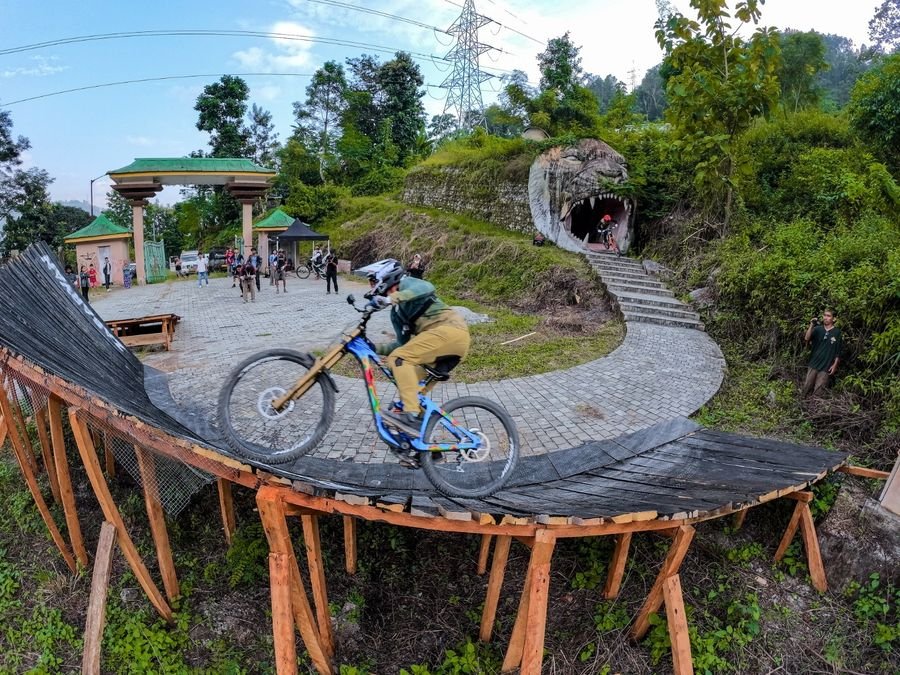
Srinagar, Oct 15: India’s mountain landscapes are emerging as a promising arena for international downhill mountain biking, with the Zabarvan Legends Series returning for its second season with races across Sikkim, Ladakh and Pune, aiming to put the country on the global adventure sports map.
Organised by Zabarvan Xtreme, the international championship seeks to bridge the gap between India’s growing mountain biking community and the professional infrastructure, sponsorship and competitive opportunities available to riders in established cycling nations.
Founded by Sehan Shetty, a snowboarder, surfer and football player, Zabarvan Xtreme was conceived to help Indian athletes pursue mountain sports professionally rather than treat them merely as recreational activities.
“Zabarvan Xtreme was created to build an ecosystem for mountain sports where Indian athletes can thrive and see these disciplines as serious sporting opportunities rather than simply hobbies,” Shetty said.
The series made its debut in October 2025, travelling through Gulmarg in Jammu and Kashmir, Shillong in Meghalaya and Guwahati in Assam. More than 30 riders participated in the inaugural edition, including competitors from Brazil, Australia, the Czech Republic and Iran. Brazil’s Douglas Vieira, a five-time national champion, emerged as the overall winner.
Building on that experience, the second season has introduced three new venues, each offering a distinct combination of terrain, technical challenges and regional character.
The opening race, Singge Oralo, was held from October 7 to 11 at Zoom village in Sikkim’s Eastern Himalayas. The two-kilometre course, named Snow Lion, featured a 200-metre descent through dense forests, with steep gradients, exposed roots, rocky drops and centuries-old granite stairways passing through historic mountain settlements.
With gradients reaching 40 degrees, the track tested riders’ precision and adaptability across slippery roots, soft forest soil and unforgiving stone surfaces. The event attracted participants from eight countries, including India, Brazil, Australia, Iran, the Czech Republic, Taiwan, Nepal and Italy.
Vieira continued his winning run, finishing first in the elite category. Czech rider Matej Charvat secured second place, while Iran’s Hossein Zanjanian finished third. Australian mountain biking legend Samuel Hill, an eight-time world champion, finished fourth.
Indian riders also made their presence felt, with Taitus Marak finishing eighth, Virendra Mali ninth and Aaronson Oniel Kharpuri tenth. In the second competition category, Meghalaya’s Will Willbornson finished second and Darian Laloo of Meghalaya Pro Cycling secured third place.
The championship has now moved to Ladakh for Druk Layul, scheduled from October 14 to 18 at South Pullu, near the gateway to Khardung La.
Named after the legendary Tibetan Thunder Dragon, Druk Layul translates to Thunder Dragon’s Heaven. The approximately 3.5-kilometre course descends from an altitude of 4,300 metres to 3,700 metres, presenting riders with a 600-metre elevation drop across the rugged Trans-Himalayan landscape.
Loose shale, rocky chutes, exposed traverses, technical switchbacks and fast sections punctuated by jumps and drops are expected to test the competitors’ endurance and technical skills. Around 25 athletes are expected to participate in one of the championship’s most demanding high-altitude settings, where temperatures may range from minus 5 to 15 degrees Celsius.
Riders are being given two days to acclimatise to the altitude before racing. The event is being organised in partnership with Unexplored Ladakh, represented by Tenjin Jamphel, whose regional knowledge and experience in mountain biking and adventure travel are central to the competition.
Beyond hosting the race, the organisers see Ladakh as a potential long-term destination for competitive mountain biking, with plans to encourage local participation, create opportunities for young riders and establish recurring competitions.
The final leg, Gaur Ghat, will be held from October 22 to 25 in Pune, Maharashtra, beneath the historic walls of Sinhagad Fort.
Drawing its name from the historic mountain pass leading towards the fort, the race will take riders through the rugged Sahyadri mountains. The 2.2-kilometre course, set at approximately 1,300 metres, features a 400-metre descent across dry basalt terrain, loose gravel, exposed bedrock, steep rock faces and technical switchbacks.
The track’s rocky surfaces and rough rock gardens offer a different challenge from Sikkim’s forest trails and Ladakh’s high-altitude desert. The organisers hope the event will help establish Pune as a destination for international mountain biking, building on its active cycling community and access to outdoor recreation areas.
For Zabarvan Xtreme, however, the championship is about more than race results. The organisation aims to address the structural challenges confronting Indian mountain biking, including expensive equipment, limited training facilities, inadequate sponsorship and a shortage of professional racing opportunities.
Bringing international riders to India gives local competitors an opportunity to experience professional racing standards without having to travel overseas. Collaboration with local organisers and cycling communities is also intended to build the foundations for sustained participation beyond individual events.
The series could additionally create opportunities in adventure tourism, local employment and sports infrastructure, particularly in mountain destinations with the terrain and natural appeal to host international competitions.
However, the long-term benefits will depend on sustained investment, local athlete development and responsible management of fragile mountain environments.
From Gulmarg, Shillong and Guwahati in its inaugural season to Sikkim, Ladakh and Pune in 2026, the Zabarvan Legends Series is expanding its geographical reach while seeking to establish a stronger professional pathway for Indian mountain bikers.
Its larger ambition is to create an ecosystem where Indian athletes can train, compete at international standards and pursue mountain sports as a career, while bringing the country’s diverse landscapes to a wider global sporting audience.
