



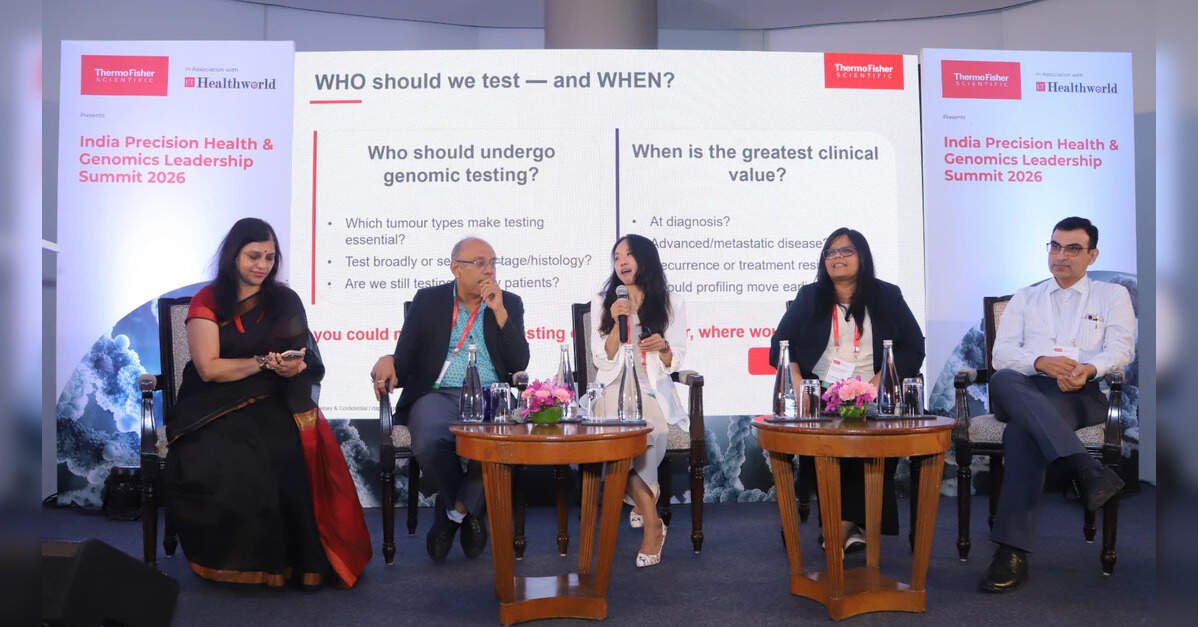
Hosted by Thermo Fisher Scientific in association with The Economic Times Healthworld, the India Precision Health & Genomics Leadership Summit 2026 featured a panel on Integrating Genomics into Patient Management: Oncology as a Case. Bringing together leading clinicians and laboratory experts, the session highlighted how genomic insights are helping translate precision medicine into more personalised oncology care.
Panellists included Dr Mamta Soni, Chief Medical Officer, Apollo Health & Lifestyle Limited and Chief of Laboratory Services & Senior Consultant, Apollo Central Reference Laboratory; Dr Rahul Bhargava, Principal Director & Chief Haematology, Fortis Memorial Research Institute; Dr Shrinidhi Nathany, Consultant, Fortis Memorial Research Institute; and Dr Ullas Batra, Director, Medical Oncology and Chief of Thoracic Medical Oncology, Rajiv Gandhi Cancer Institute & Research Centre. Dr. Daphne Goh, Head, Precision Medicine, Asia Pacific, Thermo Fisher Scientific, moderated the session.
Dr. Goh set the context by posing a series of questions central to the adoption of precision oncology: “How has genomics been integrated into patient care? Who should be tested, and when? Are we testing enough patients? Are we testing early enough, or are we still missing opportunities to intervene at the right time?”
Genomics reveals India’s unique disease biology
For Dr Rahul Bhargava, genomics has become indispensable not only for cancer management but also for understanding disease patterns within the Indian population. Drawing from his experience in haematological cancers, he explained that genomic profiling is helping reveal how disease biology can differ across populations. “Every single patient brings value, and genomic testing needs to be done,” he said, arguing that building large Indian genomic datasets will be critical to improving diagnosis, treatment selection and prevention strategies.
Balancing clinical utility versus discovery
While Dr Bhargava advocated continued exploration and data generation, Dr Ullas Batra stressed that testing strategies must remain grounded in clinical utility and health economics. “Nobody has unlimited resources. We need to channelise our resources appropriately,” said Batra.
Drawing from extensive experience in solid tumours, Dr. Batra argued that testing decisions should be guided by disease type, clinical evidence and the likelihood of identifying actionable findings. “I think it should be the right patient, the right test, the right time.”
He also cautioned against creating unrealistic expectations for patients when the probability of identifying a targetable mutation may be low, particularly with rare alterations.
Dr Bhargava, meanwhile, highlighted the importance of maintaining a discovery mindset. “We will continue to discover newer molecules, not based on Western data, but on the entire cancer genome, to understand what is driving the biology.”
Broad panels, better answers
Dr Shrinidhi Nathany noted that even a relatively small possibility of uncovering an actionable mutation can be meaningful for a patient with cancer.
She explained that while focused panels remain common practice, comprehensive genomic profiling is increasingly demonstrating value. Dr Nathany noted that India still relies largely on genomic panels developed using Western evidence. Developing tumour-specific Indian panels will require large-scale whole-genome studies and greater indigenous data generation.
Drawing on comparative studies, she highlighted that broader testing could reveal clinically meaningful findings missed by narrower panels. Her evolving approach is driven by a practical challenge faced daily in oncology. “Tissue is always an issue.” Because tissue samples are often limited, she argued that comprehensive upfront testing can reduce repeat procedures while helping clinicians anticipate resistance mechanisms and future treatment options.
Speed matters as much as accuracy
The discussion also highlighted the growing importance of turnaround time in genomic testing. Dr Mamta Soni observed that clinicians view rapid reporting as a critical component of patient management. “It’s not only the molecular result. I think turnaround time is turning out to be the biggest requirement for the clinician.”
She noted that improvements in testing volumes, workflow optimisation and newer technologies are helping reduce reporting delays, making genomic information more actionable within clinical decision-making timelines.
Dr Nathany reinforced this point with a practical example from haematology. “We give reports in three days, not three weeks.” According to her, faster reporting has helped accelerate treatment decisions and contributed to meaningful improvement in clinical care.
Building a molecular-ready care pathway
“The biggest challenge is the mindset that genomic testing is the responsibility of the molecular lab alone,” said Dr Soni. She advocated a molecular-ready specimen management pathway involving oncologists, surgeons, interventional radiologists, pathologists, molecular biologists and bioinformaticians from the outset. Sample quality, she explained, can be influenced at every stage, from biopsy planning and tissue collection to fixation, processing and tumour enrichment.
“All of us, from the oncologist to the bioinformatician, have to work together. This journey cannot happen in isolation.” She also highlighted the importance of tissue stewardship, ensuring that limited tissue samples are used strategically to maximise diagnostic and therapeutic value.
The conversation also turned to liquid biopsy and its expanding role across cancer care. Dr Batra described its potential in supporting diagnosis, monitoring disease progression, understanding resistance mechanisms and guiding treatment decisions, particularly when tissue samples are inadequate. “We’ve got people off a ventilator because of it.” He also added that liquid biopsy is beginning to show promise in transplantation, including monitoring through donor-derived cell-free DNA.
Rethinking affordability through precision
Dr Bhargava challenged the long-held perception that genomic testing is a costly addition to treatment. “At Fortis, our philosophy is test more, treat less.” The cost of testing, he argued, should be considered alongside the potentially greater costs associated with ineffective therapies, prolonged hospital stays and delayed treatment decisions. “Testing is not expensive, treatment is.”
He cited examples from his practice where rapid three-day genomic testing has helped reduce treatment intensity, shorten hospital stays and improve resource utilisation. In acute myeloid leukaemia, he noted, faster access to genomic insights has contributed to shorter lengths of stay and more precisely targeted therapeutic decisions.
As the discussion concluded, one message emerged clearly from the panel: moving beyond its traditional role in diagnosis to become increasingly integrated across the oncology care pathway. From selecting therapies and understanding resistance to making better use of limited tissue and accelerating clinical decisions, genomic information is becoming more closely connected with day-to-day patient management. At the same time, the panel emphasised that wider adoption would depend not only on advances in technology, but also on generating Indian genomic evidence, improving turnaround times, strengthening multidisciplinary collaboration and ensuring that testing is deployed where it can deliver meaningful clinical value.
Disclaimer: The views and opinions expressed in this content are those of the speaker and do not necessarily represent an endorsement, promotion, or official position of Thermo Fisher Scientific India or reflect any views of Thermo Fisher Scientific India. This content is intended for educational purposes only and should not be considered medical advice. The information discussed may not be applicable to all patients or situations. Healthcare professionals should use their own clinical judgment and consult relevant guidelines before making any medical decisions.
Disclaimer: The above content is non-editorial, and TIL hereby disclaims any and all warranties, expressed or implied, relating to it, and does not guarantee, vouch for or necessarily endorse any of the content.
