



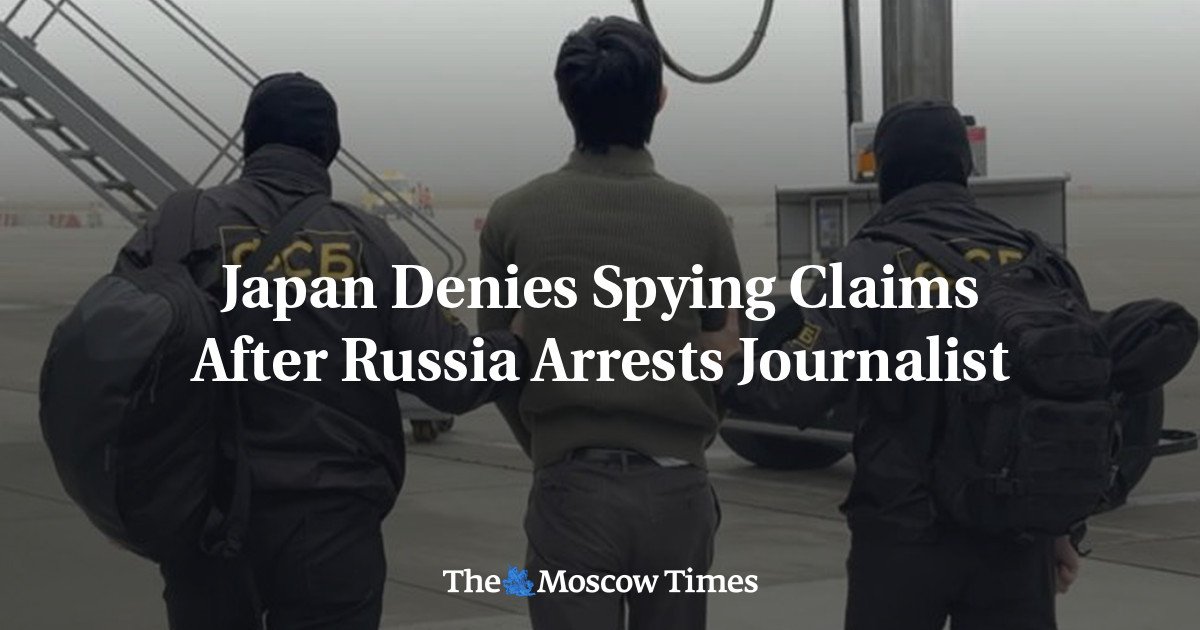
Japan’s Prime Minister Sanae Takaichi on Thursday denied Russia’s allegations of espionage after the FSB security service arrested a Japanese journalist.
“There is no such fact,” Takaichi told reporters when asked about Moscow’s claims that the reporter was acting on behalf of Japanese intelligence.
She said details remain sparse surrounding the arrest of Yuki Imai, a correspondent for the northern Japanese newspaper Hokkaido Shimbun, in Far East Russia’s Sakhalin region.
Chief Cabinet Secretary Minoru Kihara said Wednesday that Japan had not been able to contact the individual and did not know about the arrest until the official announcement from Moscow.
The FSB accused Imai of collecting and storing information on Russia’s defense capabilities for intelligence purposes that it said could be used against Russian security.
Russia’s Ambassador in Tokyo Nikolai Nozdrev, who was summoned by Japan’s foreign ministry to lodge its protest, hit back Thursday with his own accusations that Japan enlists reporters into intelligence gathering.
Nozdrev said it was “unacceptable that Japanese special services recruit private persons, including Japanese journalists accredited in Russia, for ‘collaboration’ through the collection of classified information.”
Takaichi said Tokyo intended to focus on “the protection of Japanese nationals.” The Hokkaido Shimbun said the reporter’s safety was its top priority.
The case adds to long-running tensions between Russia and Japan, which have yet to sign a formal World War II peace treaty due to a territorial dispute over the Kuril Islands, known in Japan as the Northern Territories.
Imai’s arrest comes days after Japanese law enforcement in Osaka apprehended a 28-year-old Russian national linked to the international ransomware group Qilin and extradited him to Germany to face cybercrime charges.
AFP contributed reporting.
A Message from The Moscow Times:
Dear readers,
We are facing unprecedented challenges. Russia’s Prosecutor General’s Office has designated The Moscow Times as an “undesirable” organization, criminalizing our work and putting our staff at risk of prosecution. This follows our earlier unjust labeling as a “foreign agent.”
These actions are direct attempts to silence independent journalism in Russia. The authorities claim our work “discredits the decisions of the Russian leadership.” We see things differently: we strive to provide accurate, unbiased reporting on Russia.
We, the journalists of The Moscow Times, refuse to be silenced. But to continue our work, we need your help.
Your support, no matter how small, makes a world of difference. If you can, please support us monthly starting from just $2. It’s quick to set up, and every contribution makes a significant impact.
By supporting The Moscow Times, you’re defending open, independent journalism in the face of repression. Thank you for standing with us.
Continue
Not ready to support today?
Remind me later.
×
Remind me next month
Thank you! Your reminder is set.
