



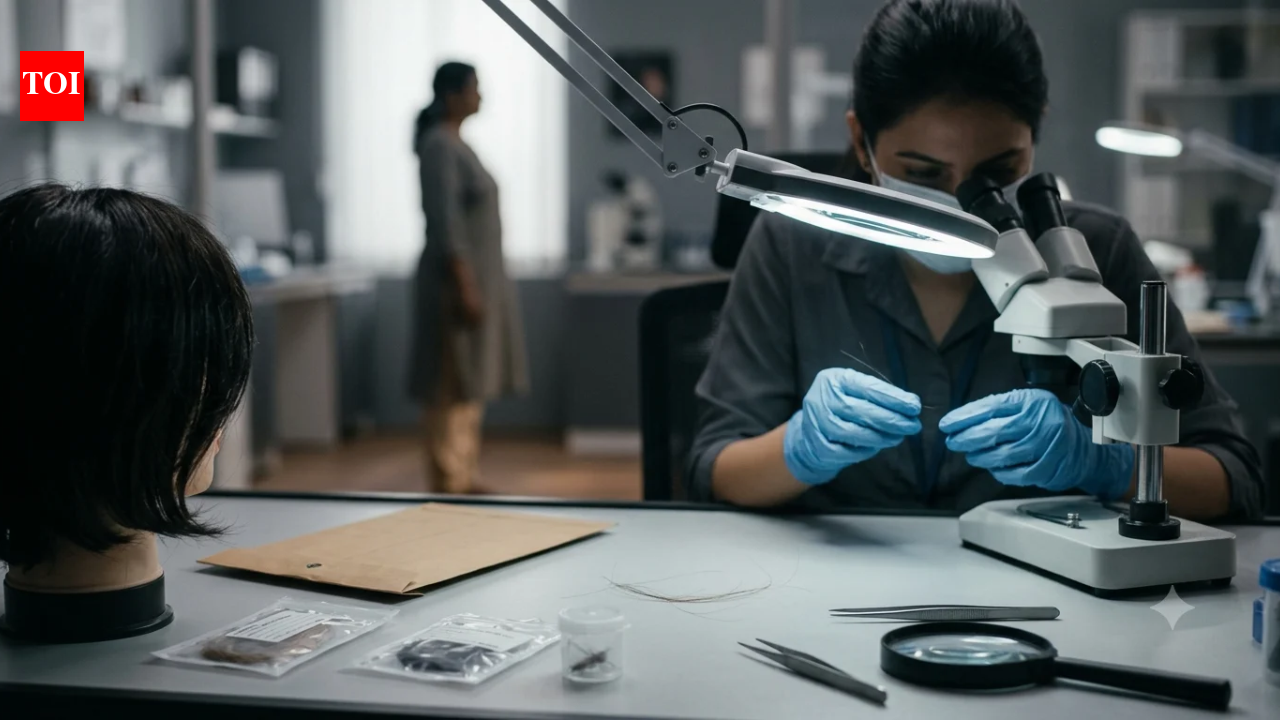
NEW DELHI: Hair is a big business in India. Hair trade involves donating hair to make wigs, especially for cancer patients.But have you ever wondered what happens if a strand of this donated hair is recovered from a crime scene? Can the donor get in trouble?In practice, this is very unlikely. Cut hair usually cannot be tested for DNA, and even a genetic link to a donor would not show that the donor had anything to do with the offence. Here is why, and what the law says if police do come calling.Why is donated hair so hard to trace?The main obstacle is scientific. DNA profiling depends on the type and condition of the material recovered, and hair that has been cut is a poor source.“We generally can’t get DNA from hair without a follicle namely, hair that is cut from someone’s head. So, donated hair won’t contain enough lingering DNA to be tested,” said senior advocate Vivek Narayan Sharma.The other methods fare little better, he said. Microscopic comparison can only corroborate other evidence and cannot identify an individual. A 2009 review by the US National Academy of Sciences criticised the technique, and a 2015 FBI review found errors in most of the examiner testimony it examined. Mitochondrial DNA, which is passed down the maternal line and so is shared by relatives with a common mother or grandmother, points only to a lineage. Dyeing, bleaching and other processing further degrade wig hair.Can a donor be treated as a suspect?Sharma said finding donated hair at a scene does not, by itself, place the donor there, let alone link them to the offence. Investigators must look at how the hair arrived, whether the forensic identification is reliable and whether independent evidence connects the person to the crime.A donor can be treated as a suspect only “in the narrow sense of being a person whose link needs to be checked,” he said.The supply chain is central to this. “Donated hair is processed and sold. It is pooled, treated, and often made into wigs, extensions or hairpieces, and it passes through collectors, exporters and manufacturers. The wearer, not the donor, is the natural first line of inquiry,” Sharma said.In his view, a donor can be traced and asked about the supply chain, but treating them as an accused on this basis alone is legally weak.
–
And if a DNA match is found?Even where testing produces a result, it answers only part of the question. DNA can be stronger evidence of biological origin, Sharma said, but the strength of the conclusion depends on the sample, the method of analysis and how the material was collected and handled.“A DNA match does not automatically establish when, how or why the material came to be at the scene,” he said. If the prosecution can show only that the hair came from a particular donor, and cannot reliably connect that donor to the offence, that alone may not be enough to sustain a conviction.Section 39 of the Bharatiya Sakshya Adhiniyam (BSA), 2023, recognises expert opinions on scientific matters as relevant evidence, but does not make them conclusive proof of guilt. Sharma pointed to Rajesh v. State of Madhya Pradesh (Criminal Appeal Nos. 793-794 of 2022), decided by the Supreme Court in 2023, in which the court scrutinised DNA evidence involving hair and stressed the reliability of its source and origin. The case shows, he said, that a forensic match cannot be considered in isolation when the circumstances in which the sample was obtained are doubtful.What must police establish before linking a donor to a crime?The first question is how the hair reached the scene. If it came from a wig worn by the alleged perpetrator, investigators must examine the connection between the wig, its wearer and the person who donated the hair.They must also show that the sample was collected, labelled, sealed and transferred for testing without contamination or tampering. The forensic report should make clear what test was conducted and whether it identifies a source or merely shows similarities between samples. Hair evidence must also be assessed alongside other material, such as CCTV footage, phone-location evidence, recoveries or evidence establishing presence and opportunity.The law does not allow the biological origin of a sample to replace proof connecting a person to the alleged crime. “Reasonable suspicion needs a rational connection between the person and the crime,” Sharma said, adding that the Supreme Court has repeatedly held that arrest cannot be routine or based on bare suspicion, citing Joginder Kumar v. State of UP (1994) and Arnesh Kumar v. State of Bihar (2014). Those rulings deal with the power of arrest rather than hair evidence, but they set the standard police must meet before taking someone into custody.
–
What if police contact a donor?The more realistic scenario is not arrest but a request for information. Under Section 179 of the Bharatiya Nagarik Suraksha Sanhita (BNSS), police can require the attendance of a person acquainted with the facts of a case, subject to the safeguards provided by law.Being called does not mean being accused. Sharma’s advice is practical: ask in what capacity you are being called, as a witness or an accused, request written notice and keep a lawyer informed.Article 20(3) of the Constitution protects an accused person against being compelled to be a witness against themselves. Police may obtain hair or other physical samples only through the statutory route, including Section 51 of the BNSS or a magistrate’s order under Section 349. The legal treatment of physical samples is distinct from the protection against compelled testimonial statements.Should questioning ever turn into arrest, Articles 21 and 22 of the Constitution guarantee personal liberty and the right to be told the grounds of arrest and to consult a lawyer. Section 58 of the BNSS requires that an arrested person generally be produced before a magistrate within 24 hours.For a donor, though, the practical position is far simpler. Identifying where a strand of hair originally came from is not the same as establishing who committed a crime, and the science makes even that first step difficult.
