



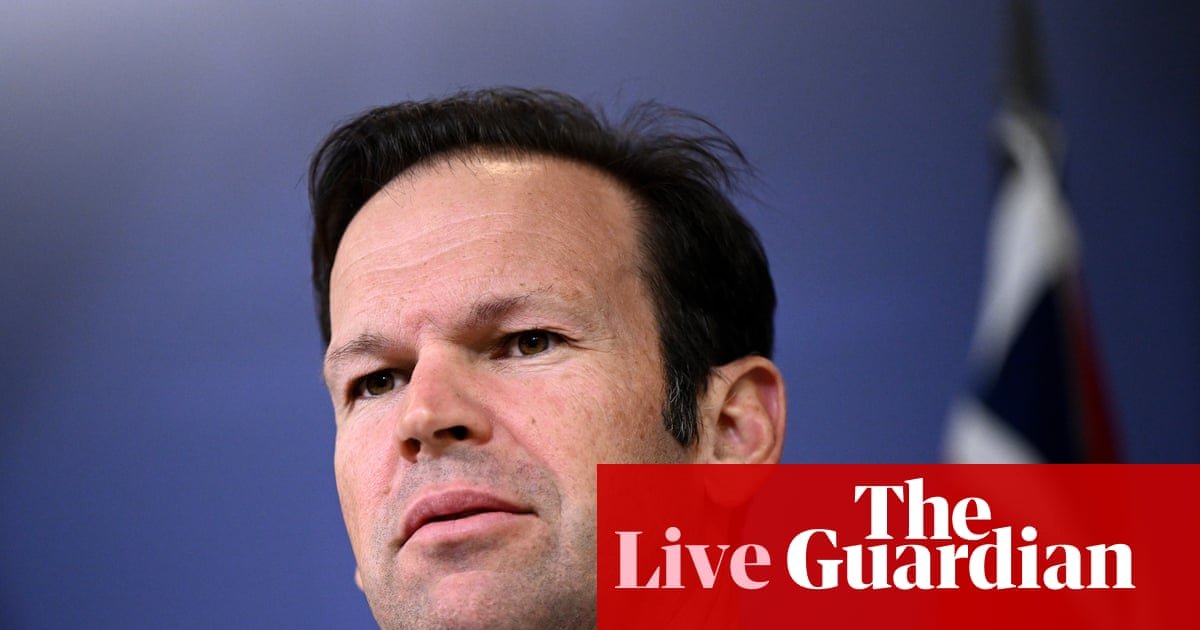
Nationals leader disputes trade minister’s claim he walked out of meeting on EU trade deal
The Nationals leader, Matt Canavan, has disputed the trade minister’s claim he walked out of a meeting on the European Union trade deal, suggesting Don Farrell might be “under a lot of pressure”.
Farrell told the ABC yesterday afternoon that Canavan and shadow foreign affairs minister, Ted O’Brien, had walked out on him while he was explaining the deal.
In response, Canavan said:
I can understand that Don is under a lot of pressure, because there are barely any friends of his dud European deal. I am happy to meet with Don anytime, but he ended our discussion, not me.
I have written to Don with practical suggestions about how the deal can be improved and I remain open to discuss my concerns at any time.
While Australian and EU representatives have agreed to the deal, it still needs support from parliament. The Coalition has already ruled out support while the Greens are considering it.
Key events
‘It’s got hairs on it’: Coalition interested but wants changes to gas reservation scheme
Nationals senator and shadow resources minister, Susan McDonald, is now in the RN Breakfast hot seat and says the Coalition wants more investment in gas, not less, among other changes to support the reservation scheme.
She says the opposition supports legislation in the national interest, but this bill still has “hairs on it”.
McDonald also says she wants to see some modelling from the government to answer exactly how much they reckon prices will go down and when.
If we start seeing prices reduced to a point that it is no longer economic to explore and to develop new projects, then we could have this sugar hit of cheaper gas prices for a year or two, but then the worst consequence, which is that we then become solely reliant on big LNG exporters and we stop developing our own resources, particularly in the places that are domestic-only supply.
Still no confirmation of when and how much gas prices will drop
We still don’t have any clarity on when gas prices will begin to drop and by how much – only that there will be “downward pressure” on prices.
Yesterday, Madeleine King told the press club there would be a transitional year for the policy – ie don’t expect immediate price drops.
She’s asked again today to guarantee that prices will drop and provide a timeline, and we get another broad answer:
What I will guarantee is this will be an enduring regulatory framework, and we expect fully that it will put down the pressure on prices. And that’s what happens when you get more gas into the market. And that’s what we expect will happen.
‘This is a lot for early in the morning’: King explains gas reservation scheme
I feel ya Madeleine King, it’s 7:50am on a sitting week Thursday and my brain is FRIED.
Anyway, back to the interview, King is asked what the hell the gas reservation scheme is and what over supply means.
She says that there will be “demand-calibrated” oversupply to help push down prices and make sure there’s enough gas for us in Australia.
But the complicating factor is some producers like Santos have to buy gas from other domestic gas producers to meet their exporting demands. So how are they supposed to reserve extra domestic gas and add to the total pool of domestic gas if they’re already buying other domestic gas to fulfil their existing export contracts? We don’t get a super-clear answer.
King tells RN Breakfast:
This oversupply will be demand-calibrated. So, this is a lot for early in the morning … The Australian energy market, AEMO, will do their normal studies through the gas statement of opportunities, which do very well thought out, well-researched forecasts that industry participates in. And that will then inform the demand calibration that the Australian Energy Regulator will set about in adjusting domestic supply obligations to each of the exporters.
We will be respecting existing export contracts because that’s a really important principle. So the ministerial discretion, and I know there’s a lot of discussion about that discretion, we will be able to moderate how those exporters are able to account for domestic gas. But everyone, every exporter will have to contribute to domestic supply in some fashion.
‘They want to blow the place up’: King accuses Coalition of hypocrisy over private health insurance rebates
The resources minister, Madeleine King, has defended the government’s proposed changes to reduce the private health insurance rebate for over-65s, saying it’s fair for the rebates to be tied to income, not age.
She tells RN Breakfast pensioners will still get a higher rebate than other over-65s with a higher income.
King accuses the Coalition of being hypocritical for calling on the government to reduce its spending and then block this cost-saving measure.
It’s a tricky time for the government – this is a key revenue-saving measure that’s come out of the budget. The other revenue-raising measure – a minimum 30% tax on trusts – is also facing an icy reception in the parliament, although it looks like the Greens are willing to sit at the negotiation table.
What we have seen last night is the Coalition and the Greens teaming up again to really be quite destructive of budget and budget savings, important principles that they, well, certainly the Coalition say they want to follow around responsible fiscal management, yet they want to blow the place up. In one moment, they want to save money, and the next moment they just want to keep spending money. So, we will be reintroducing this bill. It’s an important part of our budgetary process.
Josh Taylor
More powers required but AEC reluctant to take on truth in political advertising
The AEC chief also said the the organisation needs more powers to deal with the “contemporary information environment” around elections to be able to speed up takedowns of misinformation about the voting process.
Jeff Pope told the joint standing committee on AI on Wednesday night that one option for dealing with misinformation could be to label deepfakes online but a challenge will become the ubiquity of AI videos online. He said it was not far away:
I think if you’re labelling everything with AI, then I think probably the next election or not too long thereafter, every bit of [election content] could have an AI label on it, and you’ve got to wonder about the effectiveness of that.
Pope expressed reluctance that the AEC become the arbiter of truth over political advertising more broadly in the AI age.
We feel that that would put our impartiality at significant risk. Our impartiality is incredibly important. But in my opening comments about trust and confidence in the intellectual process and the elected process, and that flows through to the trust confidence in you in parliament and institution.
And I think there is a risk that the more we asked to regulate and to make judgment, then there is a risk that around that impartiality being challenged. And that is something that I would ask parliament to consider very deeply when it’s considering giving us further responsibilities or whether it sits with other agencies that don’t need to grapple with that very fine tuned impartiality.
It’s a similar stance to Pope’s predecessor, Tom Rogers, who also warned putting the AEC in charge of truth in political advertising laws could ruin the “neutrality” of the agency.
Private health insurance changes ‘recalibrating precious taxpayer dollars’, says Wells
The health minister, Mark Butler, yesterday promised to reintroduce a bill to reduce private health insurance rebates for over-65s, after it was thrown out of the Senate by the crossbench and Coalition.
The Greens want pensioners carved out of the bill, but they make up nearly half of the affected cohort.
Modelling shows up to 80,000 older Australians would ditch their private health insurance in response to the policy – up from the 44,000 people that the health department estimated.
Anika Wells, who was aged care minister in the last parliamentary term, says the government needs the $3bn saved by the policy to pay for aged care beds.
It’s really important we reintroduce it, because we need to raise the level of support and resourcing for aged care. I was the aged care minister before being the communications minister, we need to work urgently. There’s not enough beds being built for older Australians who need that support. It’s recalibrating precious taxpayer dollars.
Asked about the modelling, she says there’s lots of different numbers to choose from, but reiterates that the essence of the policy is: “All Australians will have the same access to private health insurance based on their income, rather than their age.”
eSafety appealing to platforms not to show execution live stream
The communications minister, Anika Wells, says the eSafety commissioner has written to tech companies while she has met with Meta’s senior leaders to urge them to not show the live stream of an execution in the US on their platforms.
Yesterday, CNN reported the US president, Donald Trump, was considering calling off the live stream.
Wells tells ABC the government is still making preparations:
The eSafety commissioner has written to all of our tech companies to say we expect them to take steps not to show this on their platforms. And I met with Meta, the vice–president, president, and global head of safety of Meta yesterday, and made that point directly. We will work together with companies like Meta to go everything we can to make sure Australians don’t have to see this.
Australia can’t rely on US to defend it against China, security expert warns
The United States will not “have enough skin in the game” to send troops to defend Australia in the event of an attack from China, a leading international security expert has warned.
Sam Roggeveen, director of the Lowy Institute’s International Security Program, also said the anti-immigration policies being touted by major parties, as well as One Nation, would weaken Australia’s position on the global stage.
“Retreating from immigration will make us materially weaker,” he told a studio audience at the ABC in Sydney on Wednesday.
We should recommit to multicultural immigration, not because diversity is strength … but because scale is strength.
He said the rise of China had made the US’s position in Asia “unsustainably weak”, meaning Australia could no longer rely on the United States to defend it in the region.
America won’t risk its own troops in a fight against a nuclear-armed opponent because its vital interests won’t be at stake. To put it bluntly, America won’t have enough skin in the game.
He recommended Australia strengthen ties with Indonesia, warning that the dangers of getting the relationship wrong were immense.
Indonesia is south-east Asia’s leader, and soon its economy will surpass ours. If we get this relationship right, Indonesia offers a natural barrier against threats from third countries.
Krishani Dhanji
On the agenda this Thursday
Good morning, Krishani Dhanji with you here for the final sitting day of the week, thanks to Martin for getting us started.
The communications minister Anika Wells is doing the media rounds this morning, ahead of a press club address to sell the government’s digital duty of care bill.
She’s also facing questions on how the government will try and stop Australians being able to see a live stream of a firing squad execution in the US in December.
The government will try to reintroduce a bill to lower private health insurance rebates for over-65s after it was thrown out of the Senate yesterday by the Coalition and crossbench – it’s a major cost saver for the government. Mark Butler says he’ll plough ahead to try and get the changes through (with more negotiations).
It’s going to be another big one – let’s get stuck in!
People getting voting info from AI an ‘emerging concern’, AEC says
Josh Taylor
The Australian Electoral Commissioner, Jeff Pope, has said people getting their information about voting from AI chatbots such as ChatGPT or Claude is an “emerging concern”, and has forced the commission to overhaul its website to attract bots looking for the correct information.
Speaking at a hearing of the joint standing committee on artificial intelligence on Wednesday night, Pope said it was “dangerous” to rely on social media platforms or AI tools as “your only source of research when it comes to forming an opinion around voting”.
Pope floated a legislative response may be required for platforms around election time.
Pope pointed to a study on the Scottish election reported by the Guardian in May found that AI services gave voters misinformation to 34% of the questions it posed.
The AEC had started to prepare for this, he said.
We’re undertaking significant investment at the moment in modernising our webpage so that AI tools actually pull factual information from our webpage and reflect that back to the voter, rather than pulling … from a variety of other resources which may or may not be correct.
Nationals leader disputes trade minister’s claim he walked out of meeting on EU trade deal
The Nationals leader, Matt Canavan, has disputed the trade minister’s claim he walked out of a meeting on the European Union trade deal, suggesting Don Farrell might be “under a lot of pressure”.
Farrell told the ABC yesterday afternoon that Canavan and shadow foreign affairs minister, Ted O’Brien, had walked out on him while he was explaining the deal.
In response, Canavan said:
I can understand that Don is under a lot of pressure, because there are barely any friends of his dud European deal. I am happy to meet with Don anytime, but he ended our discussion, not me.
I have written to Don with practical suggestions about how the deal can be improved and I remain open to discuss my concerns at any time.
While Australian and EU representatives have agreed to the deal, it still needs support from parliament. The Coalition has already ruled out support while the Greens are considering it.
Anika Wells to introduce digital duty of care bill today
Josh Butler
Anika Wells will introduce the government’s digital duty of care bill into the parliament today, with all eyes on what amendments Labor may have made to the initial draft bill.
The communications minister has confirmed the government will drop its earlier plans for her office to have broad rule-making powers to define what content is classed as “harmful”.
Wells will tell the National Press Club:
In response to concerns we heard during the exposure draft consultation and to make this abundantly clear, we have removed the ministerial rule-making power to define new harms in the final bill.
Instead, new “harms” will be added by parliament through legislative amendment.
Wells will tell the NPC that the digital duty of care will “set basic safety standards for the online services we use every day, just like we have in every other industry”.
We must shift the burden from the shoulders of victims to the companies that are creating the environments where harms occur.
The Digital Duty of Care gives Australians choice … If someone wants their feed filled with friends and creators they follow, the social media platforms must give them that choice. And if you’re happy to stick with your algorithm – you can do so.
Wells will also confirm new carve-outs for journalists and news media in the Online Safety Act, to assist professional news organisations and public interest journalism.
We’ll bring you more from her speech later in the day.
Victorian Labor pledges to offer free abortion care
Benita Kolovos
The Victorian Labor government – if re-elected in November – say they will make Victoria the first state to offer free abortion care.
Under the $30m election commitment, the government would pay private providers to deliver medical and surgical abortions up to 16 weeks, removing out-of-pocket costs. This means women would no longer need to pay for GP or specialist consultations, imaging and tests or medications at participating providers.
Medical abortions can cost almost $700 out of pocket for patients with a Medicare card, or more than $1,000 for those without one. Surgical abortions can cost $895 with Medicare, rising to almost $1,500 for those without a card.
The government has also vowed to extend the nine week window for medical abortion to 10 weeks’ gestation. If elected, they would direct Safer Care Victoria to lead a clinical review into extending access to the medication up to 12 weeks, which aligns with World Health Organisation guidelines.
Patients who need to travel to access abortion would also be eligible for a subsidy to help with their travel and accommodation costs, community health care providers trained to provide abortion care and 1800 My Options would receive extra funding under the plan.
The health minister, Ingrid Stitt, said this morning:
Abortion care is healthcare and Labor will make it free. Only Labor will protect a woman’s right to choose.
Albanese to attack Hanson over ‘monoculture’ remarks
Sarah Basford Canales
Anthony Albanese will criticise Pauline Hanson’s claim that Australia should be “monocultural”, suggesting that anyone who believes that “should get themselves down to the nearest Specsavers”.
In a speech , the prime minister will say cultural and ethnic communities give the country’s character more “breadth”, expands “palates” and unites people.
Australia’s migration story has been many generations in the making. Anyone who can look in the rear-vision mirror and see a monoculture should get themselves down to the nearest Specsavers.
The reality is that Australia’s heart is multicultural.
His speech at the conference for the Federation of Ethnic Communities Councils of Australia will also also says:
I want every Australian to leave behind the baseline of mere tolerance for something far greater: the joy of celebration … Celebrating the birthright of heritage and the comforts and strengths of faith. Celebrating the land of your roots while adding to the land that is your home, and your future.
Welcome
Good morning and welcome to our live news blog. I’m Martin Farrer with the top overnight stories and then it will be Krishani Dhanji with the main action.
