



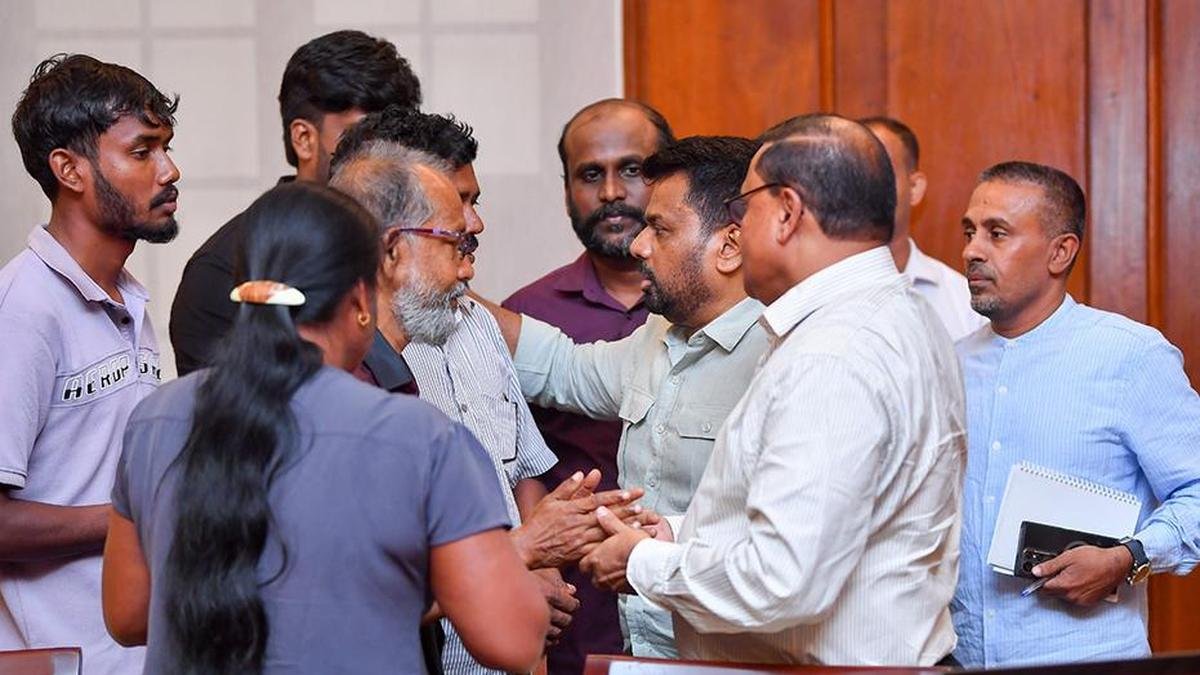
President Anura Kumara Dissanayake met Sivarasa Anojan’s family in September, at the Presidential Secretariat in Colombo. File photo Credit: Presidential Media Division
The Supreme Court of Saudi Arabia on Wednesday (October 14, 2026) set aside the death penalty awarded to Sri Lankan a migrant worker over a Facebook post that was deemed blasphemous.
“On 13 October 2026, the Supreme Court of Saudi Arabia set aside the judgment imposing the death penalty on Anojan Sivarasa. This follows sustained diplomatic and legal efforts by the Government of Sri Lanka,” Sri Lanka’s Deputy Foreign Minister Arun Hemeachandra announced in a social media post, terming the development “a major relief” for the 24-year-old engineer hailing from the island’s eastern Ampara district.
According to senior lawyer and President’s Counsel Upul Kumarapperuma, who was on the team sent to Riyadh by the Sri Lankan government, Anojan’s death penalty was set aside by the Supreme Court of Saudi Arabia and referred to the lower court that originally heard the case. “The case is expected to be heard within two weeks, and a fresh sentence is likely,” he told The Hindu on Wednesday (October 14, 2026).
Anojan’s Facebook comment, posted in June this year, was part of a heated exchange among social media users over a video of a Muslim man attacking a dog named Subramani, which had drawn media attention even as it accompanied Hindu pilgrims to Kathirgamam or the Kataragama temple, a famed shrine for the deity Skanda in southern Sri Lanka. Accused of “verbally insulting and offending Prophet Muhammad”, Anojan — who subsequently posted a public apology — was sentenced to five years in prison initially. In September, the Saudi Court of Appeal in the Eastern Region awarded him a death sentence.
The ruling sparked a wide campaign within Sri Lanka, including from political parties and civil society groups, that demanded the ruling be overturned. Global human rights watchdogs such as Amnesty International and Human Rights Watch, too, urged Saudi Arabian authorities to overturn the sentence. In a statement issued earlier on Wednesday (October 14, 2026), Human Rights Watch said Saudi Arabia has executed more than 2,000 people over the last decade, “in many cases violating Saudi and international law”. “Authorities executed at least 356 people in 2025, setting a new record in the country for the highest number of executions in one year since monitoring began,” it said.
Amid sporadic calls to abolish the death penalty, Sri Lanka, too retains capital punishment in the law, although the country has not executed anyone in five decades.
Published – October 14, 2026 01:31 pm IST
