



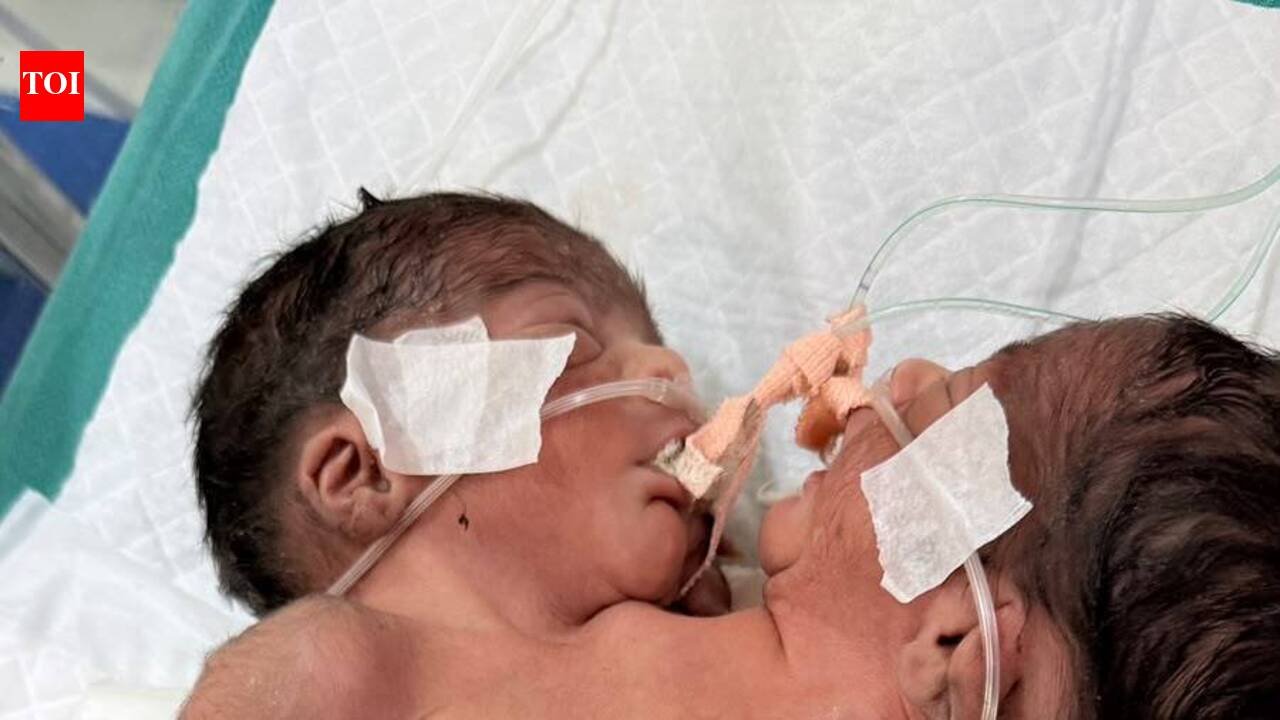
Berhampur: A 22-year-old woman from Kandhamal district gave birth to male conjoined twins with two heads at the govt-run MKCG Medical College and Hospital here on Sunday night.The newborn, medically termed dicephalic parapagus twins, weighed 2.25 kg at birth. Often referred to as a two-headed baby, the infant has two distinct heads and necks attached to a single trunk.The baby has two spinal columns but shares a single heart and liver, along with one pair of arms and legs. The infant also has a single genito-urinary tract with male external genitalia and no anal opening, said Dr Manas Ranjan Sahu, head of the department of paediatric surgery.The case is reminiscent of Kandhamal’s famous craniopagus twins, Jaga and Balia of Milipada village, who were born on April 9, 2015, joined at the head. They were successfully separated in a landmark surgery at AIIMS, New Delhi, in Oct 2017, though Balia later died of septicaemia in Nov 2020. Jaga continues to survive and undergo rehabilitation.Doctors described the latest case as extremely rare, occurring in roughly one in every three lakh births. They said the chances of survival are poor because of the baby’s complex anatomical abnormalities and associated health complications.The newborn has been admitted to the neonatal intensive care unit (NICU) and is being closely monitored. “We have formed a multi-disciplinary team to manage the baby. This is perhaps the first case of its kind reported at MKCG Medical College and Hospital,” said hospital superintendent Dr Sudeepa Dash.Dr Sahu said the baby’s condition was critical and that respiratory complications had already developed. The infant was delivered through a caesarean section after the mother, a resident of Kandhamal’s Tumudibandh area, was referred to MKCG Medical College and Hospital. Her husband works as a daily-wage labourer. The baby was born at 32 weeks of gestation and was the couple’s first child.Explaining the condition, Dr Sahu said conjoined twins originate from a single fertilised egg that begins to split into two embryos but fails to separate completely. As a result, the twins remain physically connected and may share organs and body parts.Another theory suggests that two embryos initially separate completely but later fuse during early development, leading to conjoined growth at specific points of contact. Such cases can result in shared tissues and organs, depending on the nature and extent of the fusion, he added.
