



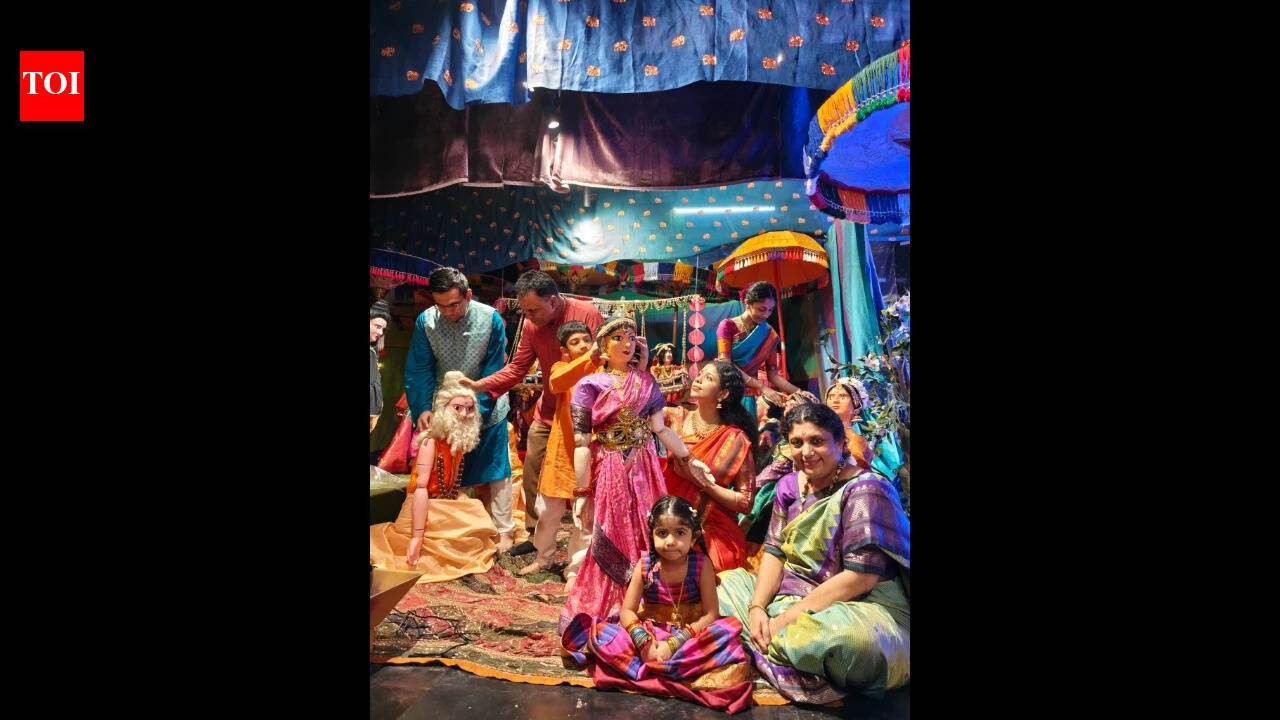
As Dasara nears, homes across Bengaluru are beginning to come alive with miniature worlds of colour, devotion and memory. Shelves and stepped displays are being readied for Gombe Habba, the traditional 10-day festival in which families arrange dolls that weave together epic tales, artistry and scenes from everyday life.Some of these dolls have been passed down over generations, making Gombe Habba a celebration of shared memory.Inherited Treasures For older generations, making dolls was a form of self-expression and creativity. Where money for toys was limited, imagination filled the gap.In an age when children are surrounded by imported toys, and digital entertainment, handmade dolls offer something different.Jayalakshmi Sriram owns a wooden elephant set inherited from her grandmother that is now about 100 years old. “The set was gifted to her by her cousin from Singapore,” she recalls, adding that she has also inherited Chettiar and Chettichi dolls, which are at least 50 years old. The traditional handcrafted clay dolls represent an affluent merchant couple.As the festival gets closer, software engineer Divya Padmanaban lovingly wipes dust off her dolls, and marvels at some unique pieces in her collection — a bungalow and a temple that date back over 75 years.They were handmade by her husband’s great-grandfather, who was a state govt employee.“My husband’s grandfather, who lived with us for a while, taught us how to assemble the pieces. The interlocking pieces remind you of a jigsaw p u z z l e , ” says Divya, showing us photographs of her son Rohan assembling the sets with his 90-year-old great-grandfather. The structures promote intergenerational bonding as family members learn about their heritage together.Bonding Over Nilu Gowris At Dhaatu Puppet Museum on Kanakapura Road near Silk Institute Metro Station, Keshav and Rukmini, aged eight and four, are helping their grandmother, Padma Shri awardee Anupama Hoskere, to arrange dolls for the annual Navaratra Mahotsava. The doll display opens on the first day of Navaratri.Anupama has a personal collection of over 10,000 dolls which include Nilu Gowri, terracotta, brass and porcelain ones, and they are on display at the museum. This year’s Nilu Gowri dolls exhibit, titled Yaduvamshi Tilaka, celebrates the splendour of Nandagokul.It features Krishna with the Gopikas, people bringing presents, a woman fetching water from a river, babies playing and a cow. Another section shows Gopikas chasing Krishna after he steals a butterchurning stick.Keshav and Rukmini worked on a forest section spanning about 10ft x 10ft and a fairyland. Through the tradition, the children learn about Indian epics, and storytelling from their grandmother. The children’s mother, Prakruti Hoskere, an architect by training, also participates.Dolls Carry Memories Every doll has its own story. A doll can be more than a pile of fabric or a bunch of wooden blocks. It can be a family’s keepsake, and a quiet bridge between generations.For many women, the dolls they cherish were not bought from bright supermarket shelves. They were shaped by mothers, grandmothers, older sisters and neighbours using scraps of cloth, beads, wool, carved wood or whatever materials that were available at home. And they are reminders of childhood evenings spent beside loved ones, watching them take shape under patient fingers.Traditional dolls often reflect the world around us. Their clothing may resemble local attire. Their hairstyles, colours and accessories may echo familiar women in the community. Women would dress their dolls in a style that reflects the community’s tastes and sensibilities.The dolls are not produced in silence; they are made in conversation. While women cut, stitch and decorate, stories are told — about family histories, marriage, festivals, farming seasons, market days and the values expected of young girls growing up in the community.Each doll carries something of the person who made it or gifted it. Vismaya Vishwa, course coordinator and assistant professor at Dayananda Sagar University in Bengaluru, has a red teddy bear gifted by her late mother. “She won it in a game at Safina Plaza. My pet name is Monu, and she named the doll, Sonu,” she says. Over time, it became a part of her Gombe Habba collection.Vishwa traces her fascination with Gombe Habba to childhood Dasara visits to her grandparents’ home in Belur, where she would carry her dolls along. Her grandparents would invite children from across teh village amd present them with fancy chocolates on Vishwa’s behalf.Today, Vishwa celebrates the Habba, bringing together wooden dolls her mother had given her, including a set of Raja-Rani dolls that were presented to her as part of her wedding trousseau. “While unpacking a suitcase recently, I found tiny Raja-Rani dolls my grandmother had given my mother for her wedding. My mother also gave me a marble Krishna doll, one of my most precious possessions,” she recalls.Vishwa, who lost her mother, Rukku, in 2024, believes she lives on through the dolls she gave her.For many women like Vishwa, Gombe dolls are small objects with large emotional value. And they continue to matter. Families keep these dolls even after their colours fade. Their stuffing may loosen, and their fabric may tear, but they remain treasured because of who made or gifted them.…………………………………………………………………………………………………………………………………………………………….“Back then, we couldn’t afford a big setup, so it was just a few dolls in the puja room. I think my mother did it simply to make me happyVismaya Vishwa|ASSISTANT PROFESSOR AT DAYANANDA SAGAR UNIVERSITY “The wooden Raja-Rani dolls in my collection must be at least 50 years old. I received them from my mother-inlaw, who inherited them from her parents. My parents gifted me clay dolls when I got married, and I recently had them repaintedLakshmi Suchin | PLAYSCHOOL TEACHER …………………………………………………………………………………………………………………………………………………Mark your calendars for the Dhaatu Puppet Museum’s annual doll exhibition, as part of Navaratra Mahotsava, running from Oct 11 to 20.Visitors can enjoy free entry to view the exhibits, including a remarkable collection of Krishna dolls, and can even experience the tradition of arranging Gombe dolls for Navaratri.
