



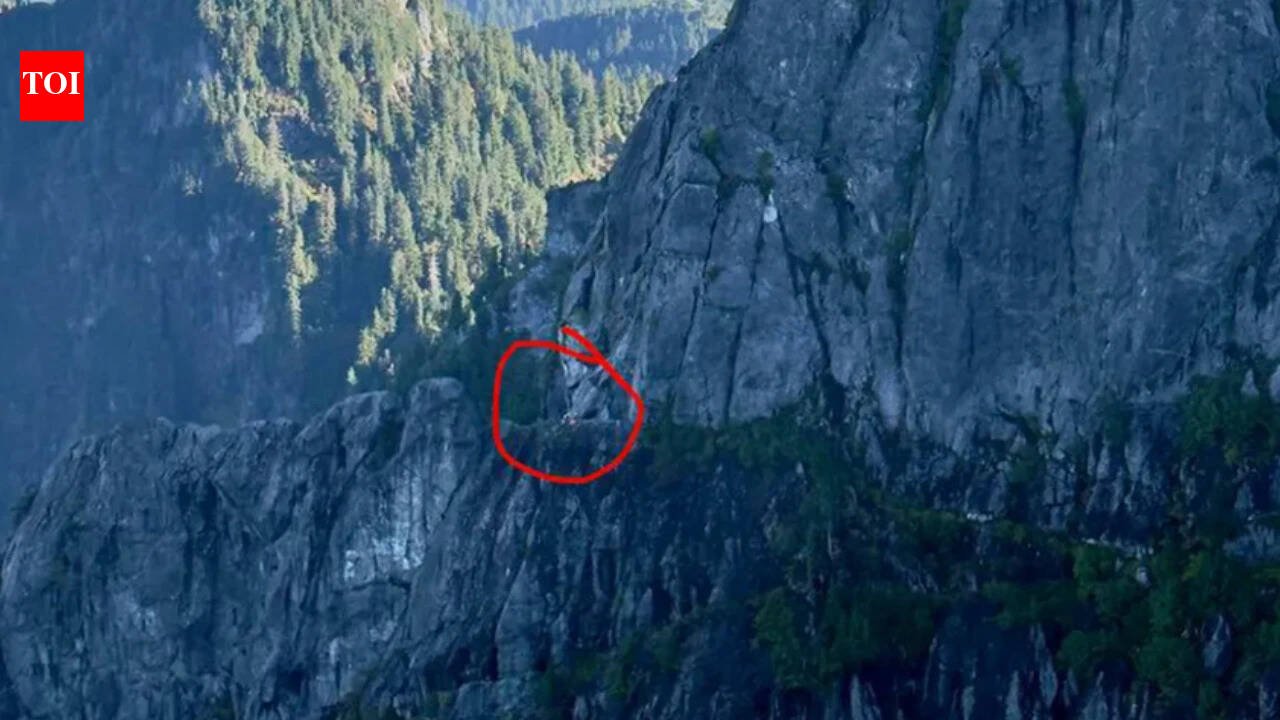
A 16-year-old boy in Canada had to be rescued by helicopter after becoming stranded on a steep mountain cliff during a hiking trip he had planned with the help of artificial intelligence. The teenager, Bryce Vincent Gowryluk, was hiking on Crown Mountain in British Columbia on Saturday, when he lost his way and ended up on a dangerous climbing route.According to People magazine, the teenager had used Claude AI, an artificial intelligence assistant developed by Anthropic, to help plan his hike. However, he eventually moved away from the usual hiking trail and reached a section of the mountain where he could neither safely continue nor return.The situation became serious when he found himself trapped on a narrow ledge along an almost vertical cliff. He contacted the police for help, following which North Shore Rescue was called to the mountain. The rescue operation required a helicopter and specialised climbing equipment because the location was difficult to reach.The teenager was eventually brought to safety after spending several hours stranded on the mountain. The incident has also prompted rescuers to warn hikers against relying entirely on AI-generated routes when planning trips through difficult mountain terrain.
What happened during the hike
According to North Shore News, the teenager began his hike from Grouse Mountain and intended to reach Crown Mountain. Paul Markey, search manager for North Shore Rescue, said the planned hike was difficult and normally took around seven to eight hours to complete.Markey said the boy had used Claude AI while preparing for the trip. According to him, the AI assistant suggested a particularly challenging route that eventually led to the teenager becoming stranded.North Shore Rescue later explained that the hiker had moved far away from the established Crown Mountain hiking route. However, rescuers were unable to determine exactly where or how he had taken the wrong turn.“It turns out that this hiker had somehow got far off the Crown hiking route and became stranded on a climbing route known as the ‘Widowmaker’, at the base of its final headwall,” the rescue organisation wrote.Speaking to The New York Times, Bryce acknowledged that he had mistakenly entered an area known as Widowmaker Arete. He said he did not blame the AI assistant entirely because he had also used Google Maps and other tools while planning his journey.The teenager explained that he continued walking because he believed he was in a different location. By the time the route became “too sketchy”, he realised he was “trapped on a ledge” on an almost vertical cliff. Markey told also CTV News that a fall from the location could have caused serious injuries or even death.
The difficult rescue
North Shore Rescue received information about the stranded teenager at approximately 3.30 pm on Saturday. By then, he was stuck in an area that was difficult for rescue teams to approach.A helicopter was deployed to reach the mountain, but the aircraft could not land directly beside the teenager because of the steep terrain.Therefore, rescue technicians had to land at a higher location and descend towards him using ropes. Once a rescuer reached the teenager, additional safety equipment was secured to help move him away from the dangerous section of the cliff.“There, the member established additional protection and was able to move the subject to a suitable extraction point,” North Shore Rescue said in its account of the operation.After the teenager was moved to a safer position, he was lifted into the rescue helicopter. The aircraft then transported him to a rescue base near Cleveland Dam. The operation took approximately three hours from the time rescuers received the initial call.“The boy was very scared. He definitely feared for his life,” Markey told North Shore News.
Mother recalls son’s distress
During the incident, Bryce managed to contact the police, who alerted North Shore Rescue. He also called his mother, Joelle, while waiting for help.Speaking to The New York Times, Joelle said her son had started the hike with good intentions but had ended up in a frightening situation.“He had very good intentions going in, but it’s never the call that a parent wants- that he needs a helicopter rescue,” she said.
Rescuers warn against AI
Following the rescue, Markey warned that hikers should not depend entirely on artificial intelligence when choosing routes through mountainous areas.He said AI assistants do not have first-hand experience of the terrain and cannot replace proper knowledge of the area, navigation skills and training.“Claude has never been in that specific area, has never been on that route, and has never been in the outdoors. Do your own research and gain your own knowledge of the area and supplement it with training and navigation,” Markey told CTV News.This is not first such incident, however. Most recently, three rookie Roseville hikers were stranded during their climb of Mount Shasta, last month. They heavily relied on Google Gemini for their trip. Similarly, in August 2023, a student nurse was stranded in the Central Australian Dessert withiut food and water after following Google Maps.
