



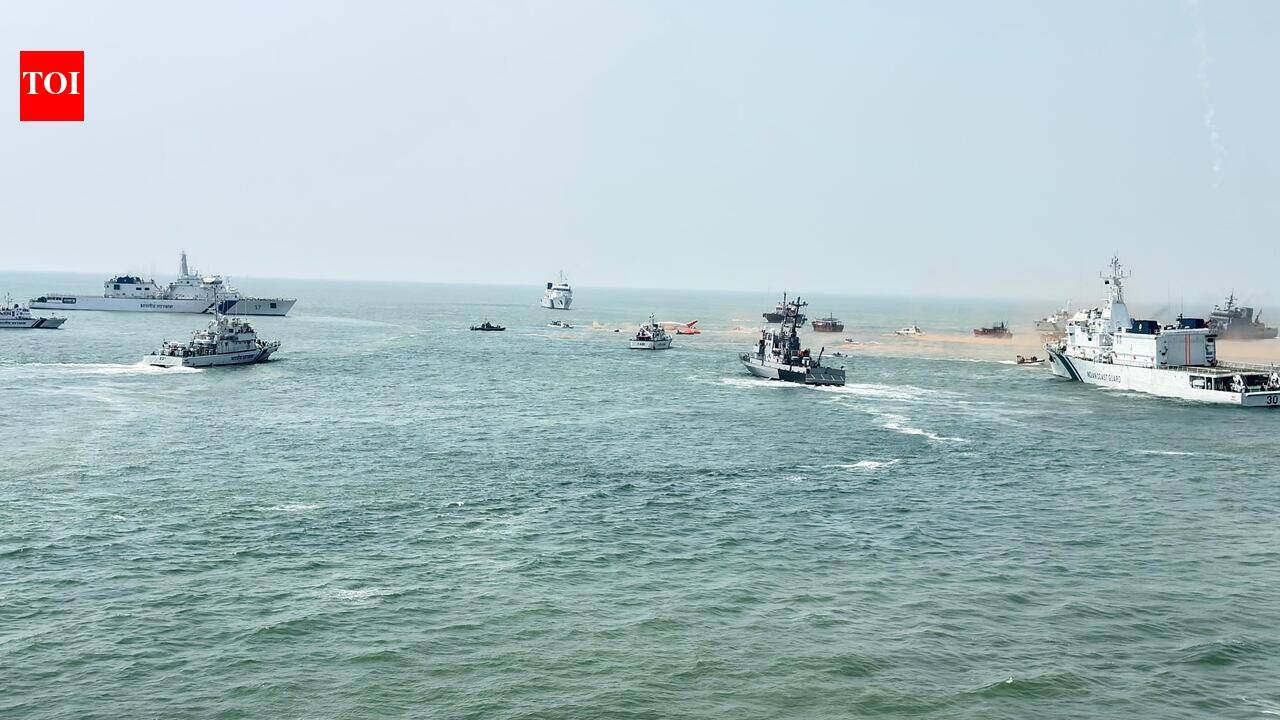
Bhubaneswar: India has taken a major stride in satellite-aided maritime search and rescue by commissioning the Medium Earth Orbit Search and Rescue (MEOSAR) system, a technology that significantly improves the speed and accuracy of locating distressed vessels and persons at sea, Indian Coast Guard (ICG) said.Describing MEOSAR as a “game changer” in maritime emergency response, ICG director-general Paramesh Sivamani said the system overcomes critical limitations of existing satellite-based distress alert networks and enables faster, more reliable rescue operations.“MEOSAR is a major advancement over the conventional LEOSAR (Low Earth Orbit Search and Rescue) and GEOSAR (Geostationary Search and Rescue) satellite networks. It is a game changer in distress alert transmission and reception, overcoming the limitations of both systems,” Sivamani told TOI on the sidelines of the sea-based drill conducted by the ICG off the Paradip coast on Thursday as part of its biennial national maritime search and rescue exercise (SAREX) 2026.According to the ICG, LEOSAR satellites orbit at an altitude of about 850-1,000 km above the ground and can locate distress beacons. However, alerts transmitted after a satellite has passed over an incident site may not be detected until its next orbit, causing delays in response.GEOSAR satellites, positioned nearly 36,000 km above the earth in geostationary orbit, offer near-instant detection of distress signals across much of the globe. But their coverage is limited to roughly 70 degrees north and south latitude, leaving gaps in polar regions, officials said.Operating in the medium earth orbit range between 2,000 km and 20,000 km, MEOSAR combines the strengths of both LEOSAR and GEOSAR. By leveraging navigation satellite constellations such as GPS, Galileo and GLONASS, it receives distress signals simultaneously through multiple satellites, allowing for near real-time detection and far more precise positioning of emergency beacons.As the ICG harped on advanced space-based technologies to strengthen maritime safety, officials said the milestone has been achieved through the commissioning of the indigenous Indian Medium Earth Orbit Local User Terminal (MEOLUT), a seven-channel ground station equipped with advanced antennas and digital signal-processing systems. The facility instantly determines the location of distress beacons, processes emergency alerts and seamlessly feeds information into the national search-and-rescue network.“Signals guide, technology connects and the ICG coordinates, ensuring that no lives are lost at sea,” Sivamani said.
