



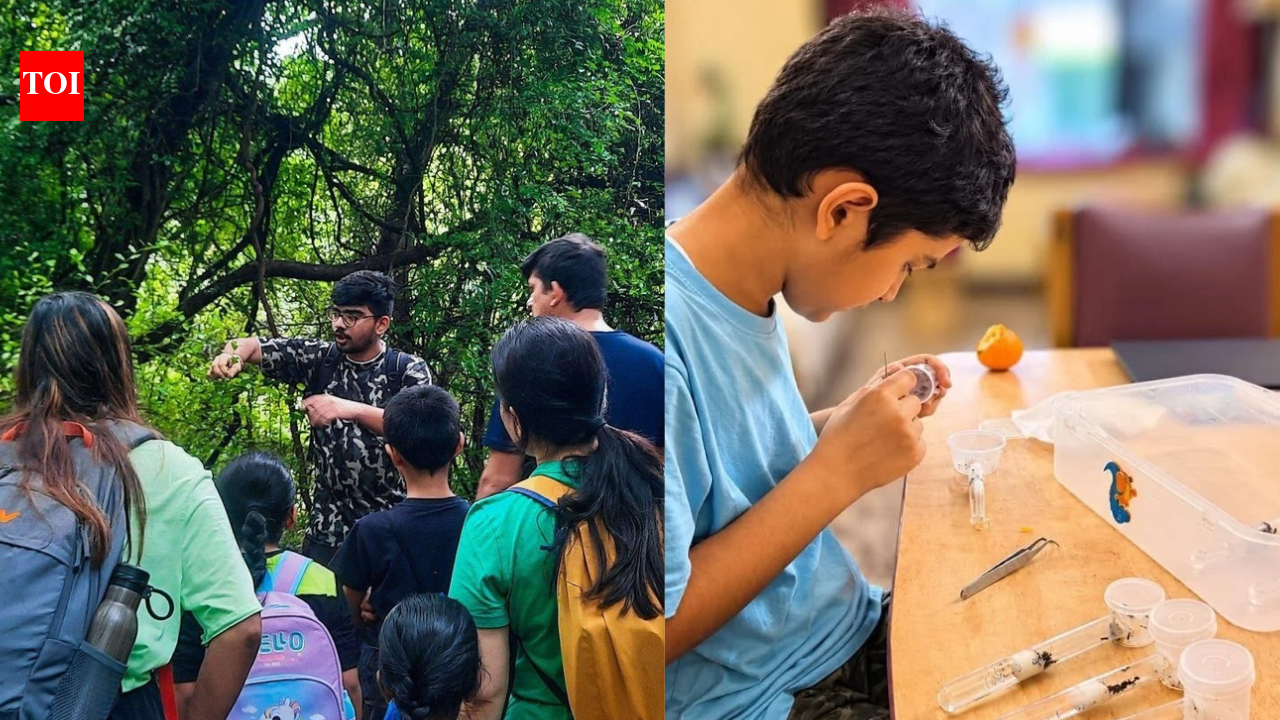
People huddled in groups, necks craned upward, are a common sight in parks and forests these days. Now, a new group pose can be spotted in the urban outdoors: people crouching low, their gaze locked on the ground. They’re not birding but ‘bugging’.Insects have crawled into the city’s nature calendar, with walks, talks and camps organised around beetles, moths, dragonflies, and stinkbugs—calling attention to a class of organisms that, despite its outsize numbers and diversity, has long been overlooked for its undersized dimensions. Entomologists and nature educators are trying to correct this anomaly.“More people are now turning to insects because they are a close and accessible subject and offer a variety that no other subject can,” says V. Shubhalaxmi, an entomologist who has been conducting workshops and walks for two decades.That variety is much greater than previously thought: a major study published this June estimates that there could be 14-20 million insect species in the world, more than double previous estimates. (By comparison, birds log 11,131 species.) Only 1.2 million species have been formally described so far.Advanced phone cameras have helped bring bugs into focus. Several budget smartphones today have macro lenses that allow people to magnify insects as small as weevils and closely observe the dazzling diversity of their shapes, colours and patterns, says Meehir Pawar, a recipient of Sanctuary’s Young Naturalist Award and expert in dragonflies and damselflies.The ability to observe the 5mm triangular head of an Indian Grass Mantis or the translucent margins of the Indian Green Tortoise Beetle fosters a new appreciation for these overlooked creatures. “A common reaction people have to bugs is fear and repulsion,” Meehir notes. But when they learn more about them, including their benefits as decomposers, pollinators and pest controllers, the reaction “changes to awe and appreciation”.Learning about bugs also dispels myths, such as the belief that dragonflies sting with their tails (they don’t).Children are drawn deeper than adults. It’s probably because this generation hasn’t been exposed to ‘insectophobia’, says Shubhalaxmi, adding that children also have more opportunities to experience nature first-hand, along with access to online knowledge.Viyaan Bhatia, an 11-year-old from Chembur, is closely acquainted with ants. He has raised several colonies at home, inspired by a YouTube video. “It took me a while to identify a queen ant in my compound,” he says. The first queen he collected, of the Indian black ant species, produced an all-male brood. The second, incubated in a test-tube, produced females, but the colony perished in an attack by ghost ants. Viyaan is now raising six colonies at a time. His friends haven’t been bitten by the bug but are willing to halt a game when he spots a queen.Entomologist Eshaan Pahade is doing his bit to spread the bug. In 2023, he set up the Entomon Institute of Invertebrate Zoology to focus on research and communication, and this Jan launched a series of online courses on everything from insect behaviour to forensic entomology, which studies arthropods as evidence in death investigations. He’s had participants from age 7 to 82 sign up.Today, several forums exist for people to discuss insects, such as InsectIndia, a Facebook group to which Pahade belongs, which has 46,000 members. “Around 2,000 are active,” he estimates. Even within the insectiverse, specialisations exist, with subgroups dedicated to ants, butterflies, moths—and beetles.Nonprofit India’s Nature runs an annual campaign called Beetle Mania to celebrate and document Coleoptera, the largest order of all animals, with nearly 400,000 species described. India has an estimated 22,299 species, according to the Zoological Survey of India.“There is a real, measurable gap in citizen science coverage of beetles in India,” says co-founder Ramnarayan Kalyanaraman. “Butterflies average about 461 research grade observations per species on iNaturalist; beetles average about 24.” This gap is due to a dearth of popular literature and field guides, especially in vernacular languages, and of outreach groups, he adds. Beetles also have a negative association from their role as crop and property pests (like the cotton boll weevil).Beetle Mania aims to change this. The campaign, the 5th edition of which ran this year from Aug 22 to Sep 13, conducted webinars and encouraged participants to document what they saw. They’re currently inviting species nominations for a Beetles of India pamphlet they’re assembling, complete with regional names and local folklore.Folklore helps connect people both to nature and to oral storytelling, says Jennifer Divyadarshi, co-founder of India’s Nature. “Natural historians are also storytellers—they observe a landscape and its beings but also help people understand what they are seeing. Stories are a good way to do that. For people working with rural communities, hearing their perspectives and ways of seeing nature reveals deep relationships,” she says.There’s another, more pressing reason to look closely at insects: they are early indicators of threatened ecosystems and climate change. Shubhalaxmi compares them to the first-floor occupants of a 3-storey building developing cracks from the ground up: “We need to spot and fix the cracks early on before they reach the terrace, where humans reside, and the building collapses. More research on the impacts of climate change on insects could provide this fix.“
