



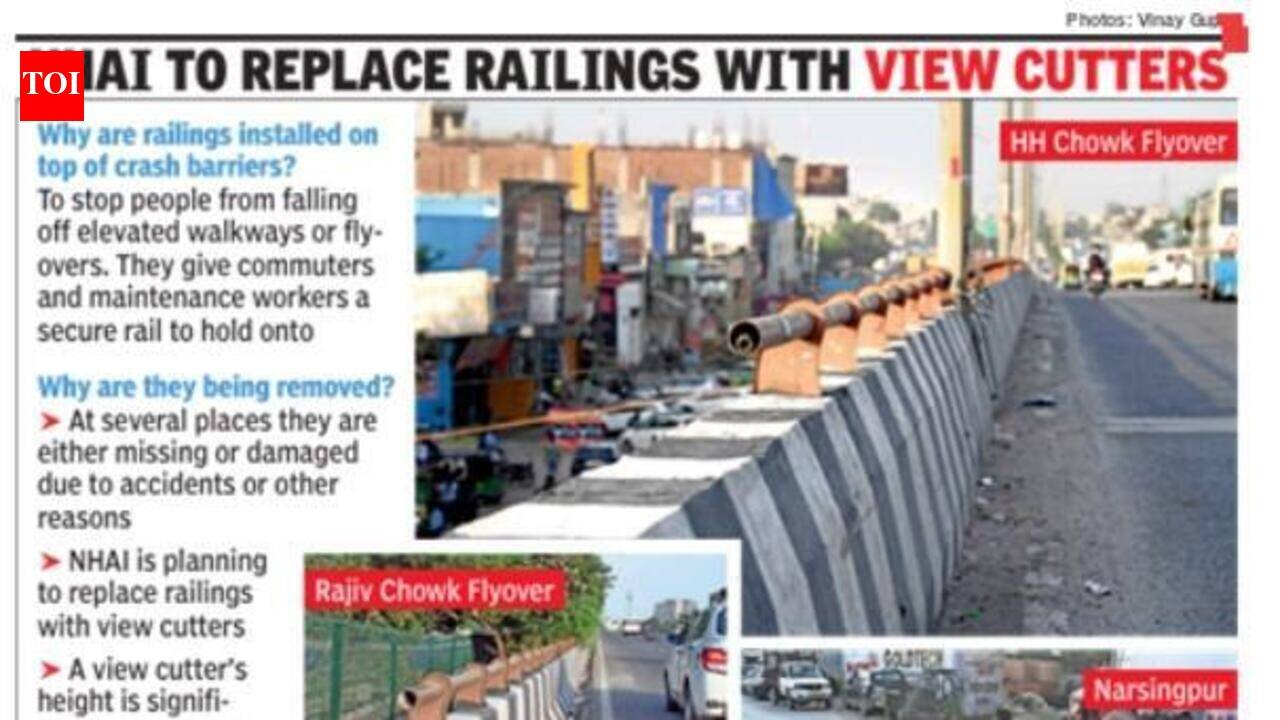
Gurgaon: A day after a 37-year-old delivery rider died in a crash near Signature Towers on Delhi-Gurgaon Expressway, National Highways Authority of India (NHAI) said it would remove the railings along the stretch within two weeks. NHAI has maintained that the railings are not required where crash barriers are installed.The accident took place in the early hours of Oct 5, when Ajay Kumar — who worked as a delivery rider for two online food delivery and quick-commerce companies — was riding his motorcycle on the flyover. Police said his motorcycle was involved in a collision with an unidentified vehicle. An ASI found Ajay lodged inside a pipe fixed on the flyover, while his motorcycle was found lying on the side of the road. He was taken to a govt hospital, where doctors declared him dead.Police registered a case against the unidentified vehicle under sections 281 and 106 of BNS. The condition of the roadside railings came under scrutiny after the incident, with several flyovers having missing, bent or damaged sections. On Tuesday, an NHAI official said the agency had already directed its contractor to remove the remaining railings.“We are in the process of removing the railings as part of the ongoing upgradation work of Delhi-Gurgaon section of NH-8. We have already instructed the agency to do so. The railings are not required at these locations and since several of them have been bent or stolen, we are removing them,” the official said, adding that railings had already been removed at some locations and the remaining ones would be removed within two weeks.According to NHAI’s preliminary site assessment, a fatal road accident was reported when the rider, travelling in the slow lane, was allegedly hit from behind by an unidentified vehicle. Following the impact, the rider collided with a roadside railing, which had reportedly been damaged in the accident. The rider sustained fatal injuries and succumbed at the spot. The exact circumstances leading to the accident are yet to be established. The matter is “under investigation” by the concerned authorities, and the possibility of foul play has not been ruled out at this stage.The accident has also brought the functioning of surveillance infrastructure at the spot into focus. The CCTV system at the location was not functional at the time. The camera system had developed a fault after its wire was found cut, the official said, adding that the agency was examining the matter. According to the police FIR, Reshma, the mother of the deceased, told police that she received information around 3am on Oct 5 that an unidentified vehicle, allegedly being driven at high speed and negligently, had collided with Ajay’s motorcycle near the flyover.Founder of road-safety NGO Trax Anurag Kulshresthra said the safety concern was not necessarily the presence of the railings but its damaged condition at the accident spot. “If the round pipe forming part of the railing is damaged and protruding out, it can become a hazard, particularly on a high-speed road where a two-wheeler could collide with it. If the railing is intact and continuous, it may not pose a safety risk. But once a section is damaged or missing, it has to be treated as a hazard,” he said.He said highway agencies are required to address such damage promptly. “As part of the standard safety procedure, if any portion of the roadside infrastructure is damaged, it should be immediately repaired or replaced. Till that is done, the damaged portion should be barricaded or clearly marked so that it is visible to approaching motorists. Leaving a damaged or missing section without any warning or protection amounts to negligence. The agency should ensure that the existing damaged sections did not pose a risk until their removal. The fact that the agency was already planning to remove them does not take away the responsibility to make the existing infrastructure safe until it is removed,” he added.An NHAI consultant said the damaged railing at the accident spot constituted a safety concern and should have been repaired. “The purpose of such railings is safety. If a section is damaged, the contractor has a responsibility to maintain and repair it. Regular inspections should identify such defects and ensure their timely rectification. If a damaged section is not repaired despite being identified, that raises a clear issue of maintenance and safety,” he said.
