



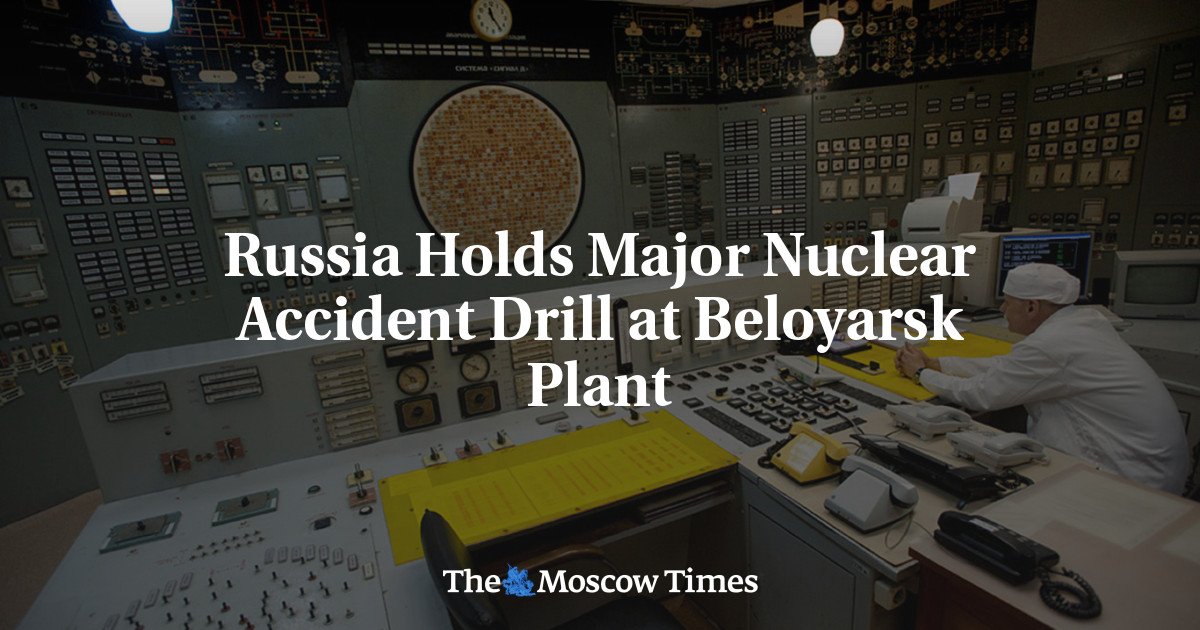
More than 1,000 people began a two-day emergency exercise at Russia’s Beloyarsk nuclear power plant on Tuesday, testing how staff and emergency services would respond to simultaneous accidents at two reactors.
The exercise in the Sverdlovsk region, which organizers said is the largest in Russia’s nuclear industry this year, will simulate a natural disaster compounded by failures in reactor safety systems.
The plant’s reactors will continue operating normally throughout the exercise, its communications department said.
Emergency crews will extend the drill to the nearby town of Zarechny on Wednesday to rehearse the response to a simulated nuclear accident.
Crews in protective equipment will use fire engines and military vehicles to clear debris, extinguish simulated fires and set up decontamination facilities. They will also practice sheltering and evacuating residents.
Plant management has asked residents to remain calm during the exercise, which may include sirens and loudspeaker announcements.
The drill is part of an annual program in which different Russian nuclear plants take turns hosting large exercises. Plant officials said the scenario combines highly unlikely events to test emergency preparedness.
Russian federal regulations require nuclear plant operators to hold exercises involving specialist support teams and emergency services at least once a year.
International Atomic Energy Agency safety standards also call for regular drills to test coordination between plant staff and outside agencies. The agency’s guidance includes exercises involving emergencies at multiple reactors on the same site.
Participants at the Beloyarsk drill include plant employees, specialists from nuclear plant operator Rosenergoatom and state nuclear corporation Rosatom, rescuers, police, medical workers and local officials.
Military radiation, chemical and biological defense units are also taking part, along with observers from Belarus and Kazakhstan.
Beloyarsk supplies about 16% of the Sverdlovsk region’s electricity. Its two operating units use BN-600 and BN-800 fast-neutron reactors, which began operating in 1980 and 2015, respectively.
The exercise comes amid reported drone strikes on Russian nuclear infrastructure, though its announced scenario centers on a natural disaster and equipment failures.
Rosatom said drones struck cooling towers at the Kursk II nuclear power plant twice this year, hitting unit 2, which is under construction, on July 6 and unit 1 on Sept. 17. The company said neither incident affected plant operations or radiation levels.
