



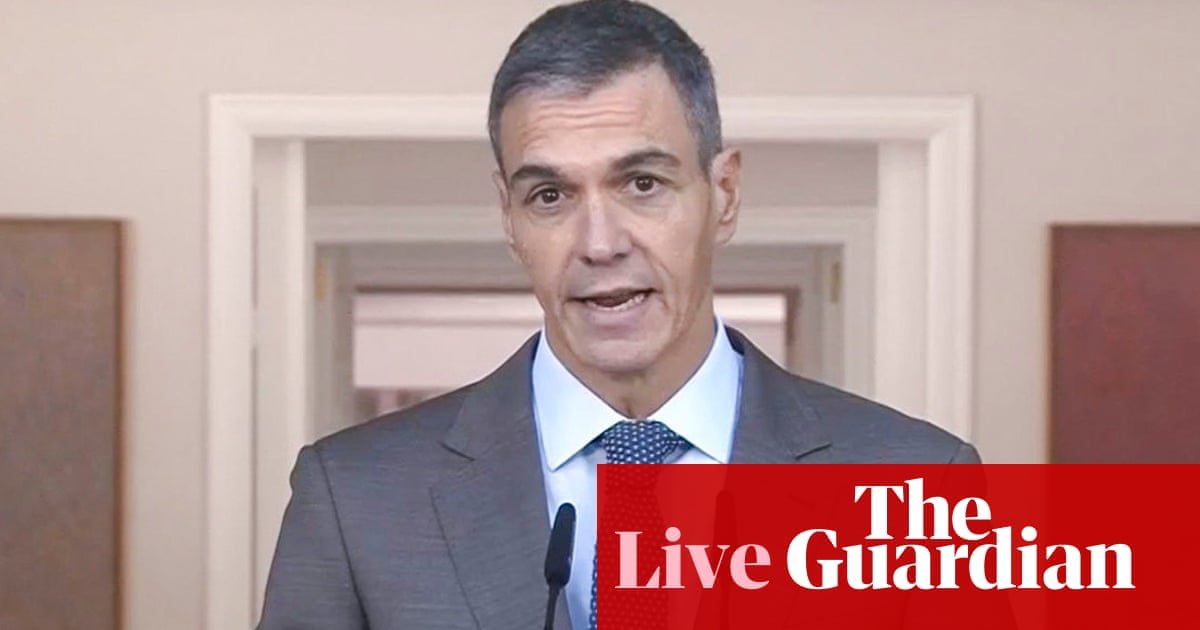
Spain’s Sánchez calls snap elections for 29 November – summary
Spanish prime minister Pedro Sánchez has called a snap election for 29 November, just days after rightwing parties blocked his minority government’s emergency measures on housing amid widespread protests (9:10).
The election will take place on Sunday, 29 November, the earliest possible date procedurally.
In a fierce address, Sánchez framed the election as choice between “regressing” under a “far-right coalition” or “keeping moving forward” with his progressive administration (9:04, 9:09, 9:17).
He said the election will be about who will guide Spain through a period of disruption amid high political tensions, global instability, climate emergency, and uncertainty posed by the rise of AI (9:13).
Key events
Spain ‘will find its voice again,’ opposition leader as he blasts Sánchez’s record in government
The People’s Party’s Alberto Núñez Feijóo is speaking now, and he begins with what looks to be his party’s top reaction line today: “At last.”
He says Spain “will speak its mind, and will find its voice again.”
“At last, we can close this chapter and open a better one. At last, the person who should never have made it this far can leave.”
He says “these are not like any previous elections in our democracy,” as he frames it as a battle for “defeating Sánchez and what he represents.”
“It is a choice between corruption and decency, between decline and prosperity, between a government that aspires only to survive and a country that looks to its future. The question … is whether they want four more years of what we are currently experiencing or whether they want to give change a chance.”
He talks about “corruption” in public institution and funds, “disregard” to social harmony, and “unbearable” cost of living and housing issues.
He says immigration is “out of control” as he draws on the recent migration crisis in Ceuta, while public infrastructure is “deteriorating,” with “power outages and increase insecurity.”
He says it’s all “not a question of money, but of mismanagement.”
“The truth also requires acknowledging that those who created these problems are incapable of solving them. If eight years were not enough, why do they want four more?”
He says Sánchez’s move to call early elections is about damage control and to get ahead of possible other crises.
He then moves on to what looks like to be the key framing of his campaign, as he promises “a government with the authority to lead” and to “rally the nation’s collective energy once again.”
“We must reclaim the pride of belonging to a country that refuses to resign itself to defeat. We must reject the formulas that have already devastated other nations and instead embrace a path where decisions are made by the majority of Spaniards. It comes down to this: decline or change, lies or change, incompetence or change, division or change, corruption or change.”
He then says:
“I am fully aware of the scale of the work that lies ahead. My hand will not tremble; if the Spanish people place their trust in me, I will not betray it.”
And he finishes where he started, saying the vote is coming “at last.”
In terms of technical process behind the snap election, it is now emerging that Sánchez told King Felipe VI about his plans by phone yesterday afternoon, Spanish news agency EFE reported.
The formal decision to dissolve the parliament will be approved at the government’s meeting later this morning.
Jakub Krupa
There was a telling part in Sánchez’s address where he acknowledged some of the voters’ frustrations with his government.
“I know that we have made mistakes and have failed to do everything we had set out to do.
It is also true that there are still many injustices to correct, many social goals to conquer and many problems to solve, especially in the areas of inequality in public services and access to housing.”
To be fair, Sánchez’s has been running a minority government, and that’s not making his life any easier. Hence the direct call that “to do more, we need to renew and expand public support.”
Expect to hear more messaging along these lines: yes, we are not perfect, but we are moving in the right direction trying to secure more of your rights, and not to roll them back.
Can he make another comeback given the state of the polls, though? It would be quite a feat.
The opposition People’s Party leader Alberto Núñez Feijóo is about to speak in the next 10-15 minutes.
I will keep an eye on his response to Pedro Sánchez’s statement earlier, and will bring you the key lines here.
Sánchez calls snap election after housing legislation fails to pass
Sam Jones and Ashifa Kassam in Madrid
The government’s efforts to address the housing crisis were set out in two decrees that contained a range of measures aimed at improving access to housing, from a ban on evictions until 2030 to the regulation of temporary lettings and lettings by room.
But the decrees were voted down in congress on Friday by the conservative People’s party (PP), the far-right Vox party, and the rightwing Catalan pro-independence party Junts.
The PP, which is leading the polls but which may need to rely on Vox’s support to form a government, said it had rejected the government’s plans as it believed that construction, and not regulation, was the best way to tackle the crisis.
The rejection of the decrees met with an angry response from the crowds who had gathered outside congress, eliciting boos and cries of “shame” and “Your profits; our misery”.
Long-brewing fury over the high cost of renting and the precarious nature of many tenancies exploded late last month following the eviction of Maricarmen Abascal, an 87-year-old woman who was removed from the home in Madrid where she had lived for 70 years. Abascal said she could not possibly afford the 230% rent hike demanded by the investment fund that bought her apartment.
Her plight prompted tens of thousands of people to take to the streets to protest, and saw a huge tent camp reminiscent of the 2011 indignados movement spring up in Madrid’s central Puerta del Sol square.
Over the weekend, large demonstrations were held across the country as protesters stepped up their demands for urgent action on the housing crisis. Authorities said 70,000 people had taken part in a protest in Madrid on Saturday, while organisers put the figure at 500,000.
Although polls consistently place the PP well ahead of Sánchez’s Spanish Socialist Workers’ party – and show that support for Vox is growing – the prime minister may be hoping that the focus on housing, and the right’s rejection of his government’s plans to address the crisis, will mobilise leftwing voters.
The housing issue has also served to deflect attention from the government’s much-criticised handling of the continuing crisis in Spain’s North African enclave of Ceuta, which was sparked when around 70,000 people crossed into the territory from neighbouring Morocco in the space of 48 hours.
Sánchez bets on anger over housing, defence of progressive values as he trails behind opposition in polls – snap analysis
Jakub Krupa
Pedro Sánchez is clearly hoping to mobilise voters around the housing crisis and the broader message of home, with opinion polls suggesting his left-wing government might otherwise struggle to retain power.
The conservative People’s Party (PP) looks most likely to take first place and could be take power alongside the far-right Vox party. Polling currently puts the PP on roughly 32-34%, well clear of Sánchez’s Socialists (PSOE) on 26-27%. Vox sits in third place on 18-19%, comfortably ahead of smaller left-wing rivals Sumar (5-6%) and Podemos (2-3%).
Vox’s potential entry into a governing coalition would mark the first time a far-right party has held power in Spain since the end of the Franco dictatorship in 1975.
A defeat for Sánchez would bring down one of western Europe’s few remaining left-leaning administrations at a time when populist and conservative parties are making gains across the continent.
Sánchez’s decision also brings forward one of Europe’s most closely watched electoral contests – originally slated for 2027 alongside major votes in France, Italy, and Poland.
‘At last,’ opposition party welcomes snap election
The conservative People’s Party is very pleased with the announcement.
“At last,” they say on their X, with a slick election video – set to the EU’s anthem “Ode to Joy” – to go along with it.
Game’s on.
Spain’s Sánchez calls snap elections for 29 November – summary
Spanish prime minister Pedro Sánchez has called a snap election for 29 November, just days after rightwing parties blocked his minority government’s emergency measures on housing amid widespread protests (9:10).
The election will take place on Sunday, 29 November, the earliest possible date procedurally.
In a fierce address, Sánchez framed the election as choice between “regressing” under a “far-right coalition” or “keeping moving forward” with his progressive administration (9:04, 9:09, 9:17).
He said the election will be about who will guide Spain through a period of disruption amid high political tensions, global instability, climate emergency, and uncertainty posed by the rise of AI (9:13).
Sánchez frames the election as a fight to defend ‘rights and freedoms’ of progressive government
In a very political conclusion of his speech, Sánchez says the voters will have to decide whether they want the country to “regress or keep moving forward,” as he paints the opposition as “a far-right coalition that offers no proposals,” but only wants to “repeal and curtail the rights and freedoms of the last eight years.”
“I have faith in my fellow citizens because I know you are a brave and compassionate people who rise to meet challenges and are unafraid to be the first, or the only ones, to step up and stand on the right side of history. We will work to earn your trust, to inspire hope, and to win again.”
Sánchez says “to do more, we need to renew and expand public support” for the “deep reforms” required.
“We must mobilise and secure a much broader progressive majority in parliament – one that allows us to overcome the elites … and continue transforming Spain,” he says.
“The time has come for the Spanish people to decide what future you want for yourselves and for your country,” he says. “It’s now up to you.”
He says the world is facing “a highly complex era” with “great tensions,” climate emergency, and social and technological changes, brought about by the rise of AI.
But, he says, it can also be a great opportunity.
“You, the Spanish people, must decide what role you wish to play in this era, and what role you want Spain to play,” he says.
Pedro Sánchez calls snap election for 29 November
There it is.
Sánchez calls snap election for 29 November.
Sánchez says his government had to deal with “a highly contentious” parliament where “many confuse reaching agreements with betrayal,” and deal with “powerful economic and social elites” who want to influence Spain’s future without being ever elected.
He says his government had to deal with “the worst opposition in history,” as he says they never wanted to show any responsibility for the state, but kept challenging and questioning the legitimacy of the government.
He sums up what he says are his government’s achievements with Spain becoming the fastest-growing economy in the EU, recording a purchasing power increase “at three times” of France and Germany, but also with social and energy reforms.
“We have done everything in our power to defend the interests of the Spanish people,” he says.
He also points to his government’s decisions on foreign policy, with continued support for Ukraine, and work in the EU and at the UN, “fighting tyrants, oligarchs and speculators.”
He says it all transformed Spain into “a global example.”
It’s coming, surely.
Sánchez opens by saying that just over three years ago the electorate chose a progressive government following “the path of transformative ambition and social justice” that his government has been on since 2018 – despite various “unprecedented” emergencies and international challenges.
He very clearly sums up his government’s achievements and work of the last few years, so I think it’s pretty clear what’s coming next.
Sánchez speaks at La Moncloa
There he is. Let’s listen in.
Jakub Krupa
The very format of Sánchez’s appearance this morning – “an institutional declaration” – is in itself a very heavy hint at what we are likely to see this morning.
It essentially means it’s not a regular press conference, and the PM is unlikely to take questions – and he’s just there to tell us something important.
His appearance comes after up to 500,000 protesters gathered in Madrid on Saturday to demonstrate against soaring housing costs.
Public anger was triggered a week ago by the case of an elderly woman who had been forcibly evicted from her flat.
Sánchez’s minority government in response had tried to pass two relief measures: restrictions on evicting vulnerable tenants and an automatic renewal on tenancies.
But these were voted down by opposition parties in parliament on Friday. The rejection infuriated protesters.
Morning opening: Spain’s Sánchez to speak amid speculation over early election
Jakub Krupa
Spain’s prime minister Pedro Sánchez is about to hold a press conference shortly amid speculation he is about to call a snap election to address a national housing crisis, after parliament rejected two of his government’s emergency relief measures on Friday.
The vote prompted tens of thousands to march in the street on Saturday, in the capital Madrid and other cities. Protesters were calling for action on rent prices and tenant protections.
Spain’s next general election had been due next year, and Sánchez had previously said that he would complete a full four-year term.
But the defeats in parliament have raised questions on how effective his government can be in getting through key legislation, and analysts say while there’s the risk with an early election, it might be worth striking while the iron’s hot.
We will bring you the details as soon as Sánchez begins his speech.
Elsewhere, up to 500 schools remain closed in France following nationwide protests against classroom conditions last week which also saw outbursts of violence and teachers attacked.
And Germany – Ukraine’s largest financial backer – says it will not be intimidated by Russian strikes after chancellor Friedrich Merz announced $1.1bn in military aid in his surprise visit to Kyiv yesterday, which was also marked by a drone strike on a city bridge.
I will bring you all the latest from across Europe here.
It’s Monday, 5 October 2026, it’s Jakub Krupa here, and this is Europe Live.
Good morning.
