



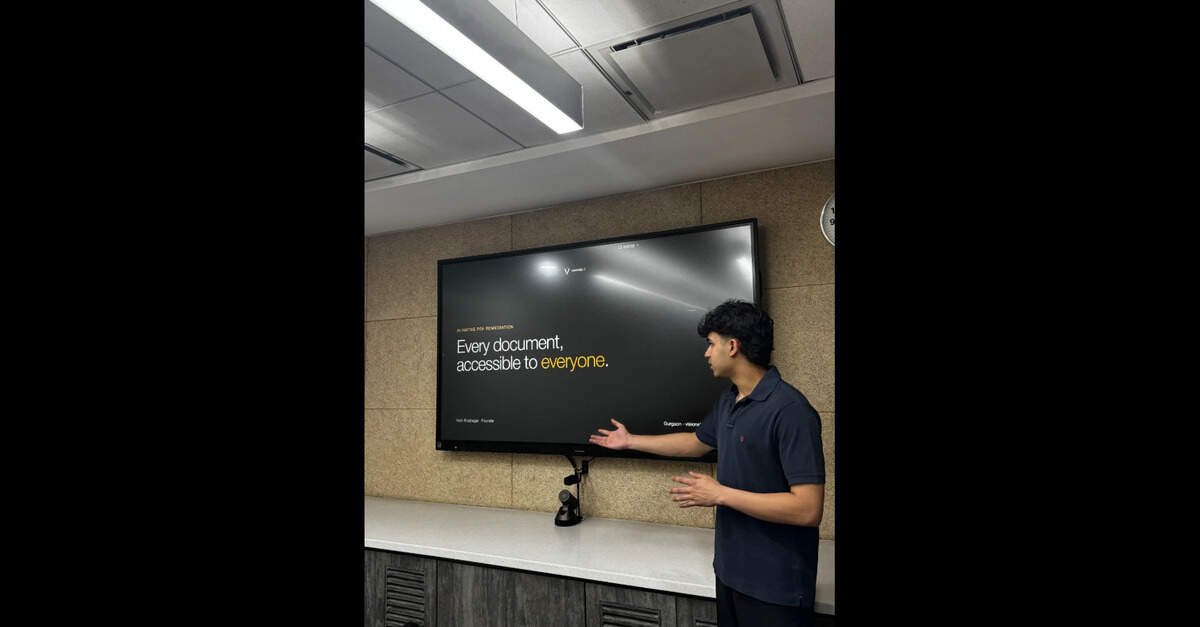
A Class XI student at DPS International, Gurugram, is building technology to address a problem that can determine whether people with disabilities are able to independently use essential digital services. Yash Bhatnagar, founder of accessibility technology company Visionably, has developed tools to identify barriers across websites and digital documents. Its latest assessment of Indian banking websites has identified 2,221 accessibility failures across 182 webpages, including 233 classified as critical.Bhatnagar’s work sits at the intersection of school education, technology and inclusive design, with the student entrepreneur developing products alongside his academic journey. In April, a report on his work noted that Bhatnagar was balancing Class XI studies with developing AI-based technology to make digital content accessible to visually impaired users.
Visionably’s latest Digital Banking Accessibility Index 2026 examined 23 Indian banks and asked whether visually impaired customers could independently complete three basic online banking journeys: finding a branch, filing a complaint and reaching the net-banking login.
The findings showed accessibility gaps across the banking websites assessed. None of the 23 banks had all three essential customer journeys free of accessibility faults, while 20 recorded failures across all three journeys. Visionably’s own publication of the research says the assessment covered 182 pages and recorded 2,221 confirmed failures, including 233 critical failures.
The audit also identified problems that may not be obvious to users without disabilities. A button, for example, may appear normal visually but be announced by a screen reader only as “button”, without explaining its purpose. Visionably also found keyboard traps associated with homepage carousels at 13 banks.
Bhatnagar has been developing accessibility-focused technology since his school years. His earlier work included Structag, an AI-based tool designed to make PDFs more accessible to screen readers. A report on his work at DPS International described him as a Class XI student developing technology for visually impaired users.
Visionably currently works through two products. Visionably Audit automates several aspects of website accessibility testing, including crawling webpages, checking accessibility criteria, testing keyboard navigation and documenting problems for auditors to review.
Visionably Docs focuses on digital documents and is designed to produce tagged, screen-reader-ready versions of PDFs when users request them. Bhatnagar’s LinkedIn profile lists Visionably as his current venture and DPS International Gurgaon among his educational institutions.
The banking project expands that school-age technology journey into a larger real-world application. Rather than looking at accessibility as a series of isolated webpage errors, Visionably’s system attempts to identify recurring problems that can be addressed across multiple pages.
“The good news is that these are cheap to fix,” Bhatnagar said. “Banks reuse the same buttons and menus on every page, so repairing them once improves hundreds of pages at a time. For most banks, it’s a few weeks of work.”
Visionably has shared individual findings with the participating banks and plans to repeat the assessment in December to track whether accessibility issues across the three critical customer journeys have been addressed.
For Bhatnagar, the project represents an extension of technology work that began while he was still in school. His earlier projects included education-focused AI tools, while his more recent work has moved towards digital accessibility and inclusion. His LinkedIn profile also lists projects including AI tools for students and teachers.
The banking findings highlight a wider issue for education as well: as schools, universities and other institutions increasingly rely on websites, PDFs and digital learning platforms, accessibility can affect whether students and faculty with disabilities can access the same information and resources independently.
That places accessibility not only in the domain of technology companies, but also within the broader conversation around inclusive education and digital learning.
