



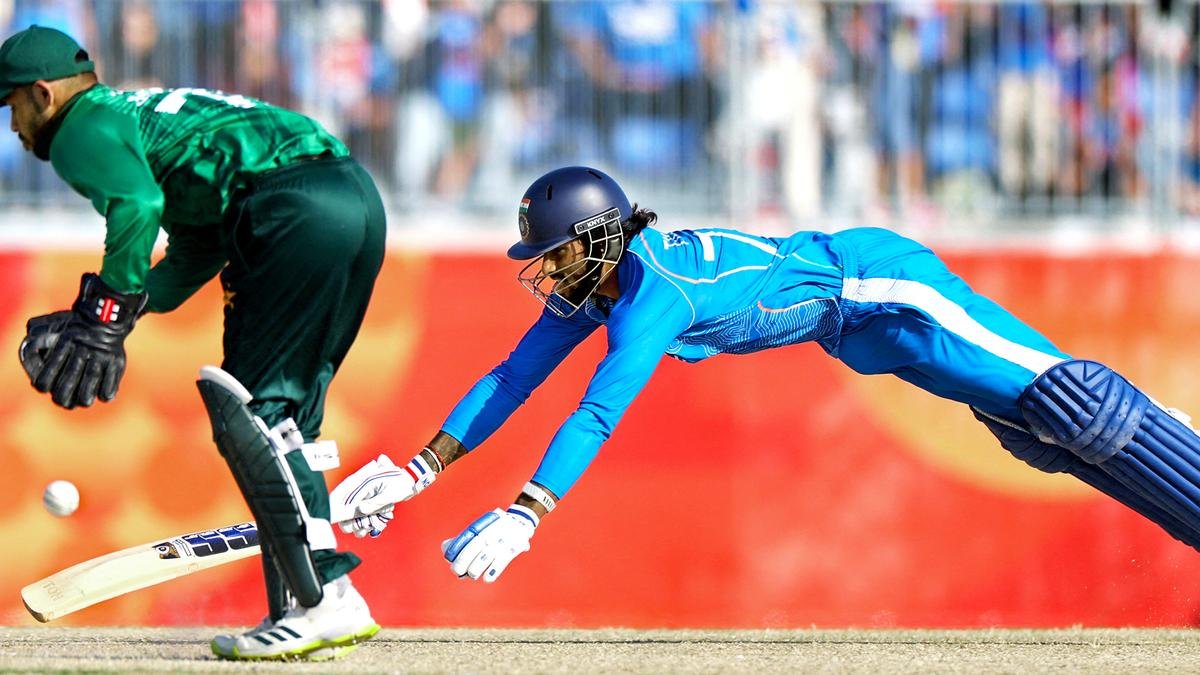
To be installed the overwhelming favourite ahead of any major sporting extravaganza is a double-edged sword. The moniker is suggestive of a formidable individual (or team) clearly more skilled, more temperamentally adjusted, and the most likely to go all the way, but it also comes with a rider. You are marked; the rest will be doubly determined to hunt you down and add a coveted scalp to their kitty.
Long before a single ball was bowled at the Asian Games, the Indian men’s cricket team was fancied to come up trumps. The women too, of course, considering that they had just blazed to the Asia Cup in Dubai, sweeping everyone in front of them. Harmanpreet Kaur’s intrepid bunch kept its tryst with gold in commanding fashion, brooking no opposition and flexing its not inconsiderable muscle with aplomb. Immediately thereafter, the spotlight turned to Shreyas Iyer and his lads, up against four other continental Test-playing nations who chose to put out experimental rather than full-strength outfits.
One of the talking points in the lead-up to the Asiad was why India’s selectors had chosen to go with the tried and the tested. People harked back to the previous event in Hangzhou three years back, when Ruturaj Gaikwad led a second-string team to the gold medal after the final against Afghanistan was washed out, and wondered why a similar squad wasn’t pieced together. For more than one reason, it is apparent.
The previous Asian Games overlapped with the 50-over World Cup hosted by India, thereby comprehensively ruling out the presence in China of the main squad. There is no gainsaying what personnel the selectors would have picked in the absence of the said overlap; that’s delving into the realms of the hypothetical, which serves little purpose.
This time around too, India were involved in a three-match One-Day International series against West Indies at home; the first of the ODIs was played on September 27, a day before Shreyas’ boys began their title defence in the quarterfinal against Afghanistan. While there are several players who are certainties in both white-ball formats internationally, India weren’t too weakened by the absence from the 50-over set-up of Shreyas, the ODI vice-captain, and Ishan Kishan. Sure, they missed bowling spearheads Jasprit Bumrah and Axar Patel – Shubman Gill’s unit conceded more than 1000 runs to the Caribbeans in the three fixtures – but what is the weight of an ODI series with little immediate import compared to an Asian Games gold medal?
Cricket authorities have worked tirelessly in ensuring the inclusion of the sport in multi-discipline events like the Asian Games and the Olympic Games. The International Cricket Council’s avowed goal is to take the discipline to as many countries as possible. Having identified the 20-over format as the vehicle to drive that ambition, it has handed over memberships to a host of nations – the official T20I team rankings includes a staggering 102 countries – and conferred international status on matches involving even, say, Lesotho and Costa Rica, ranked 89th and joint-94th respectively.
Perfect sense
It therefore makes perfect sense to honour their presence in these big bashes by sending out the strongest team possible under the circumstances. Perhaps Shreyas might not say so publicly, but one is pretty certain that he would cherish an Asian Games gold medal more than being on the right side of a 2-1 scoreline against West Indies in a largely meaningless ODI series which, even with the World Cup a year away, was largely bereft of context. Batathons on flat tracks that took away the joy of a contest might have appealed to the spectators but it did little to edify the sport. But then, we digress.
Weight of favouritism
Shreyas and stand-in head coach V.V.S. Laxman were aware of the weight of favouritism imposed on the side. They also had the belief and the confidence that, never mind the relative strengths of their opponents, they would be unstoppable if they played at even 90% of their potential. Even at full strength, which Afghanistan were last month when they quixotically hosted India at Delhi’s Arun Jaitley Stadium, the rest of the field would have been hard pressed to stretch India. Given that Shreyas had all the big guns at his disposal, from Abhishek Sharma and Vaibhav Sooryavanshi to Sanju Samson and Kishan, and Bumrah and Axar, India had to play extraordinarily poorly and their opponents, whoever they might have been, had to play out of their skins to orchestrate an upset.
India’s Ishan Kishan celebrates with Sanju Samson.
| Photo Credit:
REUTERS
Banana skin
As their one-off T20I against Japan showcased last month, an abridged T20 game can be a banana skin. On a pitch that served as a horrible advertisement for a 5-overs-a-side affair, India huffed and puffed to a two-run victory. More than any other format, the 20-over slugfest narrows the gap between teams, and when that is reduced by 75%, the chances of a more level playing field increase exponentially.
Most pitches at the Asian Games weren’t up to scratch, favouring the bowling sides to a massive degree – how the Indian and West Indian 50-over exponents would have loved that – even though the final was played on a pretty good surface that produced more 400 runs. India’s overwhelming superiority was never more evident than in the semifinal against Sri Lanka when Kishan’s unbeaten 80 was nearly twice as much as what the entire opposition managed. India played with flair and imagination, and without the burden of expectations and fear. A lot of credit for that should go to Laxman, as good a man-manager as any the country has been blessed with but temporarily – one hopes – lost to the coaching spectrum because of personal reasons.
Laxman has now shepherded India to successive Asian Games gold medals, even though he might not individually have anything to show for it. Were he the sort, he would clamber on to the tallest rooftop and tom-tom about his contributions. But he didn’t do that when he was winning matches and shaping miracles for the country, so he is not going to embark on that journey now. In India, some people are more equal than others and that will never change, which is why Laxman’s contributions will inevitably fly under the radar though as a batter, few have influenced the outcomes of Test matches more than the stylist from Hyderabad.
One of the prime tenets of Laxman’s coaching philosophy is constancy and stability. Among the others is communication. During his playing career, Laxman suffered on both counts, so he is in a far better position to appreciate the significance of role clarity, of being made to feel wanted, and of being kept in the loop about developments so that no one is operating in a vacuum. Many of the players who travelled with him to Zimbabwe in July, immediately after the misadventures in Ireland and England, and to the Asian Games, have spoken in private of the positive influence of the 51-year-old and how his openness, approachability and his sense of balance and fairness have impacted them. Laxman is a firm believer in processes, but also in not rigidly sticking to them or making decisions on the fly, on a whim and a fancy. While no coach can ever be accused of winning or losing matches, it is undeniable that the environment they fashion within the changing room plays a massive part in how the wards approach the game. On that count, Laxman has few equals.
For Shreyas, this was a much-needed victory. Brought back to the T20I fold after two and a half years and installed as the captain with India deciding to move on from Suryakumar Yadav – World Cup-winning skipper but short on runs – he must have felt the heat after surrendering 0-2 to Ireland and 0-4 to England in his first two assignments. The clean sweep against Afghanistan last month must have lifted his morale, but this campaign, away from probing eyes, would have facilitated his reintegration to progress further. The fact that he had most of his first-choice personnel around would have aided the process of refamiliarisation and put him in a good headspace, imperative because he is the designated ODI vice-captain and will be expected to play a big part with the bat at No. 4 in the lead-up to and during the World Cup.
Shreyas knows he has a great bunch to work with. He will have taken particular joy in the sustained good form of Kishan, for whom 2026 has heralded a breathtaking second coming, and the continued development as a batter, an individual and leader of Tilak Varma, his T20I deputy. Like he had in the Asia Cup final in Dubai in September last year when he steered India past Pakistan in a tense run-chase, the left-hander from Hyderabad upped his game against the old foe in the title clash on Saturday, his unbeaten 51, off just 22 deliveries, pushing the total past 200 and out of reach of a spirited Pakistan well served by the exciting Hasan Nawaz.
Tilak was batting at No. 6, somewhat below his normal and preferred position because India stacked up their batting even if it meant they were a bowler light. He walked in with just 41 deliveries left in the innings and made a spectacular impact, showing how far he has come in international cricket. Just 23 months back, in South Africa towards the end of 2024, he sought to occupy the No. 3 position that Suryakumar had made his own. When the skipper acquiesced, Tilak expressed his thanks with two hundreds in three nights, in Centurion and adjacent Johannesburg respectively. Now, he doesn’t need the No. 3 position, which puts him in a position to play more balls than anyone else but the two openers, to unfurl his repertoire and shape the destination of 20-over games, which is exactly the kind of graph one would expect of a 23-year-old who is desperate to be a permanent for the country across formats.
Already, the Asian Games adventure is a thing of the past, what with the five-match T20I series against West Indies due to begin in Lucknow on Tuesday. A vast chunk of those who travelled to Japan will line up in the administrative and legislative capital of Uttar Pradesh, as a new challenge beckons. West Indies have shown in the ODIs that they are no pushovers and India will have their work cut out. And while they know that it doesn’t guarantee victory, Shreyas and his boys will still bask in the afterglow of an Asian Games gold medal. Whyever not?
