



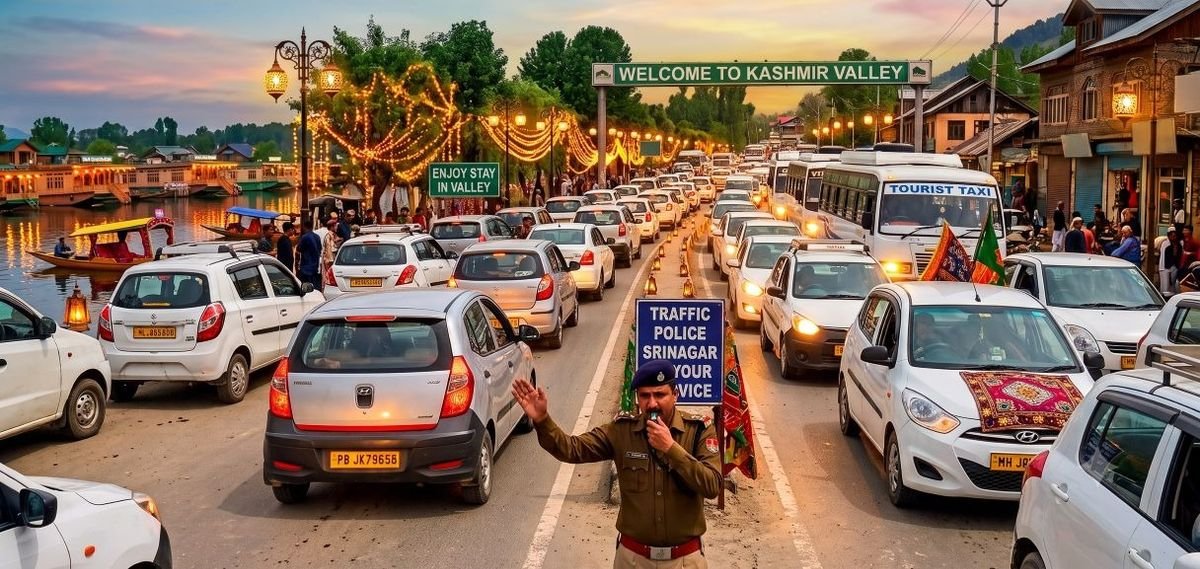
Srinagar, Oct 04: Kashmir’s tourism revival brought a massive surge in road traffic during this year’s peak season, with around 30,000 tourist vehicles from different states entering the Valley during April, May and June, adding considerable pressure to the region’s already stretched traffic system. The additional rush of tourist vehicles put Kashmir’s traffic management to a test, with authorities claiming that “additional burden was challenging but managed smoothly.”
DIG Traffic Kashmir Haseeb ur Rehman told Rising Kashmir that the influx of vehicles from outside Jammu and Kashmir had placed an additional burden on roads during the peak tourist months.
“The movement of around 30,000 tourist vehicles from various states during April, May and June put additional pressure on the traffic system. It was challenging, but extra deployment of men and machinery was made. We managed the rush smoothly,” he said. “Tourism is increasing, and we have to plan accordingly for the winter tourism rush and also for the next year.”
The vehicle surge came amid a sharp rise in tourist footfall. More than 5.4 lakh tourists visited Kashmir in May and June alone, with 2,19,449 visitors recorded in May and 3,21,196 in June. Another 2,66,363 tourists visited in July, taking the May-July total to 8,07,008.
The sharp increase in visitor numbers translated into heavier movement on major tourist corridors linking Srinagar with Gulmarg, Pahalgam and Sonamarg, while the city itself had to accommodate the additional tourist traffic alongside its regular local vehicle population.
The scale of the traffic-management challenge is also reflected in enforcement figures. Srinagar recorded 52,545 traffic challans between April and June 2026, almost twice the 26,331 challans issued during the preceding 12 months. The city’s automated enforcement network comprises 835 cameras across 66 junctions, with 792 cameras and 62 junctions reported functional.
The rising road traffic comes as Kashmir increasingly attracts visitors travelling by private cars, taxis and tourist coaches, putting pressure on roads, parking spaces and key intersections, particularly during weekends and holiday periods.
Officials have increasingly had to balance tourist movement with the requirements of local commuters, public transport and emergency services, making advance traffic planning crucial during the tourism season.
DIG Rehman said the Traffic Department would use this year’s experience to strengthen its arrangements before the next tourist season.
“For next year, our preparations will be more advanced. We will analyse the movement patterns and identify the pressure points so that we are better prepared to handle the additional traffic,” he said.
The preparations are expected to focus on advance deployment of personnel, better regulation at vulnerable points, route management and improved coordination along busy tourist corridors.
The figures underline the scale of the challenge ahead. With 8.07 lakh tourists visiting Kashmir in May-July alone, and around 30,000 tourist vehicles from outside the UT entering during April-June, the tourism boom is creating a parallel demand for stronger traffic-management capacity.
For the Traffic Department, the summer experience has provided a clear lesson–as Kashmir attracts more tourists, managing the vehicles carrying them is becoming an equally important part of sustaining the Valley’s tourism growth.
