



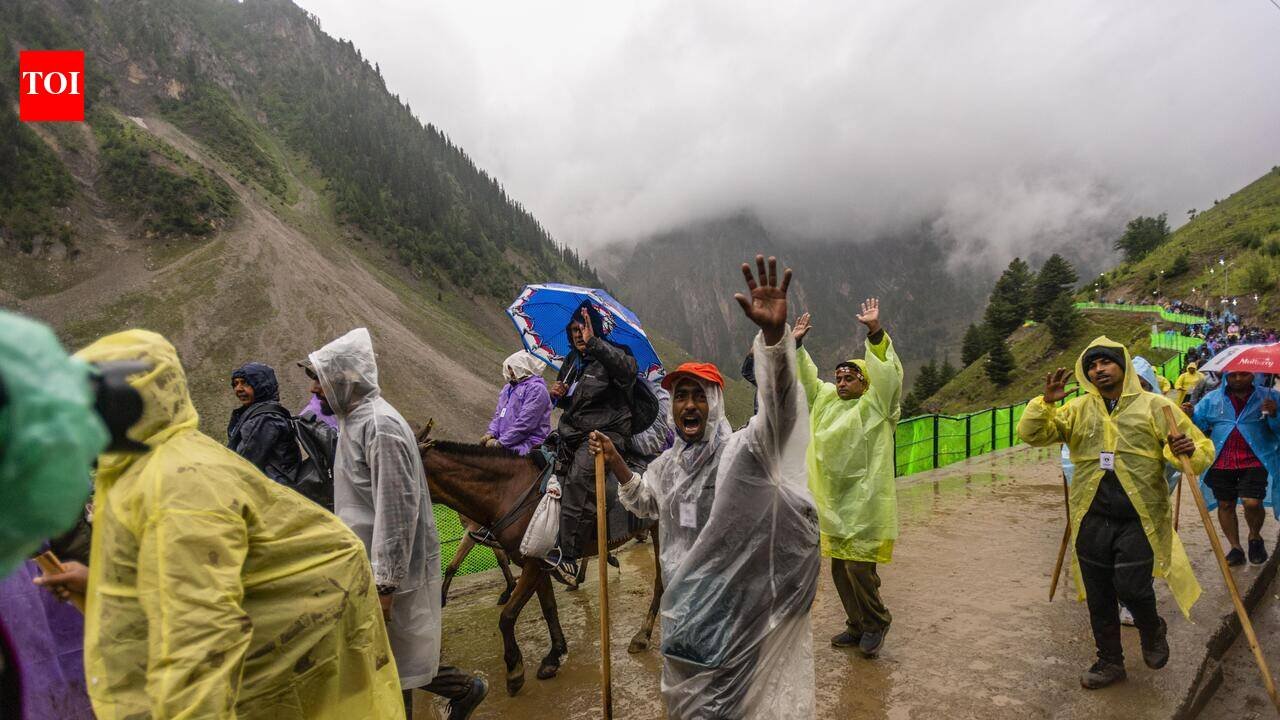
Bhopal: Many who set out for one of the country’s longest and most arduous pilgrimage sites, the Amarnath cave shrine rising beyond 12,000 feet across the fragile Himalayan terrain, packed some unusual additions to their travel kit this year — their own steel plates, bowls and spoons.The small but significant behavioural shift, backed by reusable utensils at langars (community kitchens) and fewer disposables along the Amarnath route, helped cut per-capita waste generation by 15% even as nearly 70,000 more pilgrims undertook the yatra this year.Data shared by the waste-management team show that during the full yatra period from July 3 to August 28, footfall to the revered cave shrine rose 17.07%, from 4.10 lakh in 2025 to 4.80 lakh this year. Yet, total waste collected from the route fell from 417 MT to 414.46 MT, bringing waste generated per pilgrim down from 1.017 kg to 0.865 kg.Sameer Sharma, chief executive officer and co-founder of Indore-based Swaaha Resource Management, which was involved in managing waste during the Amarnath Yatra, said the focus was on reducing waste before it entered the system. “Pilgrims were encouraged to carry their own reusable utensils, while langars shifted towards steel dinner sets. Cutting single-use plastic and segregating waste at source together helped bring down waste generated per pilgrim,” he said.Waste generation during the yatra has fluctuated in recent years. It stood at about 550 tonnes in 2022, 470 tonnes in 2023 and 520 tonnes in 2024, before declining to 417 tonnes in 2025 and 414.46 tonnes this year.According to the waste-management agency, the ‘Bartan Bank’ was among the key interventions, helping cut waste. Reusable steel dinner sets were made available to langars against a nominal deposit, while pilgrims were encouraged to carry their own plates, bowls and spoons. More than 1.49 lakh cloth bags were also distributed to cut disposable plastic use.Eight high-capacity water ATMs were placed along the pilgrimage routes to provide free drinking water. The refill facilities reduced dependence on packaged water and, according to project estimates, helped avoid the use of around 3.2 million single-use plastic bottles.According to the waste-management agency, the sanitation operation achieved Zero Waste to Landfill across both the Pahalgam and Baltal axes. All 414.46 MT of waste collected was segregated at source and processed, with average waste generation during the yatra working out to about 11.67 MT a day.Of the total, 215 MT was wet and organic waste, processed through bio-digesters, rapid composting units and decentralised biogas plants. Another 186 MT of dry recyclable waste was sorted at 1,016 twin-bin stations, baled at transit hubs and sent to authorised recycling facilities.The waste-management team said 12.75 MT of mule and horse dung was collected directly from the tracks and converted into biofuel and soil enrichers. Part of the biogas generated was used to keep a ‘Swachh Jyoti’ burning as a waste-to-energy demonstration.“Operating a zero-landfill sanitation model above 12,000 feet in an ecologically fragile Himalayan ecosystem is a major challenge. Converting animal waste into clean fuel, processing organic waste locally and routing recyclables directly to authorised facilities shows how circular-economy principles can work even in sensitive alpine regions,” Sharma said.Managing waste across nearly 70 km of high-altitude trails required 7,135 sanitation personnel working round-the-clock in three eight-hour shifts. The yatra points were equipped with 8,192 prefabricated and permanent toilet and bathing units.The operation also used the ‘Gandhi Stick’, an IIT Bombay-patented tool for hygienic waste collection without repeated bending, while ‘Triloki’, an interactive ventriloquism mascot, was used to engage families on segregation at source.
