



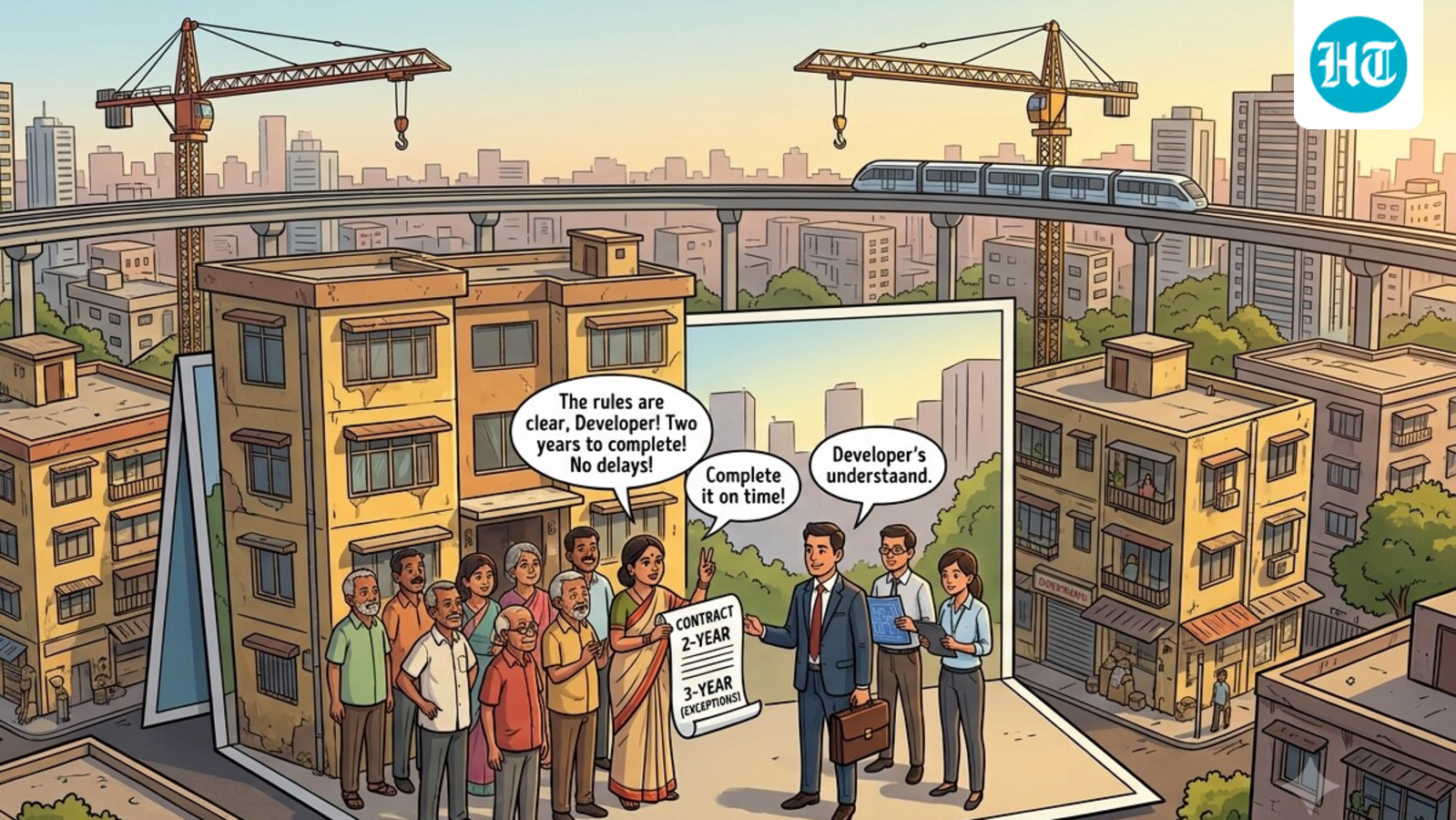
The Maharashtra government has introduced a time-bound framework for the redevelopment of cooperative housing societies, requiring developers to complete projects within two years from the date of the foundation or plinth certificate.

This new provision is part of the state government’s revised guidelines issued under Section 79A of the Maharashtra Cooperative Societies Act. It could provide a significant safeguard for members’ timelines as they wait to move into their redeveloped homes.
The government order, however, allows the completion period to extend to a maximum of three years in exceptional circumstances. This means the three-year period is not the normal timeline for every redevelopment project but is an exception to the standard two-year completion requirement. The development agreement must also incorporate the relevant terms governing the redevelopment project.
What has the Maharashtra government said about the redevelopment timeline?
The Maharashtra government said in the Government Resolution (GR) that “Depending on the size of the redevelopment project, the period for completing the society’s redevelopment/construction project shall not exceed two years from the date of the first/plinth foundation certificate. In exceptional circumstances, this period shall not exceed three years.”
“During the redevelopment period, the developer shall, as far as possible, provide members with alternative accommodation in the same area until project completion, or arrange to pay monthly rent and a deposit acceptable to the members, or provide suitable transit accommodation,” the GR said.
On September 30, the Maharashtra government tightened the redevelopment process for co-operative housing societies, placing greater emphasis on member participation, time-bound documentation and majority approval in the appointment of developers.
The Maharashtra government GR said a redevelopment decision requires a two-thirds quorum and approval from at least 51% of the society’s total members. The GR also permits virtual participation in specified cases, including for senior citizens and members living abroad.
Members living abroad, those who are critically ill, persons with disabilities or those unable to attend for unavoidable reasons can participate through VC/remote systems, the new policy document states.
Further, members voting in favour of redevelopment must provide written consent. The process also requires societies to invite at least three competitive bids from developers, with provisions to extend the deadline if fewer bids are received.
What do experts have to say on the two-year timeline for redevelopment?
According to real estate developers, the two-year provision could become an important point for existing society members when assessing redevelopment proposals and during negotiations.
“We welcome the guidelines issued by the Maharashtra government to streamline redevelopment and make the process more transparent. The majority of the pointers/guidelines existed and were followed by the developers,” said Hitesh Thakkar, vice president, NAREDCO Maharashtra.
“But when it comes to the two-year completion deadline, it may be sufficient, particularly for projects involving 18–20 floors. However, in the case of 40-floor and taller developments, additional time may be required to obtain the necessary height and other permissions and complete construction. Hence, societies may agree to allow an additional four to five years, with developers coordinating and negotiating with societies accordingly, and the terms and conditions being clearly mentioned in the Development Agreement,” Thakkar said.
According to legal experts, Maharashtra’s revised redevelopment rules set a broad two-year completion deadline, extendable to three years in exceptional cases. However, it will also depend on the understanding between the developer and the society agreed upon in the development agreement.
Also Read: What is driving the growing interest of large corporates in Mumbai’s cluster redevelopment projects?
“Ultimately, it will depend on the understanding between the housing society and the developer, and the project can be undertaken in accordance with the terms agreed upon in the Development Agreement. The timeline will also depend on the stakeholders’ understanding and how smoothly the necessary permissions are obtained for construction. However, the government has set a broad deadline for project completion,” said Nilesh Gala, advocate, Bombay High Court.
