



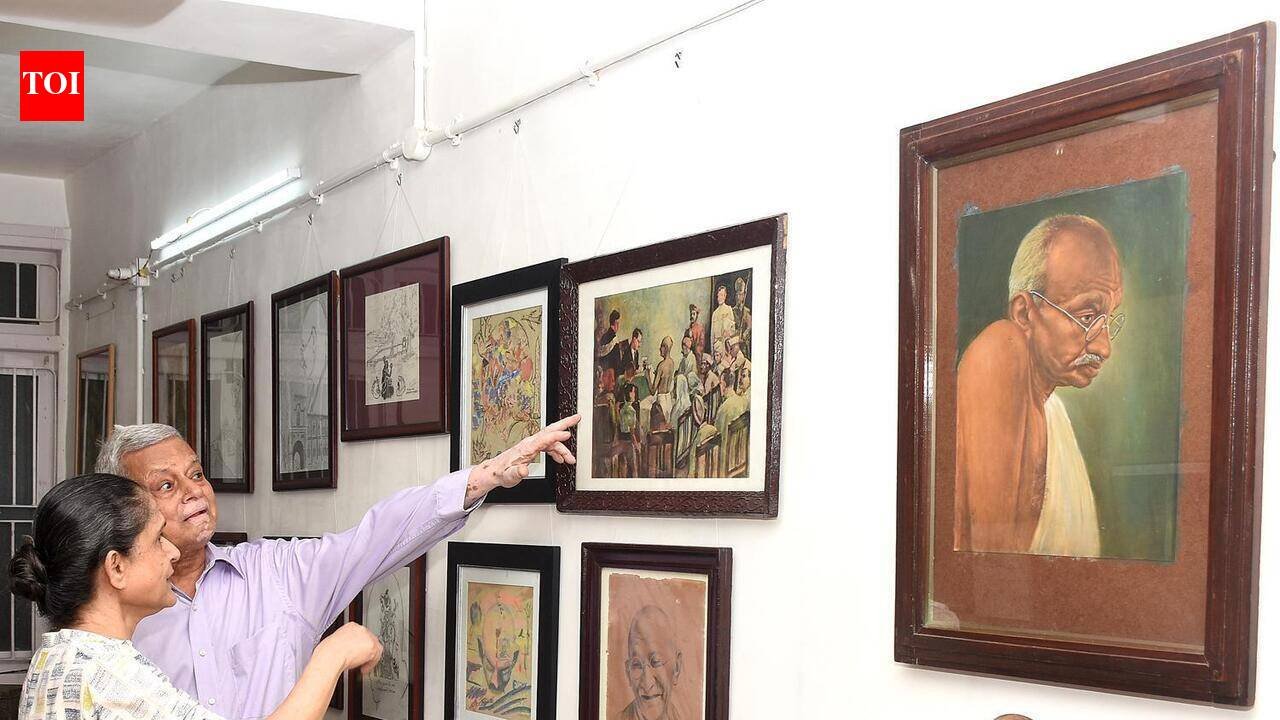
Vadodara: A handwritten edition of Hind Swaraj, a wartime printing of Gandhi’s autobiography, silver coins, gramophone records and even a hair-oil advertisement carrying his photograph form part of a remarkable private archive that has turned a Vadodara home into a living museum of the Mahatma.For Atul Shah, 72, and his wife Mudita, 70, these are pieces of a decades-long fascination with Gandhi. Their pen shop-cum-residence in Vadodara’s old city houses an extensive collection of Gandhi memorabilia gathered across generations.Since 2009, the couple have opened their home to visitors around Gandhi Jayanti under the banner “OMG — Only Mahatma Gandhi”. Different parts of the collection are displayed each year. The exhibition draws around 2,500 visitors annually.The collection is large enough, the Shahs say, to sustain a different Gandhi-themed display every month for 18 months without repeating a theme. Preparing a single exhibition takes nearly four months.Among the most compelling artefacts are the books, some almost a century old, which preserve traces of Gandhi’s writing, publishing history and the freedom movement.One of the rarest volumes is a Gujarati edition of Hind Swaraj reproduced in Gandhi’s own handwriting.According to the publisher’s note, Gandhi wrote the original manuscript in 1908 while travelling from London to South Africa aboard the Kildonan Castle. The handwritten pages were later reproduced, allowing readers to view the text in Gandhi’s script.The volume contains passages written with Gandhi’s left hand. The note explains that he continued writing after his right hand grew tired.It also argues for preserving his handwriting, saying Gandhi’s letters reveal aspects of the personality behind the words. The book serves as a record of the circumstances in which the landmark text was written.The publication offers insights into how freedom movement activities were funded. It was issued in two editions, one with a khadi cover and another with a paper cover. The publisher noted that eight annas from each khadi-covered copy and four annas from each paper-covered copy went to the Tilak Swaraj Fund for gram seva work.Another notable volume in the collection is a 1944 seventh edition of The Story of My Experiments with Truth.The 610-page book was printed entirely on handmade paper. A publisher’s note describes how the Second World War raised printing costs. The wartime edition was priced at Rs 3, compared with Rs 2 for the regular edition.The edition included 1,000 copies printed on higher-quality paper and sold for Rs 3, Re 1 more than the standard version. The note also records changes in printing, including the reduction of some illustrations because of wartime constraints.“They are not just books,” Shah says. “Their paper, handwriting, editions, prices and publishers’ notes together tell stories of the period in which they were produced.”Another edition of Hind Swaraj, published in 1930 and found by Shah at Sukravari, Vadodara’s old Friday market, carries a khadi cover and Gandhi’s handwriting. Its cover price was Rs 2 and eight annas, while the ordinary-cover edition cost Rs 1 and 12 annas.The collection also includes a Marathi biography of Gandhi that formed part of the Maharashtra government school curriculum, illustrating how his life and ideas reached generations of students.Beyond books, the archive captures the many ways Gandhi’s image entered everyday life and popular culture.A Diwali special issue of The Navyug, published on October 31, 1948, carries Gandhi’s photograph in advertisements for a Bombay-based agarbatti company and a jasmine hair-oil brand. Another advertisement used his photograph to promote hair oil.His image also appeared in an advertisement for Ratnam Pens, the swadeshi writing instruments associated with K V Ratnam of Rajahmundry in Andhra Pradesh.Some artefacts are striking for their rarity. An Ahmedabad firm, Bansi & Co, issued silver coins bearing Gandhi’s image, a departure from the customary Lakshmi and Ganesha coins exchanged during festive occasions.A Mumbai firm based in Chowpatty released a 1948 calendar featuring Gandhi’s portrait and a message of non-violence.Among the most unusual items is a German-made coat button embossed with Gandhi’s face.The archive also preserves audio records linked to Gandhi’s legacy. Shah owns around 200 books on Gandhi, along with paintings, portraits, sketches, sculptures, stamps, newspaper cuttings and artistic impressions.His gramophone records include the Mahatma Gandhi Centenary Commemoration Record, released in Great Britain in 1969 and featuring the voices of Gandhi, the Archbishop of Canterbury and Earl Mountbatten of Burma.Some exhibits have been created by the Shahs themselves. One display portrays different stages of Gandhi’s life on 61 terracotta plates. Paintings and cartoon strips offer further interpretations of his life.The collection began with Shah’s father, Natwarlal. While the family lived in Mumbai, Shah’s grandfather regularly took Natwarlal to Gandhi’s public meetings. Those visits sparked a lifelong interest.Painter Ramakant Achrekar later noticed that interest and gifted him a pencil sketch of Gandhi. It became one of the earliest pieces in the family archive.Natwarlal continued collecting books, paintings, portraits, stamps, sketches, sculptures and newspaper cuttings. Atul inherited the collection and expanded it over the years.“I am no expert on Gandhiji, but it was my father’s interest in Gandhi because of which I got fascinated with his personality,” Shah says.Today, the archive remains housed in the family’s working space in the old city, where visitors encounter Gandhi through books, advertisements, artworks and everyday objects that trace the many ways his image travelled across society.
