



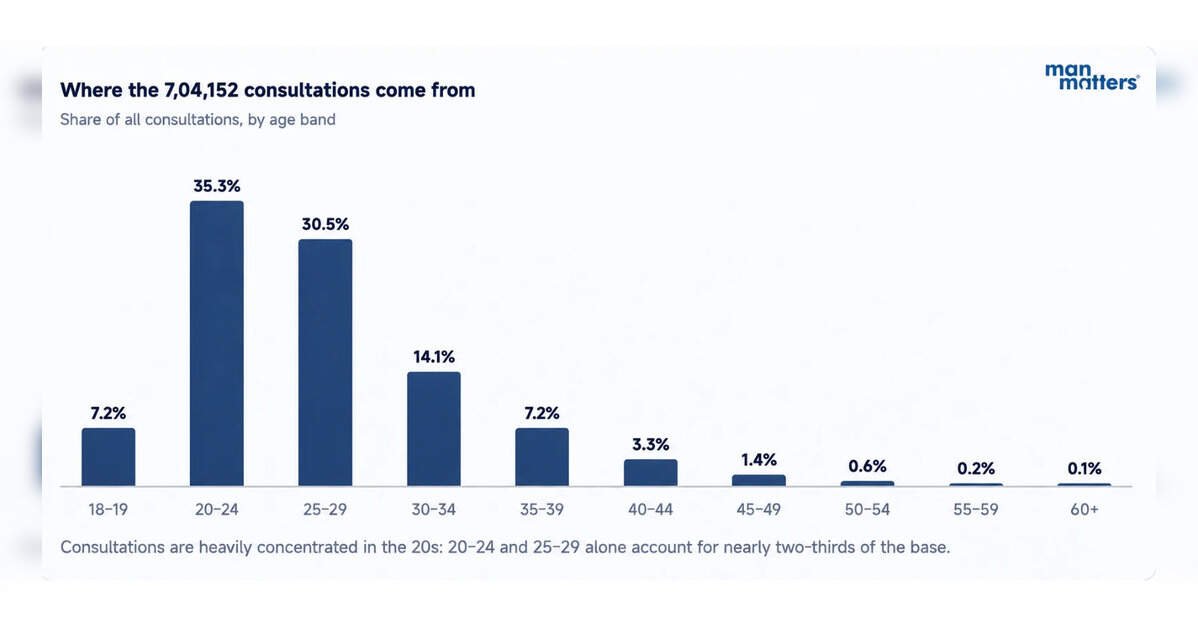
This National Hair Day, Man Matters consultation data points to a generation confronting thinning hair a decade before it was once expected.
October 1 is National Hair Day, a day that invites people to celebrate their hair, to care for it, style it, and understand what keeps it healthy. It is a fitting moment to talk about hair health, and this year the conversation among Indian men is moving toward a younger, more clinical question: why are more and more men in their 20s facing hair loss?
Man Matters, a doctor-led men’s health platform that has supported over 10 lakh Indian men and now does more than 5,000 consultations a day, sees this shift up close, which is precisely why putting the numbers on record matters. Over the year to August 2026, 7,04,152 of those consultations were for hair loss, and within that group, the concern is not concentrated where the old stereotype places it,in middle age, but a full generation earlier.
Two in three men who consult for hair loss are in their 20s. The largest single cohort, accounting for more than one in three, is aged 20 to 24, an age long assumed to be well insulated from thinning hair. Nearly nine in ten (87%) are under 35. Hair loss, at least as it presents in the consultation room, has become predominantly a young man’s concern. Taken together, these figures place the median age of a man consulting for hair loss at just 26.
Arriving young, however, is not the same as arriving early. Two in three (65%) are already at Norwood Stage 3 or beyond, visible recession and thinning rather than a first stray strand, by the time they first seek help. The interval between when hair loss begins and when it is finally acknowledged is, for many men, where the condition quietly advances.
A closer reading of the data reveals a subtler shift, not only in scale, but in language. Among men under 25, the complaint is most often the hairline: a specific, visible retreat at the temples that can be pointed to. Past 35, the description changes to thinning, low volume and reduced density. In clinical terms, male-pattern hair loss tends to broaden beyond the hairline into the crown with age, and the vocabulary follows: what begins as a hairline conversation in a man’s 20s becomes a density conversation by his 40s.
These figures describe association, not causation, and they reflect men who chose to seek help rather than the general population. Even so, the trend is difficult to ignore. The age at which Indian men are willing to acknowledge hair loss and act on it has fallen sharply. For a generation whose lives are lived across front cameras, video calls and dating profiles, the hairline is under near-constant observation, and it is being scrutinised younger than ever before.
“The men we see for hair loss are strikingly young, nearly nine in ten are under 35. Yet two in three are already at Stage 3 or beyond by their first consultation. Hair loss rarely announces itself; it progresses in stages, and most men notice it later than they think. Wherever a man is in that journey, the earlier a doctor assesses it, the more options remain available.” Dr. Sumit Upadhyay, Man Matters
Which is perhaps the most useful thing to take from National Hair Day this year. It remains a day to celebrate and care for one’s hair and for a growing share of young Indian men, caring for it now means understanding it earlier. Not with alarm, but with information. On Man Matters, that begins with a doctor consultation, one that can identify the stage a man is actually at, and help understand what is driving his particular concern, turning guesswork into a plan.
Man Matters is a doctor-led men’s health platform. The Hairfall Index draws on 7,04,152 consultations between August 2025 and August 2026; the full methodology is published and open for citation at the Hairfall Index 2026 .
Disclaimer: The above content is non-editorial, and TIL hereby disclaims any and all warranties, expressed or implied, relating to it, and does not guarantee, vouch for or necessarily endorse any of the content.
