



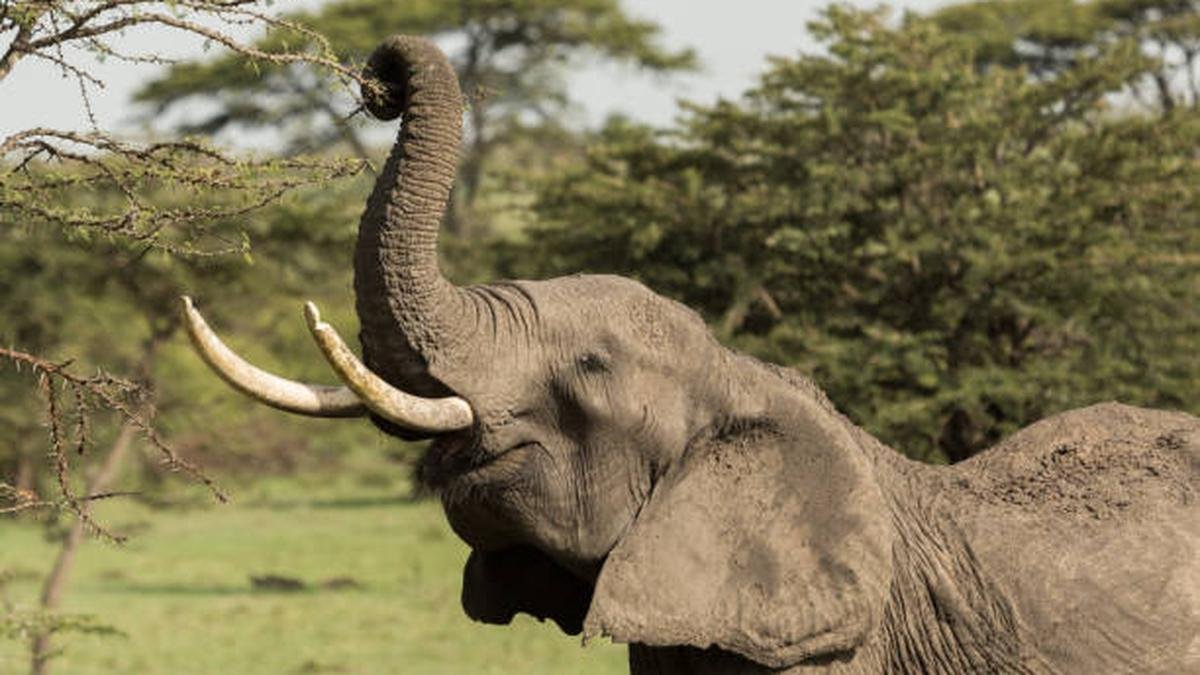
Elephants were found to travel long distances to get to a particular tree without foraging on the way. Their single-minded mission was to consume the bark or leaves.
| Photo Credit: Getty Images/iStockphoto
Wild animals have for long been known for their intuitive pharmacological knowledge: orangutans balm their wounds with plants; chimpanzees consume bitter antibacterial leaves; Indo-Pacific bottlenose dolphins queue up to rub against selected corals; and birds smear their nests with insecticidal plants to fend off anaemia-causing mites.
Scientists term this behaviour zoopharmacognosy, where animals seek out plants to treat endoparasite infestations, respiratory and fungal infections, wounds, and gastrointestinal problems. While most of these medicinal resources are plant-based, for example barks and leaves and resin, animals also treat themselves with charcoal, clay and insects.
Now, a paper published in Scientific Reports that focused on a group of African elephants in Kenya found that they consume specific plants when unwell. In fact, the scientists gathered from local experts who had worked with these elephants for decades that mothers fed plant-based “medicine” to their offspring too. This knowledge is transferred intergenerationally.
Several of these plants are also used in indigenous human traditional medicine. Local experts pointed to 39 natural resources that elephants in Kenya’s Mount Elgon region use. This included 35 plant species and four types of soil, mineral or clay. In 87% of the cases, these substances were used by local people as medicine.
Elephants were found to travel long distances to get to a particular tree without foraging on the way. Their single-minded mission was to consume the bark or leaves. Among the medicinal species consumed by elephants were Aloe arborescens, Bersama abyssinica, Coleus barbatus, Dombeya burgessiae, D. rotundifolia, D. torrida subsp. torrida, Ficus natalensis, and Kuloa usambarensis.
R. Sukumar, the National Science Chair, Centre for Ecological Sciences, Indian Institute of Science, Bengaluru, who has spent a lifetime studying elephants, told The Hindu that while in India there does not seem to be any systematic study of zoopharmacognosy in Asian elephants, he once made a personal observation: “I once observed a wild female Asian elephant feeding on the bark of Terminalia crenulata, a very rare occurrence. The elephant was secreting from its temporal gland and seemed to be in advanced stage of pregnancy.”
When Prof. Sukumar asked the mahout about this behaviour, the latter confirmed female elephants do indeed feed on the bark of this tree when they are about to give birth.
“The exploitation of such knowledge by the modern pharmaceutical industry for developing drugs for human use should respect the intellectual property rights of our indigenous communities and perhaps even contribute to wildlife conservation goals,” Prof. Sukumar said.
Published – October 01, 2026 09:15 am IST
