



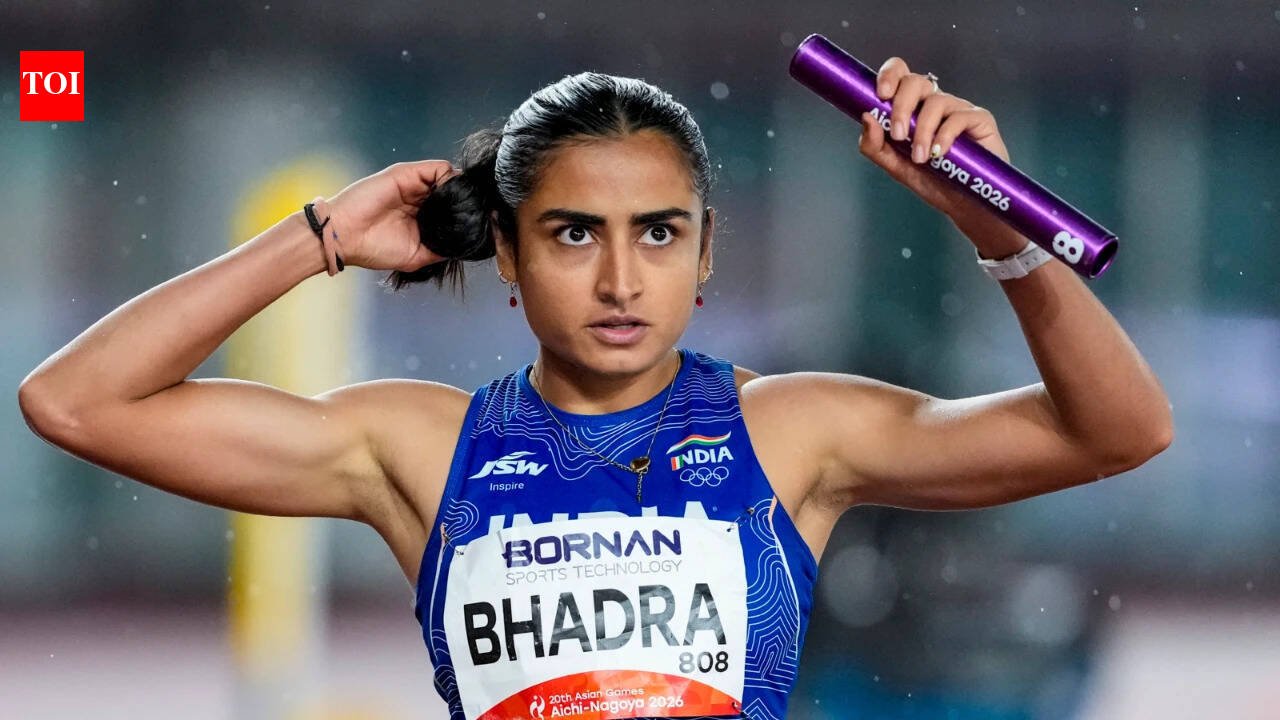
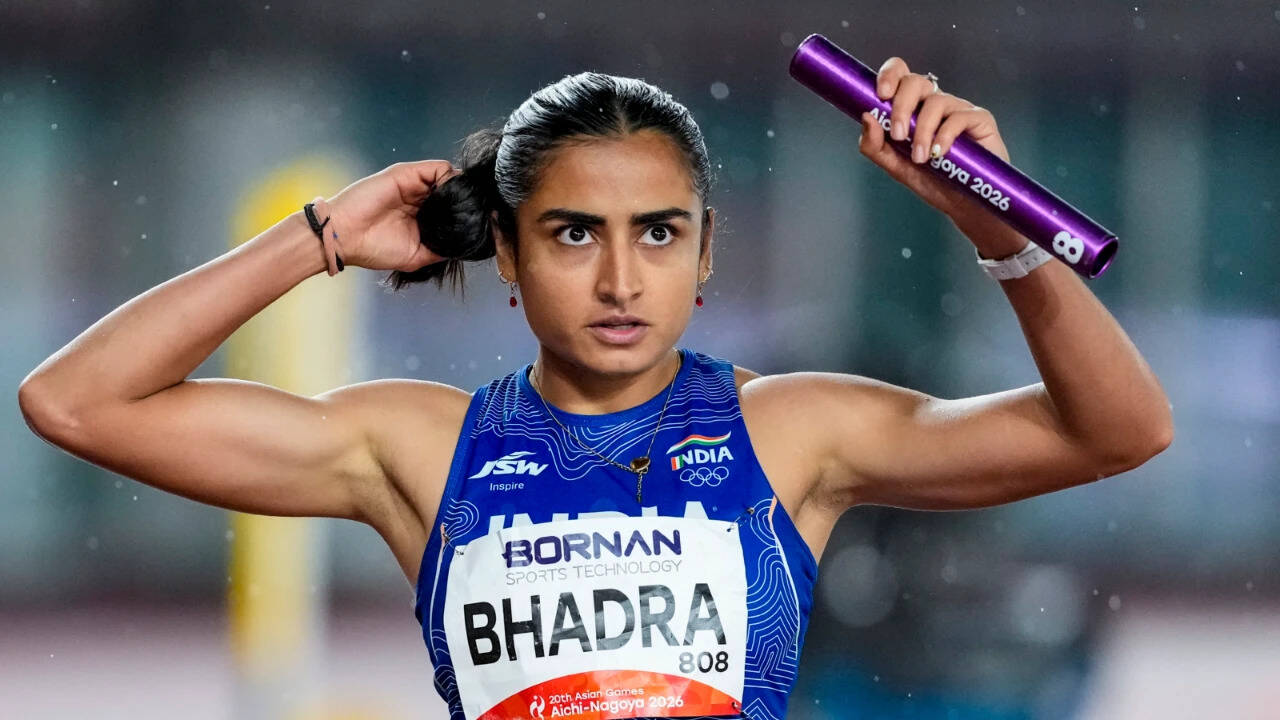
Before the Asian Games, Harita Bhadra had a fairly modest definition of success. A personal best, she had said, would make her happy. A podium finish was what she wanted to chase.She will now leave Aichi-Nagoya with two bronze medals – one from the women’s 200m and another from the mixed 4x100m relay, where she ran the anchor leg as India set a national record of 41.06 seconds.“I’m very happy because I got like two medals at the end of the day. Getting on the podium is like one of the best feelings, especially when you’re representing India, and you’re getting a medal for your country. So that was a very surreal experience for me,” Bhadra told Timesofindia.com from Japan.“And I didn’t get a personal best, but considering the weather conditions and everything, I feel like I gave my best. So that’s okay,” she added.It was also Bhadra’s first senior international competition representing India. She had not been through a junior international programme in Indian colours before arriving in Japan, so much of what she encountered in Aichi-Nagoya was new – the scale of the stadium, the pressure of the races and the closeness of the competition – but she found out quickly that training cannot reproduce all of that.“I’ve definitely learned a lot from this competition and definitely even discovered a lot about myself actually,” she said. “Such scenarios [can be experienced] only in competition, and the level of the pressure and the level of execution will only increase as you go higher and higher.”
“But I discovered how strong I can be mentally. If I tell my mind to do something, it can do it.”
Before the race, Bhadra knew she belonged
Watching Bhadra through the Games, there was a noticeable contrast. Before the races, she was quiet and composed, but her expressions would change once she crossed the line. The happiness was immediate.“On the start line, my only mindset is that I belong over here,” she replied when asked what he goes through between those two moments.“I don’t have to be scared of any of my competitors because, even I’m on the same start line. I just try to trust my body, and I’m not thinking about anything because I’m just staying in the moment, and I’m just trusting my body that all the work I have done is like my body is ready to execute it.”That composure, however, did not mean the nerves had disappeared before her 200m final. Rather, Bhadra says she was nervous. The Reliance Foundation-backed athlete had already given herself a good platform in the heats, finishing second with 23.31s, behind Singapore’s Shanti Pereira.“Everybody on the start line is nervous, but you just accept it. You’re nervous, but that doesn’t mean you’re not confident at the same time. It’s just a mix of both things: you can be nervous but also be equally confident at the same time.”
The 200m bronze came down to 0.01 seconds
The finish, though, was nerve-racking – to say the least. Pereira won in 22.78s, with China’s Chen Yujie taking silver in 22.93s. Bhadra crossed in 23.20s, but Japan’s Abigeirufuka Ido was only 0.01 seconds behind in 23.21s. That meant the bronze was decided by the narrowest of margins, with the photo finish separating Bhadra from the Japanese sprinter.For a few seconds after the finish, Bhadra was unsure where she had finished. She had expected the results to appear on the screen opposite the finish line. After the race, she went across to teammate Unnati Aiyappa and sat with her. Unnati eventually pointed towards another screen. “She was like, ‘You have come third’, and that’s when I realised that I have come third.”The medal was secure, but the race itself still had things Bhadra wanted to improve. “You will never be satisfied with a race. There is always something you will feel that, okay, this could have been done better. This part could have been executed better,” she said.
For the 23-year-old, more international exposure should help with that. The stage was completely new, and she felt there were sections of the race she could have handled better.“I know I had more left in me, but I trust the process, and I trusted that whenever I know I can, I will execute that race that I have in my mind.”One part of the race, though, had given her evidence that the work was moving in the right direction. The last 30 metres, something which had worked on, with her coach Rohit Mane at Reliance Foundation.“Yes, definitely, because I think I won the race because of the last 30 metres. So that improvement was clearly there.”Bhadra’s coach Mane was not in Japan for the Games, but they stayed in touch through video calls and regular calls, while the relay group had the support of Reliance Foundation’s Martin Owens and James Hillier, along with the AFI coaches, around them in Japan.The coaches, she said, kept reminding the four runners that the work had already been done and that they had to trust the runner alongside them. “They kept us motivated to like trust each other. And that’s how we also trusted our partners more.”
The relay brought a different kind of pressure
By the time Bhadra returned to the track for the mixed 4x100m relay, she had already raced twice. The stadium was no longer unfamiliar.“I was definitely more confident because I had, like, two races’ experience,” she said. “I knew now how it’s going to feel like, on the start, and I knew how I will feel stepping into the stadium and everything, how the call room is.”“I was more calm and settled because I was familiar with the environment, basically. So going into the relay, I felt more collected than I was in 200.”The quartet of Gurindervir Singh, Sneha Shanuvali, Animesh Kujjur and Bhadra had been working on the event well before arriving in Nagoya. The Asian Games camp in Bhubaneswar in August, followed by an acclimatisation camp in Tsukuba.
They trained the relay twice a week during the camp. As the Games approached, that came down to once a week because all four athletes also had individual events to prepare for.Bhadra ran the anchor leg in both the semifinal and final, producing strong finishes on each occasion. In the semifinal, she had to recover after a difficult baton exchange on the bend, but still produced the run that carried India into the final. In the medal race, her late surge again proved crucial as India secured bronze. The decision to use Bhadra as the anchor, she says, was made by the coaching staff and AFI team.“They decided to give me the anchor leg. So I was like, okay, I will do the anchor leg. That’s it.”The semifinal did test that decision almost immediately. Kujur fell during the baton exchange before Bhadra took the baton and glanced back for a fleeting second, but with the baton in hand, she focused on the job at hand.“My only thing was I have got the baton. So he [Kujur] has done his job of giving me the baton. So my job is to make the team qualify. As soon as I finished, I was just looking out, like just trying to understand what actually happened. I was trying to see if Animesh is okay or what actually happened.”
Studies can wait. The next number is 22.45
There was another decision from earlier in the year that Bhadra had wanted to test properly: putting her studies on hold and giving sprinting her full attention.She had not made the decision because she could not handle both. She wanted to find out what would happen if she did not have to divide her time.“I just wanted to give myself the chance to explore how it would be like. I only have to just focus on track and I don’t have to juggle two things at once,” she said.Track, she said, requires time and dedication. “I am very happy with the decision. It was a good decision. I’m happy I gave myself the opportunity to explore how it would be.”Her family being in Japan made the week different too. She had wanted them to see her compete at a major event, and they were there for it.“I actually loved it that my family was there because I was just so excited that they are going to see me run at such a big event, like one of the biggest events of my athletics career so far,” she said.“I was very happy they could be there with me because it just made everything like 100 times more special.”Having ticked one of the big markers for this year, Bhadra is eyeing higher goals now, and her next target is already clear.“I am chasing to qualify for the World Championships in 2027.”The World Championships and eventually the Olympics, which had seemed further away before Aichi-Nagoya, now feel a little closer too. “Yes, definitely. It’s a step closer to, like, step higher, step closer. The qualifying mark is 22.45s for 200 metres.”She believes it is achievable. Bhadra’s personal best in 200m currently stands at 23.14s, which she clocked in June this year.“It is doable. But yeah, it is closer but still a lot of work to do there,” said Bhadra, pausing briefly before answering.The area she wants to work on most is not the one a stopwatch will immediately show. It is the mental side. “On the starting line, before even starting the race, if you are mentally not strong, you have lost the race. Everybody is so close, like I said, 0.01 seconds. Like, it’s like nothing.”Her answer is to stay calm enough to keep competing when the race is still there to be won. “You have to have that mental thing of not giving up, of believing that, ‘No, I can still win.’”
She still wants to take it one day at a time
For Bhadra, being mentally calm and connected to the race is now part of the work alongside the physical preparation. She is not planning to choose between the 100m and 200m just yet.The two events, she says, complement each other. Training for the 100m helps the 200m, and vice versa. She will take an off-season before her coach puts together the next plan.As for a favourite?“I have my days of choosing 100 and some days of choosing 200. I can’t choose for sure.”The medals have not changed the way she wants to approach the next season either. Before the Games, Bhadra had spoken about taking things one day at a time. She still uses the same approach now, even with the attention that will come after two Asian Games medals.“I really don’t think about expectations. Over there, I’m just running for myself. I’m not running for anybody else. The only thing is, yes, every day has to be an improvement, even if it is little. But my only goal is to take it one day at a time and to improve from the previous day,” she said.For now, there is no elaborate celebration planned. Her family is staying in Japan for a few more days to explore the country. Once she returns, Bhadra wants to meet her coach and ‘show off’ the two medals. Then there will be family and friends at home.And then there is Dagina.The handmade jewellery brand Bhadra started in October 2025 will turn one next month. She designs and makes the pieces herself and, because it remains a hobby, handles the work on her own. The Asian Games build-up and the last two months in camp meant she had not been able to spend much time on it.She had started Dagina as a way of taking her mind away from athletics. Now Japan has given her an idea for what comes next.“Now, once I’m back, I’m going to start again, maybe do a collection inspired by Japan or something like that.”
