



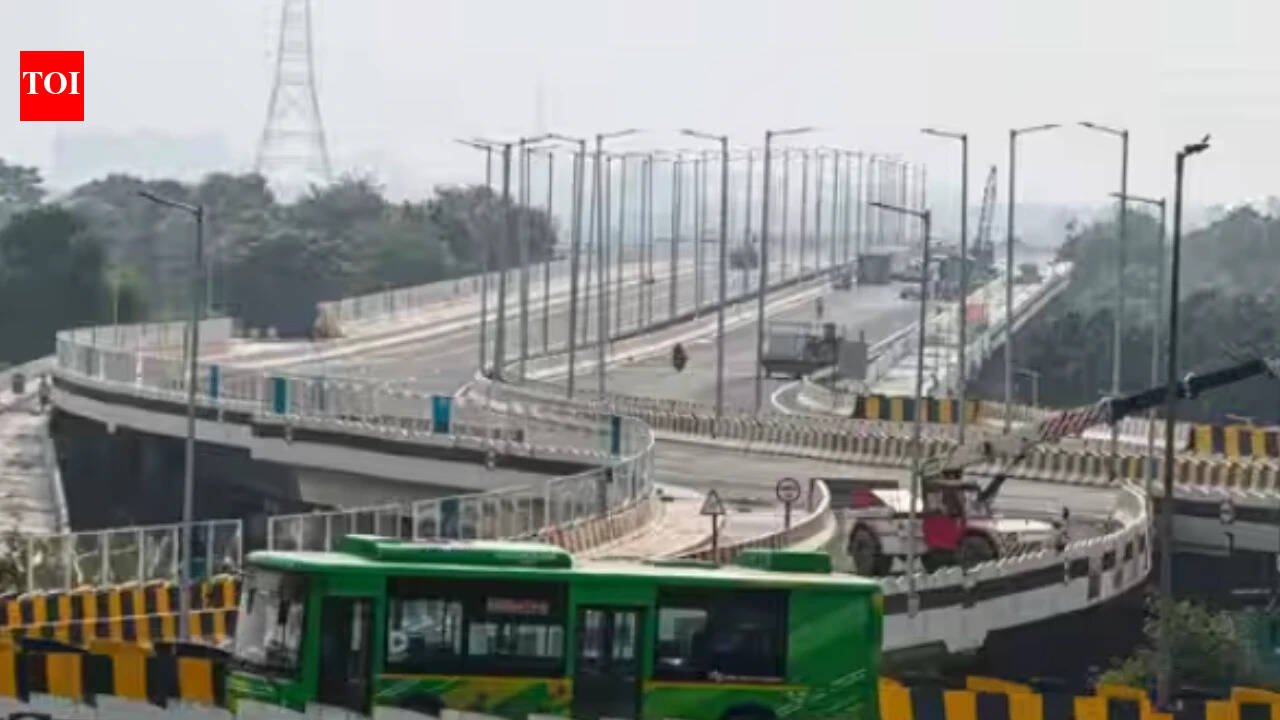
NEW DELHI: The newly opened Barapullah Phase-III elevated corridor, billed as a faster link between east and south Delhi, ran into traffic trouble on Wednesday, with motorists reporting long queues and travel times of up to nearly an hour a day after the flyover was inaugurated.A tailback of nearly 3 km was reported on the Mayur Vihar Phase-1-Sarai Kale Khan stretch, prompting Delhi Traffic Police to intensify deployment at key merging and exit points.Several commuters said traffic from Mayur Vihar Phase-1 towards Sarai Kale Khan was moving at a crawl.One commuter said he was stuck for about 40 minutes while travelling from Mayur Vihar Phase-1 towards central Delhi in the afternoon. Another said it took 55 minutes to reach the first intersection point of the flyover.Several motorists said the promised reduction in travel time from Mayur Vihar Phase-1 to AIIMS was not visible on the first day of the corridor’s operation.
Barapullah Phase-III sees 3-km tailback, traffic police step up deployment
Responding to complaints on social media platform X, Delhi Traffic Police said the congestion on the corridor from Mayur Vihar had been “noted on priority”.Officers were directed to step up regulation at critical merging and exit points, strengthen deployment and clear the build-up quickly.Police said the traffic pattern on the new corridor was being assessed and corrective measures would be taken to improve the flow.“The congestion reported on the newly-opened Barapullah Phase-III corridor, including the tailback from the Mayur Vihar side, has been noted on priority. Traffic officers have been directed to intensify regulation and strengthen deployment at critical merging and exit points,” a traffic officer said.
Experts had warned of congestion near Sarai Kale Khan
Experts had cautioned before the opening that the flyover, meant to offer an alternative to the Delhi-Noida Direct (DND) flyway, could add to congestion near Sarai Kale Khan.The corridor links Mayur Vihar Phase-1 on Noida Link Road to Sarai Kale Khan on Ring Road. It merges with the existing Barapullah network to form a continuous, signal-free stretch of about 9 km up to the AIIMS roundabout.The corridor was expected to ease traffic on the DND and Akshardham stretches.PWD officials said traffic movement from Mayur Vihar towards AIIMS has now been opened for commuters.The carriageway from AIIMS towards Mayur Vihar will be opened by Thursday afternoon, further facilitating smooth movement of traffic on the corridor.
Rs 1,635-crore project delayed for years
The Rs 1,635-crore project was approved in 2014, and work began in 2015. It was scheduled to be completed in 2017 but was delayed several times, resulting in a rise in its cost.In 2021, a pillar supporting the bridge tilted due to the strong flow of the Yamuna during the monsoon, after which work was halted during the monsoon every year.
Extradosed Yamuna bridge, nine loops among key features
A distinctive feature of the corridor is an extradosed bridge over the Yamuna, which uses much shorter stay towers than cable-stayed bridges such as the Signature Bridge.The corridor has nine loops for movement in different directions, besides a footpath and cycle track connecting Mayur Vihar Phase-1 to Ring Road.The project was inaugurated on Tuesday along with four other road projects, taking the total outlay to Rs 1,941 crore.(With PTI inputs)
