



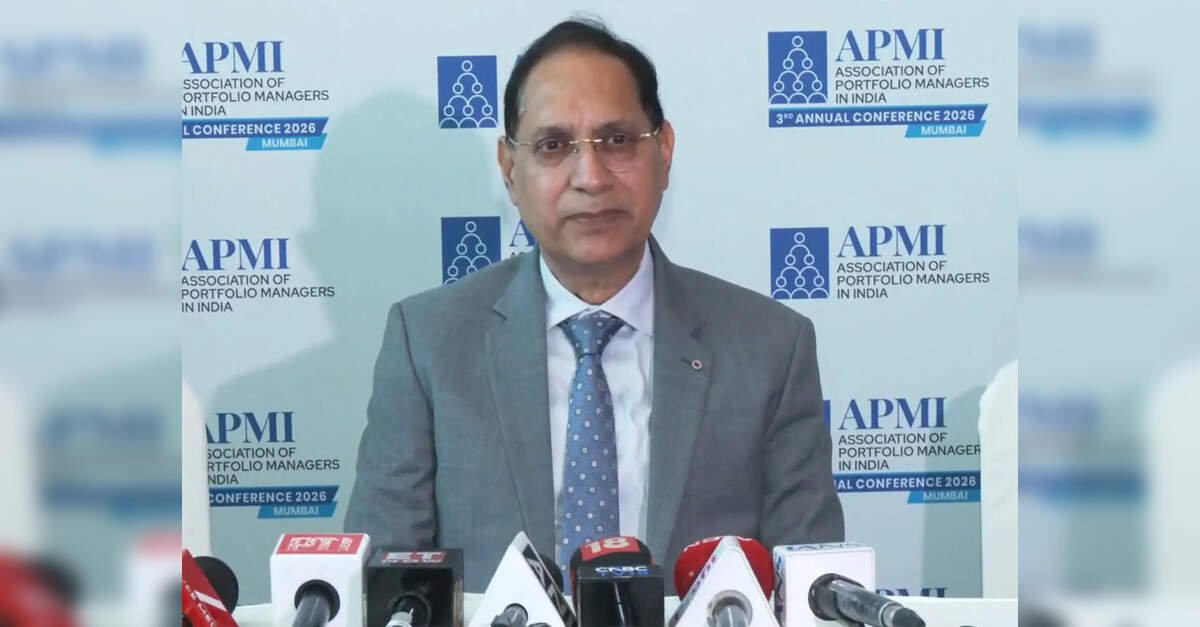
SEBI Chairman Tuhin Kanta Pandey firmly drew the line between market movement and regulatory mandate on Wednesday, declaring that while SEBI cannot force foreign capital into India, it is radically overhauling digital rails to make investor entry friction-free.
Speaking on the sidelines of the APMI 3rd Annual Conference 2026 in Mumbai, the top regulator tackled an array of pressing issues, from FPI onboarding and bond derivatives to exchange rumours and listing cleanups.
Responding to a question from News regarding joint efforts by SEBI, the Reserve Bank of India (RBI), and the Income Tax Department to attract FPIs amid market fluctuations, Pandey emphasised that investment choices rest solely with market participants.
“Investors are free to decide where they want to stay and how they want to stay-that is not for the regulators to see. It’s for the investors to decide where to invest and how to invest,” Pandey said.
He highlighted that regulatory bodies are focused on easing operational hurdles, revealing that SEBI and the RBI are actively working to make registration “very fast, seamless, and digital.”
Outlining key tech-driven measures, he pointed to the updated NSDL front-end, the unified India Market Access portal, common application tracking, and the move toward digital signatures and e-Power of Attorney over physical, wet-signature documents.
He added that the RBI is exploring document certifications via foreign commercial banks and integrating the SWIFT network to further streamline processes.
Turning to upcoming CAS (Closing Auction Session) market modifications, Pandey confirmed that SEBI is sticking strictly to its published proposal.
“No, nothing is being considered outside the paper,” he stated regarding potential changes beyond the specific derivative price adjustments detailed in the consultation document entering its comment period in October.
On the long-pending approval for bond indices and their associated derivatives, Pandey noted progress between market regulators.
“Yes, I believe they have prepared some draft guidelines and asked for comments, and I think we are pursuing with RBI to finalise,” he said.
When asked about potential implementation timelines, he deferred to the central bank, stating, “I don’t know. This is to be checked with RBI. We are pursuing.”
Pandey dismissed market rumours about SEBI exploring cross-trading platforms or exchange-level interoperability-such as trading BSE-listed products on NSE and vice versa.
Clarifying the regulator’s current position, he remarked, “There is no such thing going on… If it happens or when it happens, you will come to know. So, there is no such thing at the moment.”
Addressing continuous listing norms and non-compliant or inactive firms, the SEBI chief highlighted the importance of stringent surveillance to maintain market integrity.
He noted that evaluating the physical presence of listed entities remains possible and “well within the means” during exchange assessments.
“It’s a process, but we have said that it should be properly pursued because, after all, the investors are there and the investors must have some confidence that these listed companies are really the listed companies,” Pandey said, stressing that all actions must strictly align with SEBI LODR (Listing Obligations and Disclosure Requirements) Regulations, Company law, and Reserve Bank of India’s Liberalised Remittance Scheme guidelines
