



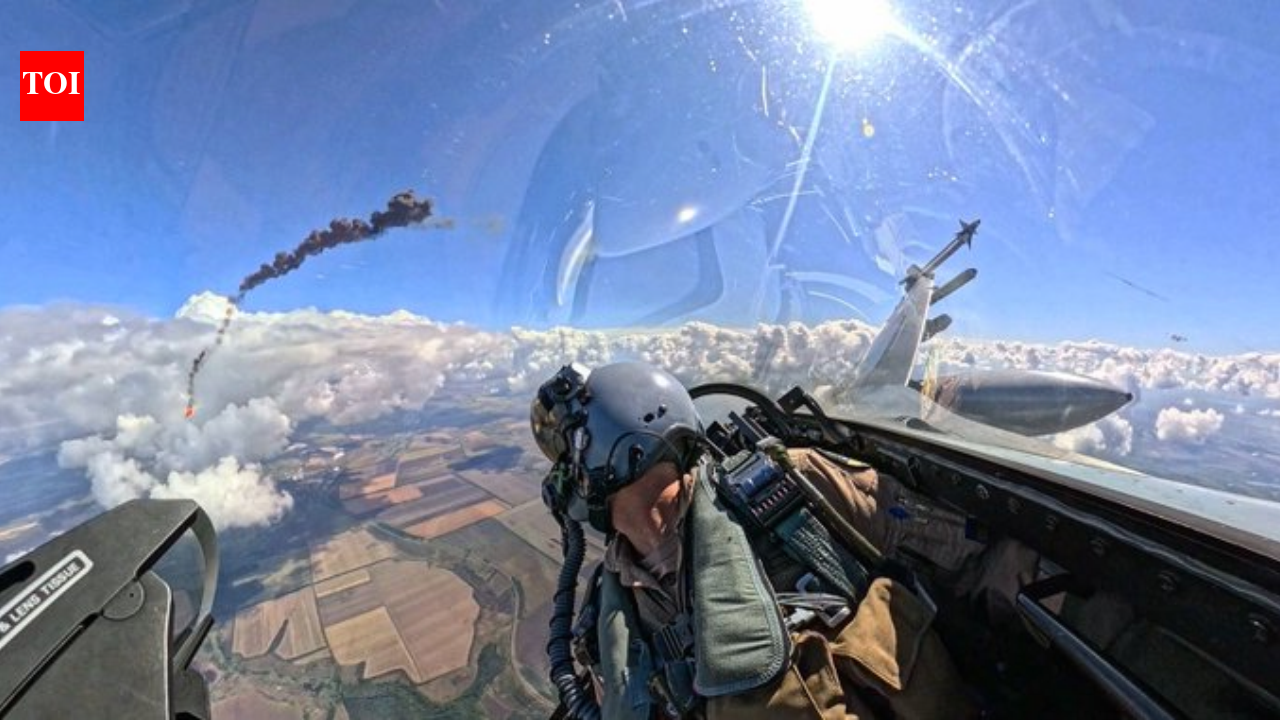
Russia’s jet-powered attack drones have emerged as one of the toughest challenges facing Ukraine’s air defences this year, flying faster and higher than the older propeller-driven Shahed-136s that have battered the country for years and proving far harder to intercept.The latest variant, the Geran-4, first surfaced last May. Unlike its predecessor, it was purpose-built for high-speed flight, as the older airframe could not withstand the stress of manoeuvring at such velocities. Its blended air intake and reinforced structure allow it to fly at altitudes of up to eight kilometres, twice as high as the drones it replaces, reaching speeds of 450 to 500 kilometres an hour and covering distances of over 700 kilometres.The engine powering it is Chinese-made, though some units are reportedly assembled inside Russia using Chinese components. Ukrainian intelligence estimates that Russia is now producing around 3,000 Geran-4 and Geran-5 drones a month.The newer Geran-5 goes further still, reportedly navigating using satellite reference imagery rather than GPS, making it far harder to jam. Ukraine has responded by using F-16 fighters to shoot the drones down with cannon fire, while also fielding purpose-built interceptor drones. President Volodymyr Zelenskyy told the UN General Assembly this week that four new jet-powered interceptors had already been tested successfully against the Russian threat.India, meanwhile, is building its own answer to this style of warfare. The Defence Research and Development Organisation’s Gas Turbine Research Establishment has successfully developed a 350-kg-class expendable turbojet engine, the kind used to power cruise missiles, target drones and, increasingly, jet-powered loitering munitions.The American Tomahawk, by comparison, uses a 400-kg-class engine for the same purpose. As warfare shifts increasingly towards non-contact strikes, this class of engine is becoming central to modern arsenals. The newly developed unit sits just below the 450-kg-class Small Turbofan Engine built for India’s Long-Range Land Attack Cruise Missile.The timing is notable, coming just a month after the Army ordered 106 jet-powered Agniveg loitering munitions from a domestic manufacturer. Designed to strike deep inside enemy territory with a circular error probable of under five metres, the Agniveg is built to be jam- and spoof-resistant. Its jet propulsion lets it fly at up to 450 kmph, more than double the speed of Shahed- or Geran-type drones.That speed makes it suited to hitting high-value targets, logistics hubs, fuel depots, command centres and radar sites, without risking manned platforms or relying solely on costlier cruise missiles.Manufacturing engines of this class demands exceptional precision and advanced metallurgy, a capability only a handful of countries possess. In India, GTRE works alongside production partner Azad Engineering, with private firms including DG Propulsion, Nabhdrishti Aerospace and Paninian Aerospace also entering the space.These efforts are steadily reducing India’s reliance on imports, even as the country continues working to solve its harder engine challenge: powering fighter aircraft.
