



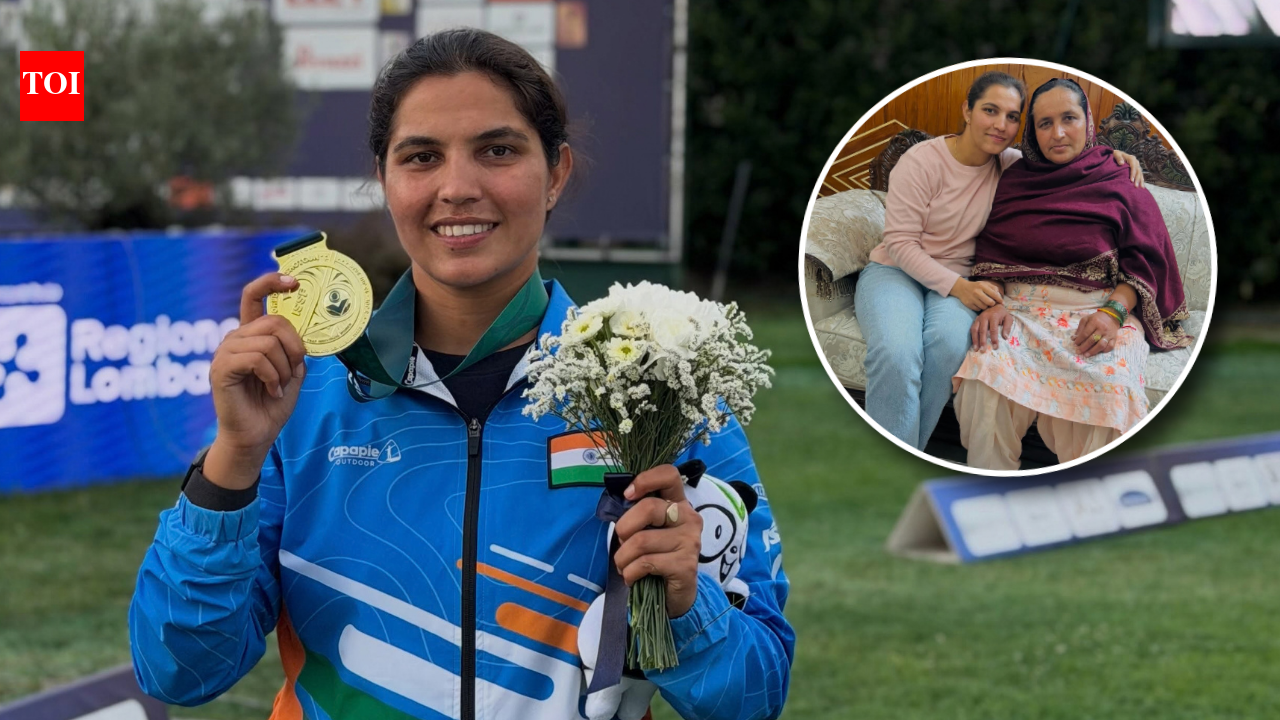
On Tuesday morning, Sudesh Devi was on her way to collect wheat under the Below Poverty Line (BPL) ration scheme in Sangatpura village in Haryana’s Jind district when she received the news that her daughter had just made history in Japan.“I was going to get the ration under the poverty line,” Sudesh told ANI, recalling the moment she learnt that Neeru Dhanda had won gold at the 2026 Asian Games.The contrast was stark. While her mother was making her way to a ration shop, Neeru was in Japan standing on the biggest podium of her career – and becoming the first Indian woman to win an individual Asian Games gold medal in trap shooting. She hit 28 of 30 targets in the final and set a new Asian Games record, finishing ahead of China’s Sun Yunong, who scored 26.For the family in Sangatpura, the medal was not simply the culmination of one competition. It was the outcome of years during which Neeru’s sporting ambition had often appeared difficult to afford.
Neeru Dhanda’s mother Sudesh Devi learnt about her daughter’s Asian Games gold while heading to collect BPL ration.
A dream that began after her cousin’s Asian Games medal
Neeru, 26, did not grow up with shooting as an obvious career path. Before taking up the sport, she played kabaddi at school and state level. Her interest in shooting grew after watching her cousin Lakshay Sheoran win a silver medal in men’s trap at the 2018 Asian Games.A year later, Neeru persuaded her family to let her try shooting. But the cost of the sport was a serious concern. “My husband owns two acres of farmland and some livestock. Neeru is the second eldest of three siblings and would play kabaddi at the school and state level. When Lakshay won the silver medal, she told us that she too wants to try her hand in shooting. But we could not afford a gun or the training expenses,” Sudesh told The Indian Express.Help came from within the extended family. Somveer Sheoran, Lakshay’s father and a former national wrestler, supported Neeru’s entry into the sport. In her early days, she trained with Lakshay’s gun and even practised shooting tin cans at a farmhouse.Her first lessons were far removed from the sophisticated shooting facilities in which she would eventually compete internationally. After proving that she could handle a gun, she moved towards formal training at the Madhya Pradesh State Shooting Academy in Bhopal, where she had access to structured coaching and equipment.Neeru herself has recalled how her uncle first took her to a pond and asked her to shoot at a small sheet of tin. “My uncle took me to a pond and asked me to shoot a small sheet of tin. I also told myself, ‘Let’s see what I can do.’ I passed that test,” she told TOI.
When the family could not afford the sport
Shooting is an equipment-intensive sport, and for the Dhanda family, paying for guns, ammunition and training was not easy. Reports from the family’s village describe Neeru’s father Suresh as a farmer and her mother as a homemaker. The family also relied on selling buffalo milk for income.Sudesh has spoken about how the family struggled to finance Neeru’s ambitions. Yet Neeru continued to pursue the sport.The support of her cousin’s family proved crucial in the early stages. She stayed with them while training in Delhi and initially used equipment made available through them. Eventually, her progress earned her a place in the formal shooting system and later in the Indian Army’s shooting programme.Today, Neeru is a Naib Subedar in the Corps of Military Police and trains with the Army Marksmanship Unit in Mhow. The Union sports ministry has also identified her as part of the Target Olympic Podium Scheme’s Development group.
Neeru Dhanda had returned to competition after an illness and weeks without regular training before her gold-winning performance.
From international breakthrough to Asian Games history
The journey was gradual rather than sudden. Neeru made her senior international debut in 2022. She won gold in women’s trap at the 2025 Asian Shooting Championships before taking an even bigger step in July 2026.At the ISSF World Cup in Lonato, Italy, she became the first Indian woman to win an individual World Cup gold in women’s trap. She finished the final with 27 hits and defeated former world champion Carole Cormenier of France. The ISSF records her Lonato victory as her maiden World Cup gold.The achievement also brought official recognition. The Ministry of Youth Affairs and Sports noted that Neeru had set a national record of 121 out of 125 in qualification at Lonato and had already won gold at the 2025 Asian Shooting Championships.But the Asian Games journey almost came to an abrupt halt before it began.
From hospital bed to the Asian Games podium
In the days before travelling to Japan, Neeru fell seriously ill. Reports said she spent three days in hospital and was unable to train for around three-and-a-half weeks. At one point during the illness, she reportedly survived for five days on a liquid diet.Her coach Mansher Singh continued encouraging her through the difficult period. Neeru eventually travelled to Japan, arriving with very little recent training behind her.The timing made her eventual performance even more striking. She topped the qualification round after a shoot-off and then entered the final in difficult rainy conditions.She missed only two of her 30 targets.With 28 hits, Neeru secured the gold and set a new Asian Games record. The victory also ended India’s wait for an individual trap gold at the Games: the previous Indian to win the event was Randhir Singh in 1978. Neeru became the first Indian woman to win the individual trap title.For Neeru, however, the medal was inseparable from the people who had stood by her when the dream seemed financially out of reach.“My father is a farmer and my mother is a housewife. My mother has contributed a lot to my life,” she told ANI, also crediting her paternal aunt Ajado Devi and coach Mansher Singh for shaping her career.
Neeru Dhanda scored 28 hits in the final to win the women’s trap shooting gold medal.
And after winning, she knew exactly where she wanted the medal to go. “I want to put this medal around my mother’s neck and my coach’s neck,” Neeru told TOI.That makes her mother’s moment at the ration shop all the more poignant. Sudesh had not watched the final on television – the family did not have one, and she did not have a smartphone to follow the competition. She was simply going about the morning’s work when a phone call told her that her daughter had become an Asian Games champion.For a family that once worried about how to pay for a gun and training, the medal represented a journey that had begun with borrowed equipment, family support and a daughter asking for the chance to try.Sudesh later recalled the belief Neeru had carried through those difficult years. “In the toughest of times, Neeru would tell me, ‘Ma, keep faith in me and ignore what the world says’,” she told TOI. On Tuesday, that faith had a gold medal to show for it.
