



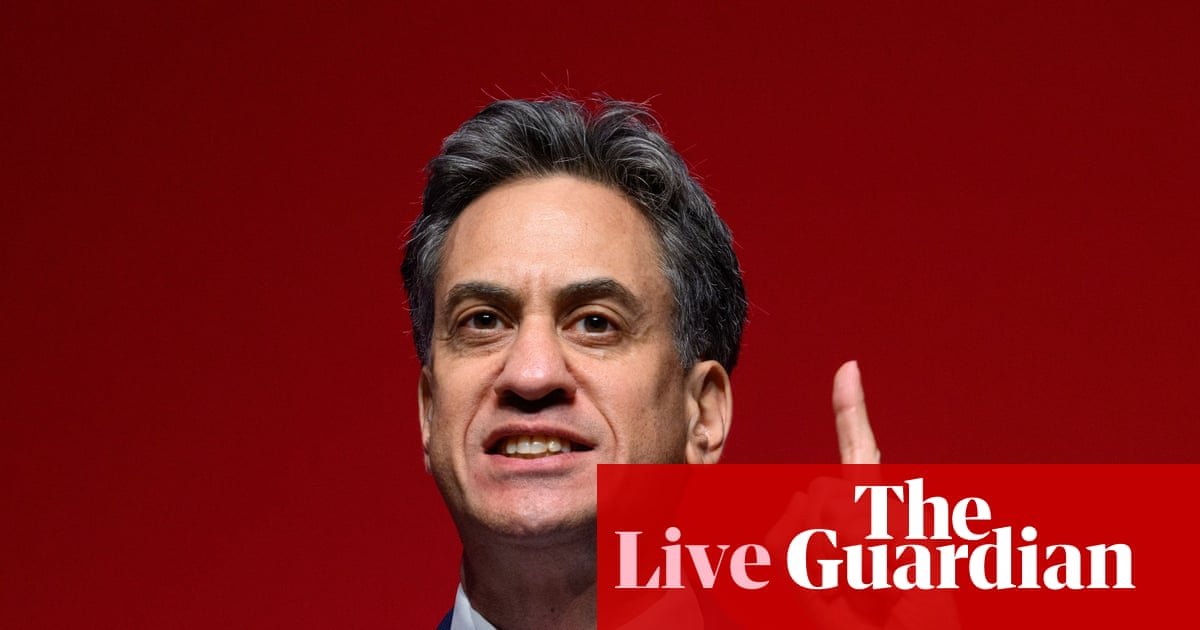
Campaigners claim Miliband saying Palestine Action ban not meant to criminalise ‘grannies’ will help legal challenge
Haroon Siddique
Haroon Siddique is the Guardian’s legal affairs correspondent.
Ed Miliband has said it was never anyone’s intent to criminalise “elderly people, vicars and grannies” who have been arrested for supporting Palestine Action.
Since Palestine Action became the first direct action group to be banned under the Terrorism Act in July last year, more than 3,700 people are believed to have been arrested for alleged support of the proscribed organisation. They include 82 arrested at a demonstration outside the Labour party conference on Sunday.
Later on Sunday, Miliband was challenged by two activists over the arrests while he was having a meal in Pizza Express in the city centre.
In an interview on LBC radio, Andrew Marr asked him about that encounter:
I can’t believe in your heart of hearts that you really think proscribing Palestine Action with all those elderly people and vicars and grannies and so on as a terrorist organisation was a sensible political …
Miliband interjected:
I don’t think anyone’s intent was to have those people criminalised. But obviously the supreme court has got to look at this issue and obviously it’s something we keep looking at as government.
On 4 and 5 November, the supreme court is due to hear a legal challenge to the ban on Palestine Action, arguing that it represents a disproportionate interference with the right to freedom of speech and freedom of protest.
A spokesperson for Defend Our Juries, which organised the civil disobedience campaign against the ban, said:
We welcome the foreign secretary’s honesty on this matter. He has finally admitted that it wasn’t the government’s intention to criminalise people for peacefully protesting against the genocide and the proscription, let alone to treat them as terrorists.
Basically he’s acknowledged that the government didn’t properly think the proscription through and that it’s had a disproportionate impact on the right to free speech. You’d think that leaves the government in an impossible position for defending the proscription before the supreme court.
We gladly accept the offer Ed Miliband made in Pizza Express to have a conversation with us.
Key events
Rayner started her speech with a thank you to Labour members who supported her after she had to resign last year.
The support I received from so many people here over the last year has meant so much to me personally. The Labour movement is a family to me, and that’s the thing about our movement. We are here not just for ourselves, but we’re here for each other. And you’ve been there for me and I’m here for you.
Rayner tells conference ‘it’s good to be back’
Angela Rayner, the housing secretary, is addressing the conference now.
She got a huge round of applause as she arrived, and she started with the words: “It’s good to be back.”
At last year’s conference she was out of government, having had to resign as deputy PM over a tax mistake.
East Midlands mayor Claire Ward says any ‘discomfort’ in devolving power will be worth it
Claire Ward, the East Midlands mayor, told the Labour conference that she and her fellow mayors were delighted to see Andy Burnham move from running Greater Manchester to being PM. In her speech, she said:
Labour mayors have just had an exceptionally busy summer. Because one of our former colleagues, you might know him, got a new job and he’s asked us to help him rewire the state so that his promise to create growth in every postcode and hope in every heart could be delivered.
And honestly the moment that Andy Burnham became our prime minister, well, it was like seeing the shop steward become the chief executive.
Ward sounded like someone who has taken on the role of shop steward herself. Rather than just talk about her region, she highlighted the work being done by all the Labour mayors. Here’s an extract
When power is in the right place it is easier to build a shared vision for how things could be. But more than that: it is easier to prioritise as your communities would prioritise. Tracy Brabin, mayor of West Yorkshire, she knows what this feels like.
She is building the Weaver Network, an integrated transport network with an ambition to bring trams into the fabric of the region by the late 2030s. And Tracy isn’t pushing for trams because central government has told her to , she is pushing for that because that is what her region needs and she will take risks to get it there.
And this is not just about hard infrastructure. Look at Kim McGuinness, mayor of the North East. As soon as she took office, she established a £29m child poverty reduction unit. Investment into childcare grants to parents trying to find work, investment into baby boxes across the north east, investment into a programme of grants to pregnant women in poverty. It is as important as any investment into hard infrastructure.
Or Oliver Coppard, mayor of South Yorkshire. And on the one hand, he is investing into the South Yorkshire People’s Network and on the other, he is setting up the Mayor’s Little Big Book Club – a new reading network for South Yorkshire.
Ward ended her speech by saying even if there was some “discomfort” in devolving power locally, it would be worth it.
I can’t promise you that power shifting to places will feel comfortable. I can’t promise you that it will happen at the same pace in all places.
But I can promise you that the discomfort means that we are heading in the right direction, because it means we are sharing these highest of stakes with the people we serve. It means we are accomplices in their success.
I’m glad to say comments are open below the line. They will be open until 4pm.
Former Irish PM Bertie Ahern says failing to resolve Drumcree crisis would be ‘disaster’ for Northern Ireland
Lisa O’Carroll
Lisa O’Carroll is a senior Guardian correspondent.
Bertie Ahern, the co-architect of the 1998 peace deal, has urged parties in Northern Ireland not to return to the “tribal past”.
His words chime with a call by Chris Bryant at Labour conference this morning. (See 10.27am.) Bryant said:
The situation in Drumcree is tense.
Nobody, nobody, nobody wants Northern Ireland to return to the 1990s. That’s not going be easy. As the last few days have shown, it’s really easy to stir up a grievance, much harder to calm it down.
Bryant will fly back to Belfast shortly, missing Andy Burnham’s speech, to attend urgent talks with parties in Northern Ireland over Drumcree, where a number of Orange Order members remain intent on a parade down nationalist Garvaghy Road.
Efforts are also underway to find an international mediator, Ireland’s foreign minister, Helen McEntee, said today.
The initial priority will be to break the deadlock but the medium term aim is to ensure Stormont, which is in danger of collapse, survives the crisis.
McEntee this morning said it was most likely an international mediator would be needed to break the Drumcree deadlock.
Ahern, a former taoiseach (Irish PM) told RTE it was “regrettable” if parties saw electoral capital in stirring sectarianism ahead of next May’s Stormont elections. He said:
If the parties believe, for an election in six or eight months time, there’s some short-term gain of winning a few votes based on going back to the tribal past, I would really caution against that.
They will regret that by the end of next year.
Ahern said if the Drumcree criss wasn’t solved quickly it would be “a disaster” for Northern Ireland and bringing Stormont down would serve no one.
Burnham warned that new GB Grid may need more funding for electricity grid upgrade
Greenpeace UK has given a qualified welcome to news that Andy Burnham will use his speech this afternoon to announce GB Grid, a government-backed body to invest in the electricity grid.
Doug Parr, Greenpeace’s policy director, said:
This is a welcome step to grapple with a problem that has plagued the green energy sector for years. Renewable energy providers urgently need an improved grid to get cheap, homegrown power flowing around the country. Greater public control to drive the transition to clean energy looks essential.
While public investment in the grid is good news, £4bn is not a game-changer when Ofgem estimates that upgrades will cost £70bn over the next five years.
Given the money will come from GB Energy’s existing budget, there’s also a risk it detracts from support for emerging technologies such as floating offshore wind and long term storage.
Burnham expected to say he will push ahead with electoral reform plans
Andy Burnham is expected to announce that he will push ahead with plans for electoral reform in his first conference speech as Labour leader, in the latest sign that he intends to radically transform the UK’s political system. Pippa Crerar has the story.
Here is the latest edition of the Guardian’s Politics Weekly UK podcast, featuring Pippa Crerar and Kiran Stacey interiewing Miatta Fahnbulleh, the energy secretary, at the Labour conference.
Bryant confirms he’s ‘ever so slighty homosexual’, in jibe at report calling him ‘colourful’
In his speech, Chris Bryant also joked about some of the coverage of his appointment as Northern Ireland secretary. He said one article had been headlined: “Will colourful Sir Chris Bryant shake up Stormont?”
Bryant went on:
I don’t know what they meant by colourful. Oh you can work it out can you? Just for the avoidance of doubt, I am ever so slightly homosexual.
Bryant seemed to be referring to this article in the Belfast Telegraph.
Northern Ireland has not always been one of the most enlightened parts of the UK when it comes to gay rights. The late Ian Paisley, the DUP leader who ended up first minister, once led a campaign to Save Ulster from Sodomy.
Bryant accuses Tories and Reform UK of putting Good Friday agreement at risk with ECHR withdrawal policies
In his speech Chris Bryant included a long passage thanking people who contributed to keeping the peace in Northern Ireland during the Troubles, including the leaders from all parties who worked to end the violence. This sort of leadership was needed in every generation, he said.
He went on:
It’s why I have this warning for Nigel Farage and Kemi Badenoch. They say they’ll bin the European convention on human rights. They’ve clearly never read the Good Friday agreement. Or maybe they don’t even care about it.
Conference, I promise you this. We will not dump the European convention on human rights. We will stand by it.
The Good Friday agreement is based on the assumption that the UK remains party to the ECHR. Reform UK and the Tories would not be able to go ahead with their plans to leave it without some sort of GFA renegotiation – which potentially might be very problematic.
Chris Byrant urges both sides in Drumcree dispute to ‘double down on compromise’
Chris Bryant, the Northern Ireland secretary, has addressed the Labour conference. He started by saying:
I had wanted to stand up here and boast about the news that Northern Ireland has the fastest economic growth of anywhere in the UK, and the lowest unemployment.
I wanted to shout out that Northern Ireland is being transformed. A thousand new jobs at Bank of America, we’re building drones for Ukraine, wings for Airbus and 30% of the world’s commercial aircraft seats.
We excel at cyber, AI, life sciences, music and film and high-end television.
We produce a fifth of the UK’s eggs and a 10th of all our food, and we’re open to business like nowhere else on earth, with unique dual access to two enormous markets, the UK and the European Union.
Our potential is enormous. We just need to harness it.
But instead he had to talk about the crisis at Drumcree, he said.
He said that the government would “always go the extra mile for peace” and that he would be in Northern Ireland this afternoon doing that. He urged both sides in the dispute to “double down on compromise”.
