



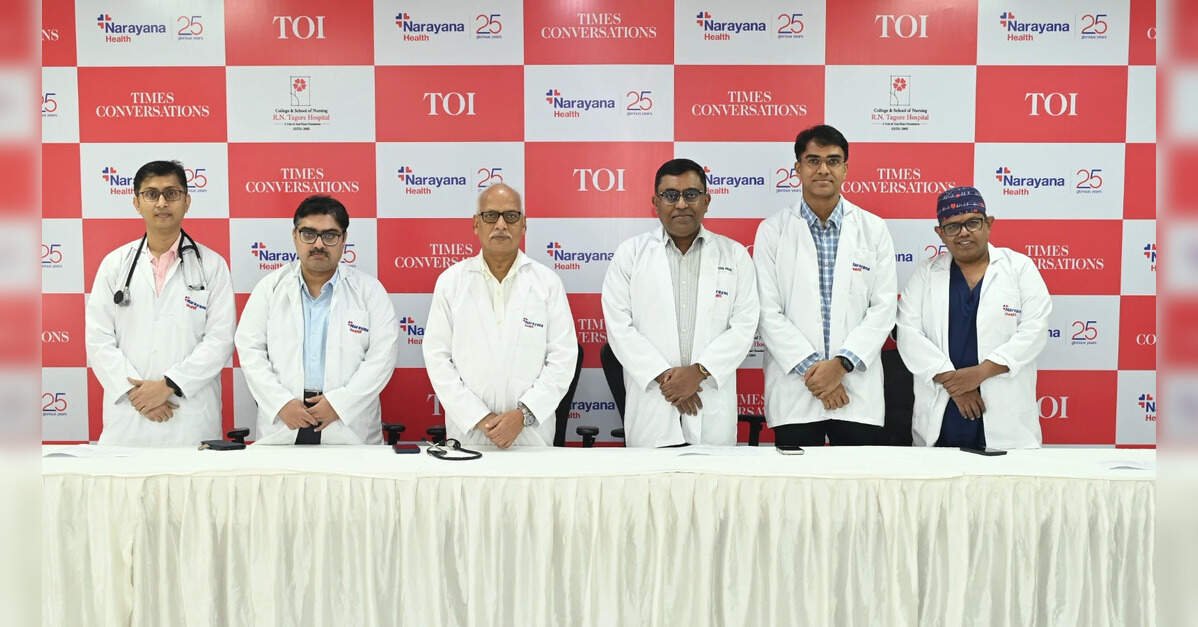
Leading cardiologists and cardiac surgeons discuss how prevention, early diagnosis and technological advancement are transforming outcomes for patients in the latest edition of Times Conversations.
The heart is one of the most vital organs of the human body. While heart disease remains a serious and potentially life-limiting condition, advances in diagnosis and treatment have significantly improved outcomes. To mark World Heart Day, which is celebrated on September 29, The Times of India, in association with Narayana Health, Kolkata—Narayana RN Tagore Hospital, Mukundapur; Narayana Hospital, Howrah; Narayana Hospital, Chunavati; Narayana Hospital, Barasat—organised a special edition of Times Conversations on heart health to spread awareness about the latest developments in cardiac care.
The panel featured leading specialists from Narayana Health, Kolkata—Mukundapur, Howrah, Chunavati and Barasat—Dr Atanu Saha, senior consultant-Cardiac Surgery; Dr Ayan Kar, consultant-Interventional Cardiology & Transplant; Dr Bijay Prakash Pandey, HOD & senior consultant-Cardiology; Dr Debabrata Bera, senior consultant-Cardiac Electrophysiology and clinical lead-East for the Cardiac EP Programme; Dr Debasis Das, HOD & senior consultant-Paediatric & Congenital Heart Surgery and Adult Cardiac Surgery and Dr Sunandan Sikdar, senior consultant-Interventional Cardiology.
Collaborative Care & Innovation
Talking about the evolving landscape of modern cardiac care and specialised treatment strategies, Dr Debasis Das said that the future of structural heart disease management lies in a balanced approach that combines advanced transcatheter technologies with traditional cardiac surgery.
“Structural heart disease primarily involves conditions affecting the heart valves and other non-coronary structures, many of which have historically required major surgical procedures. However, rapid advances in transcatheter interventions have opened new treatment options, particularly for patients who may not be suitable candidates for extensive surgery due to age, frailty, or associated medical conditions,” he stated.
Dr Das emphasised that transcatheter and surgical approaches should not be viewed as competing technologies but as complementary tools. The key is selecting the right treatment for the right patient through a “heart team” approach that brings together interventional cardiologists, cardiac surgeons, and other specialists to tailor care according to individual needs.
He also highlighted the growing challenge of managing adults with congenital heart disease. “Thanks to improvements in diagnosis and treatment over the last two to three decades, a large and expanding population of patients with congenital heart defects is now surviving well into adulthood. These individuals often have complex medical histories, including previous surgeries, interventions, or untreated conditions accompanied by multiple comorbidities. Caring for such patients requires a specially trained workforce, combining expertise in paediatric cardiology and cardiac surgery, to address their unique and evolving healthcare needs,” he opined.
Early Detection and Prevention
Highlighting the importance of timely diagnosis, Dr Bijay Prakash Pandey stressed that an ECG remains one of the simplest and most effective tools for detecting a heart attack. “Anyone experiencing chest pain or shortness of breath should undergo an ECG as early as possible, as prompt diagnosis can significantly improve outcomes. However, access remains a challenge in many rural parts of India, where patients may need to travel long distances to reach a healthcare facility,” he said. Dr Pandey believes expanding ECG services in underserved areas should be a priority to enable earlier intervention.
He also underscored the importance of reperfusion therapy, which restores blood flow in blocked arteries during a heart attack. In resource-limited settings, rapid administration of clot-dissolving medication at primary health centres or district hospitals can be lifesaving. “The sooner the treatment, the better the outcome,” he noted.
According to Dr Pandey, prevention begins with regular health screening and controlling major cardiovascular risk factors such as high blood pressure, elevated LDL cholesterol and diabetes. Early diagnosis, followed by appropriate treatment, lifestyle modifications and medication when necessary, can substantially lower the risk of heart attacks. He emphasised that routine screening programmes supported by governments and social organisations are essential to identify at-risk individuals early and reduce the overall burden of cardiovascular disease.
Heart Failure Is No Longer a Dead End
Heart failure has long been viewed as a terminal diagnosis, but advances in treatment are dramatically changing that outlook, according to Dr Ayan Kar. “Today, patients have access to a wide range of therapies, including medications, devices and interventional procedures that can significantly improve both survival and quality of life,” he informed.
Dr Kar stressed, however, that timing is critical. “Heart failure is treatable if patients seek care early,” he said. Prompt diagnosis allows doctors to identify the underlying cause and begin aggressive treatment before irreversible damage occurs. With timely intervention, left ventricular (LV) recovery rates can reach 30 to 60 per cent in many patients.
For those with advanced heart failure who continue to experience severe symptoms despite optimal medical and device therapy, more specialised options are available. “These patients are often unable to carry out daily activities and may require end-stage treatments such as heart transplantation or mechanical circulatory support,” he shared.
Modern heart failure programmes now offer comprehensive care that includes ventricular assist devices (VADs), cardiac transplantation and advanced electrophysiological services. Such innovations have transformed the treatment landscape for patients who were once considered beyond help.
“The message is simple,” Dr Kar emphasised. “Heart failure is no longer synonymous with a fatal diagnosis. With early treatment and access to advanced therapies, many patients can lead longer, healthier and more productive lives.”
Heart Attack vs Cardiac Arrest
Many people use the terms heart attack and cardiac arrest interchangeably, but according to senior cardiologist Dr Sunandan Sikdar, they are two very different medical emergencies. “A heart attack occurs when a blood clot blocks a coronary artery, restricting blood flow to the heart muscle. Cardiac arrest, on the other hand, is a sudden collapse of the body’s circulation, usually caused by an abnormal heart rhythm that makes the heart beat too slowly or too rapidly. While a heart attack is primarily a blockage problem, cardiac arrest can lead to sudden death if immediate treatment is not provided,” explained Dr Sikdar.
India faces a unique challenge, with heart attacks occurring nearly a decade earlier than in Western countries, with nearly one in four cases now occurring in individuals under the age of 45.
“Lifestyle factors such as smoking, substance abuse, diabetes, hypertension, and even air pollution increase the risk among young adults. Genetic conditions can also trigger sudden cardiac arrest, sometimes causing seemingly healthy individuals to collapse during strenuous exercise,” he pointed out.
Dr Sikdar advised young people to undergo basic cardiac screening, including an ECG and echocardiogram, before starting intensive gym workouts. Moderate exercise, rather than excessive exertion, is recommended. He emphasises that preventing heart attacks also reduces the risk of future cardiac arrest. Prompt treatment, particularly primary angioplasty performed soon after a heart attack, can restore blood flow and significantly lower the chances of sudden cardiac complications.
Prevention and Innovation
Cardiovascular disease (CVD) remains one of the leading health challenges today, but according to Dr Atanu Saha, many heart conditions can be prevented through awareness and lifestyle modification. He emphasised, “Prevention begins with understanding personal risk factors, including family history of heart disease, hypertension, high cholesterol, diabetes, obesity, and addictions such as tobacco use. These are largely preventable and modifiable risks that individuals can address through informed lifestyle choices.”
He highlighted the crucial role healthcare professionals and the media play in spreading accurate health information. “In an age of round-the-clock social media and internet access, responsible communication can encourage people to maintain a healthy body weight, exercise regularly, avoid harmful habits, and keep blood sugar and cholesterol levels under control,” he opined.
On the treatment front, cardiac surgery has undergone a remarkable transformation over the past few decades. “Minimally invasive procedures have largely replaced traditional open-heart surgeries that required large chest incisions. Robotic-assisted technology now enables surgeons to perform complex procedures with greater precision, resulting in less trauma, faster recovery, and an earlier return to normal life,” averred Dr Saha. He also pointed to advances in aortic surgery, including the sophisticated frozen trunk procedure, which allows comprehensive repair and replacement of the aorta when required.
Revolutionising Heart Rhythm Care
Cardiac arrhythmias, or disorders of the heart’s electrical system, can cause symptoms ranging from palpitations to fainting spells and, in some cases, life-threatening complications. According to Dr Debabrata Bera, “Electrophysiology (EP) is a specialised field of cardiology dedicated to diagnosing and treating these electrical abnormalities. While non-invasive tests such as ECGs and Holter monitoring provide valuable insights, EP studies offer a more detailed assessment by using catheters inserted through the groin to identify abnormal electrical pathways within the heart.”
Patients suffering from conditions such as supraventricular tachycardia (SVT) often benefit from radiofrequency (RF) ablation, a minimally invasive procedure in which heat energy is delivered through a catheter to destroy the tiny area of tissue responsible for the abnormal rhythm.
“More complex arrhythmias, including ventricular tachycardia, can be treated using sophisticated 3D mapping systems that help physicians precisely locate and eliminate abnormal electrical signals,” he shared.
Dr Bera also highlighted Pulse Field Ablation (PFA), a cutting-edge technology increasingly used for atrial fibrillation. Unlike conventional thermal ablation, PFA uses short, high-intensity electrical pulses to selectively target abnormal tissue, offering a faster and potentially safer alternative. He further pointed to the growing use of leadless pacemakers, tiny capsule-like devices implanted through a catheter, which eliminate wires, reduce infection risks, and provide long-lasting heart rhythm support. These pacemakers have almost 20 years battery longevity. When the battery runs out, doctors can place a new capsule in the heart.
Disclaimer: The above content is non-editorial, and TIL hereby disclaims any and all warranties, expressed or implied, relating to it, and does not guarantee, vouch for or necessarily endorse any of the content.
