



Artificial Intelligence is rapidly transforming healthcare across the world, and India is emerging as a significant force in shaping what comes next. From enhancing clinical decision-making and improving productivity to expanding access to care and enabling earlier interventions, AI is helping healthcare providers reimagine how healthcare can be delivered at scale.
The shift is already underway. According to the Philips Future Health Index (FHI) 2026 India Report, more than seven in ten healthcare professionals in India report that AI has increased their capacity to see more patients, while 82% also cite improvements in workflow efficiency and access to critical clinical information. Increasingly, healthcare leaders view AI not as a future possibility, but as a practical tool that is already helping address real healthcare challenges.
What is particularly exciting is that India is not only adopting healthcare AI increasingly, it is helping build it.
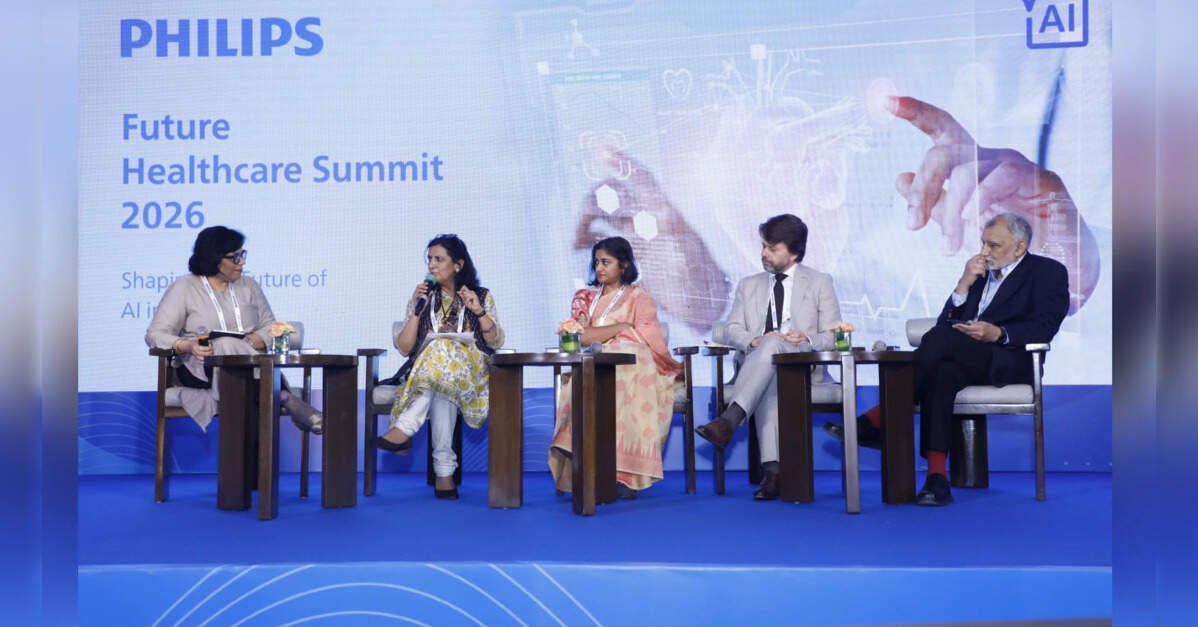
This shared focus was also reflected at the Philips Future Healthcare Summit 2026, hosted in association with ETHealthWorld, where healthcare leaders, clinicians, policymakers and technology experts came together to explore how AI can move from promise to meaningful impact. Conversations focused on the need to pair innovation with trust, responsible deployment, stronger digital infrastructure and collaboration, so that AI can help deliver better care for more people, at scale.
At the summit, Özlem Fidanci, Chief of International Region, Royal Philips, reflected on the Future Health Index 2026 India Report and what it will take to move AI from pilot to scale. She also highlighted that the opportunity lies not only in technology, but also in earning trust, enabling clinicians, strengthening healthcare delivery and bringing better care to more people.
At Philips, India has evolved into one of the most important global innovation hubs, contributing to the development of technologies that improve diagnosis, automate workflows, support clinicians and expand access to care. Today, innovations conceived and developed by teams in India are helping shape healthcare delivery across the world.
Two pillars of this ecosystem are Philips Innovation Campus (PIC) in Bengaluru and the Healthcare Innovation Centre (HIC) in Pune. Together, these teams are helping create solutions that address some of healthcare’s most important priorities: improving productivity, expanding access, enhancing clinical confidence and delivering better patient outcomes.
Creating Capacity for a Growing Healthcare System
Across healthcare systems, one of the most pressing challenges is balancing growing patient demand with limited clinical capacity.
Innovations such as Philips SmartSpeed are helping address this challenge by using AI to accelerate MRI scans while maintaining high image quality. SmartSpeed enables MRI scans up to 3 times faster, while maintaining image quality, helping improve workflow efficiency and productivity.
“Any AI application has to be embedded into the clinical workflow. It should not be a separate process, but rather part of the workflow, so that it is not cumbersome for the doctor to use. Healthcare AI is not a monolithic entity, but a series of applications. The key is to identify where the greatest challenges lie and deploy AI where it is needed most to address specific pain points. That is when you see maximum benefit.”, shared Dr. P. M. Uthappa, Group Chief Medical Director, Narayana Health, at the Philips Future Healthcare Summit 2026.
Supporting Better Clinical Decision-Making
Healthcare professionals today must navigate increasing volumes of clinical information while making timely decisions.
The Future Health Index findings show that nearly 80% of healthcare professionals report improved access to consolidated patient data through AI-enabled solutions. These findings reinforce the growing role AI can play as an enabler for healthcare professionals, helping them access relevant insights and make timely, informed clinical decisions.
Solutions such as Advance Visualization are designed with this objective in mind. By integrating advanced AI capabilities into clinical workflows, the platform helps clinicians access insights more efficiently, streamline analysis and enhance diagnostic confidence.
For Philips, the goal is to automate processes and help clinicians spend more time delivering care.
Extending Quality Care Beyond Traditional Healthcare Settings
One of the greatest opportunities for AI lies in improving access to quality healthcare.
The FHI 2026 India Report found strong optimism among healthcare professionals regarding AI’s ability to improve access to care and help bridge quality gaps across healthcare settings. This is particularly important in a country where healthcare needs continue to grow, and specialist expertise is not always evenly distributed.
As healthcare systems look to improve access and equity, AI-enabled solutions can help frontline healthcare workers make more informed decisions, support earlier identification of health risks and extend the reach of clinical expertise to underserved communities. This creates opportunities to improve outcomes while making healthcare delivery more inclusive and accessible.
Innovated in India for the World
What makes India uniquely positioned to shape the future of healthcare innovation is the convergence of world-class engineering talent, growing AI expertise, supportive policy environment, strong clinical partnerships and the ability to deploy solutions at scale.
“AI adoption in healthcare in India, particularly at scale, is very important as it opens significant opportunities for better health outcomes. It is also associated with risks, and therefore the policy for adoption of AI in healthcare is based on responsible and trustworthy deployment at scale. Through the Ayushman Bharat Digital Mission, we have tried to create a national-level digital health ecosystem through registries of patients, health facilities and healthcare professionals. That is the foundation we have created, on which both public and private sector health facilities, healthcare providers, medical device manufacturers and
service providers can work together.”, said Dr. Sunil Kumar Barnwal, IAS, Chief Executive Officer, National Health Authority, Government of India, at the Future Healthcare Summit 2026.
Initiatives such as the Ayushman Bharat Digital Mission are creating interoperable digital health infrastructure, while frameworks such as the Strategy for Artificial Intelligence in Healthcare for India (SAHI) and BODH represent important steps towards enabling responsible innovation. By providing guidance on governance, validation, safety and adoption, these initiatives are helping build trust in AI-enabled healthcare solutions while creating a supportive environment for innovation to scale. This balanced approach to innovation and regulation will be critical as healthcare systems increasingly integrate AI into routine care delivery.
Translating these frameworks into meaningful impact will require AI to work for clinicians and patients, while operating within a connected, trusted and secure healthcare ecosystem.
“AI should be adopted as an enabler of healthcare delivery. For clinicians to embrace it, it has to be embedded into the clinical workflow, whether through supporting patient management, reducing unnecessary paperwork, or giving them more time for meaningful patient interaction. From a patient perspective, it is equally important to maintain trust in the clinician and understand that AI is a powerful enabler of meaningful care. A common platform that enables interoperability and secure data exchange across both public and private healthcare systems is key. Government initiatives such as SAHI and BODH are important steps in this direction. As we advance, maintaining data integrity and protecting patient privacy must remain fundamental”, said Dr. Bishnu Panigrahi, M.D. Group Head, Medical Strategy & Operations Group, at the Philips Future Healthcare Summit 2026.
For Philips, India’s story is about innovation leadership — advancing technology, building digital capabilities, strengthening talent and translating innovation into meaningful outcomes for patients and healthcare professionals. A collaborative focus is essential in unlocking AI’s full potential.
India has a critical role to play in shaping the future of healthcare innovation, as a nation where innovation is adopted and where technologies are designed, developed, manufactured and scaled for global impact
Disclaimer: The above content is non-editorial, and TIL hereby disclaims any and all warranties, expressed or implied, relating to it, and does not guarantee, vouch for or necessarily endorse any of the content.
