



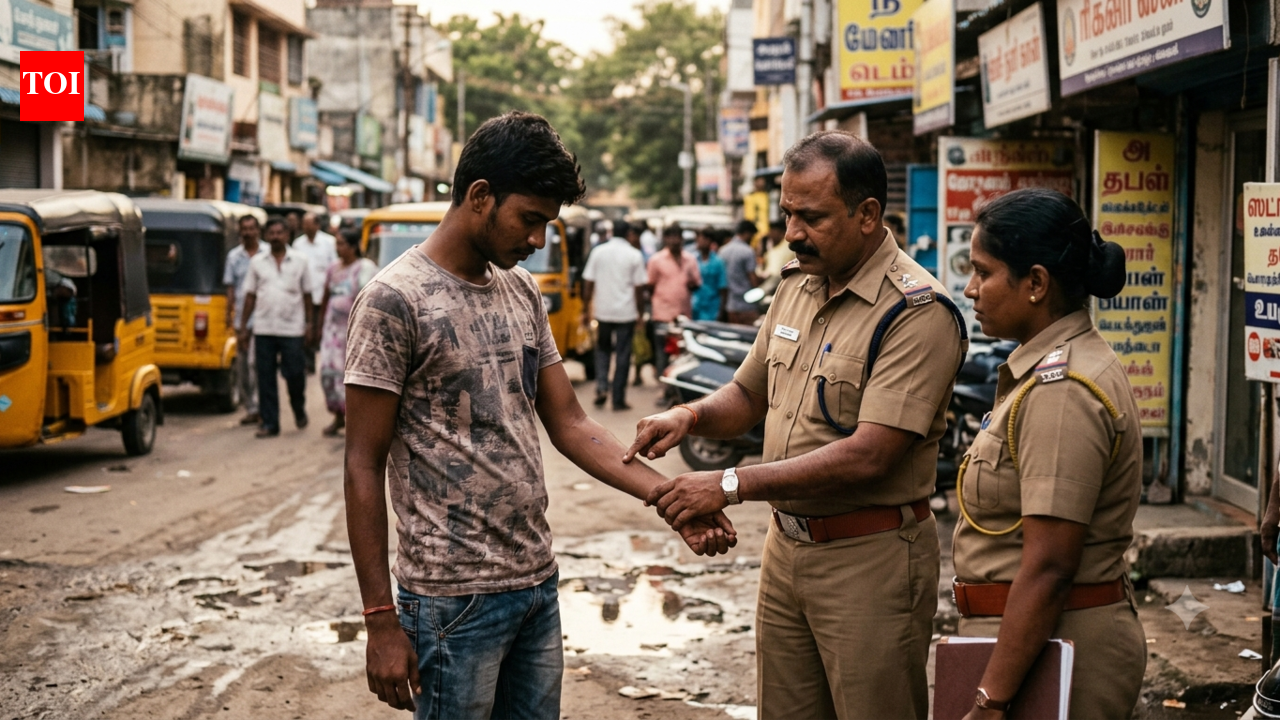
A series of tiny injection marks on youngsters’ wrists and arms has become a tell-tale sign for police chasing the city’s growing prescription-drug menace. Three suspected overdose deaths in the city recently have turned the spotlight on the misuse of prescription drugs such as Tapentadol and Nitrazepam, with some of these tablets popularly referred to as “Dol” among users.Enforcement Bureau-CID (EB-CID) seized 9.86 lakh tablets across Tamil Nadu till Aug this year, nearly 12 times the volume seized during the same period last year. Even so, officers say the law has not kept pace with changing patterns of abuse.At the centre of the enforcement challenge is Tapentadol, an opioid painkiller. Unlike Nitrazepam, a benzodiazepine covered under the Narcotic Drugs and Psychotropic Substances (NDPS) Act, Tapentadol is a prescription drug not scheduled as a narcotic drug or psychotropic substance under the Act. So, its possession or trafficking does not automatically attract stringent NDPS provisions. Violations involving its illegal sale are primarily dealt with under drug-control laws, creating enforcement hurdles for police.Meanwhile, the supply chain adapts continuously. Initially, dealers procured tablets through online platforms. After the police issued summons to some portals, they stopped listing the products. The trade then went underground.An officer attached to the Anti-Narcotics Intelligence Unit said some dealers identify customers placing bulk orders for other medicines online and later contact them to negotiate separate deals for prescription tablets, leaving fewer digital trails.Consignments arrive mainly by train from Pune, Hyderabad, Bengaluru, and Haryana. Police said couriers use Perambur, Arakkonam and Renigunta as drop-off points. Chennai Central also figured in investigations as a transit point. Some of them also use courier firms.Police said a carton of 100 tablets costing ₹900 through legitimate channels fetches about ₹4,500 in the illegal market. At the street level, individual tablets fetch ₹300, potentially taking a carton’s value to ₹30,000.What worries sleuths more is the way the tablets are consumed. Some crush or dissolve the pills and inject the solution directly into their veins for a quick high. Some use saline water, while others use tap water, adding another layer of health risk.Tapentadol, particularly when misused, can dangerously slow down breathing. “Tablets contain binders and fillers that may not dissolve in water. When injected, these particles can lodge in tiny blood vessels in the lungs, causing inflammation and scarring and, in severe cases, can prove fatal,” said Dr S Chandrasekar, head of the department of medicine, Stanley Medical College and Hospital.During checks, police look for injection marks on the arms of suspected users. Such marks have helped investigators identify users and work backwards through the supply chain to reach street-level peddlers and larger suppliers.Police officers have sought a stronger legal framework to tackle the issue. “The sharp increase in seizures reflects stricter enforcement. At the same time, our focus has moved beyond seizures to the entire supply chain, from major suppliers and wholesalers to financiers, transporters, distributors and those providing storage facilities,” said EB-CID ADGP K Shankar.
