



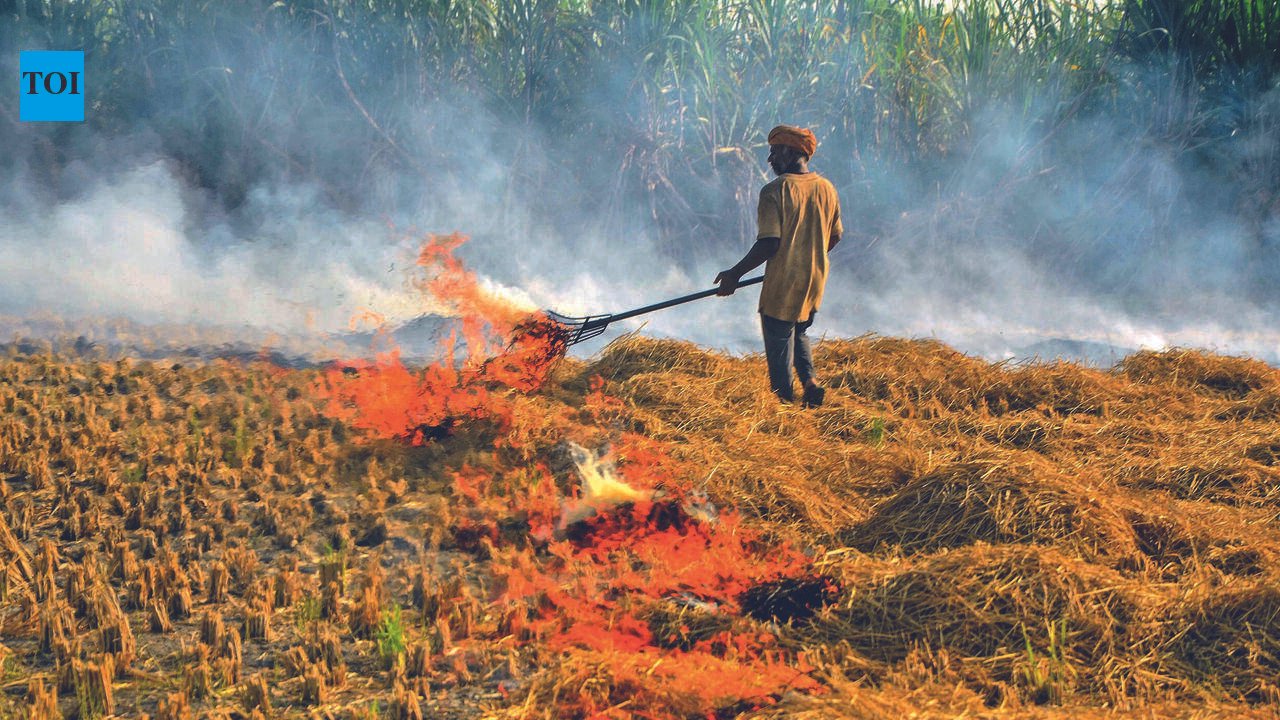
Gurgaon: Village-level air-quality monitoring will be added to the surveillance of farm fires this paddy harvesting season. Haryana govt is set to install low-cost PM2.5 sensors in villages identified as stubble-burning hotspots.The state govt has identified 148 villages as red- and yellow-zone hotspots based on their farm-fire record in 2025. Three villages are in the red zone, having recorded six or more active fire location events, while 145 are in the yellow zone, with two to five such events. Haryana recorded 662 farm-fire events in 2025, against 1,406 in 2024, according to Indian Council of Agricultural Research data cited in the state’s action plan.Alongside the sensors, Haryana plans to use about 50 drones in hotspot areas, with locations to be identified by district administrations. The drones will provide an additional surveillance mechanism during the harvesting season.The sensors are part of a wider strategy being drawn up by the state to track the impact of crop-residue burning more closely. The plan also includes ground verification of burnt areas through an ISRO-developed mobile application and additional surveillance of hotspot areas.The state govt is seeking to track not only where stubble is being burnt but also the pollution impact in areas where repeated fires have been recorded. The proposed PM2.5 sensors would add a local air-quality layer to the existing satellite-based fire monitoring system. HARSAC’s active fire location alerts are currently shared with field officials through SMS and WhatsApp, who are tasked with verification and enforcement.Officials from Haryana agriculture department said, “The focus on PM2.5 is significant because a fire alert establishes that burning has occurred, while air-quality measurements can show the pollution levels in the affected area. The village-level data could therefore provide a more direct picture of the local pollution burden associated with repeated farm fires.”“The state is also strengthening ground verification. Its action plan provides for flying squads at the sub-divisional level and teams at block and village levels for field monitoring,” said Girish Nagpal, an official and agriculture officer. Nodal officers have been tasked with ensuring action in cases of stubble burning identified through the ISRO protocol.The state has also appointed village-level nodal officers for monitoring. Farms in identified villages are to be mapped according to the proposed method of residue management, including in-situ management, ex-situ management, crop diversification and use as fodder.A dedicated parali protection force is being constituted at district and block levels, while state and district control rooms will coordinate monitoring and action. The surveillance push is being accompanied by efforts to increase the amount of paddy straw that can be absorbed by industries.According to chief secretary Anurag Rastogi, Haryana achieved 5.89% biomass co-firing in thermal power plants up to Aug 2026, crossing the 5% benchmark. In brick kilns in non-NCR Haryana, biomass co-firing has reached 21.9%, and the state has proposed increasing this to 30% from Nov 1.The figures indicate that the state is seeking to create additional demand for paddy residue beyond farm-level management, particularly through power generation and brick kilns. The state’s broader crop-residue plan includes pellet and briquette plants, biomass power plants, compressed biogas plants, industrial boilers and furnaces and co-combustion facilities.The technology-based monitoring will feed into the state’s enforcement system. Verified stubble-burning cases can attract environmental compensation of Rs 5,000 for fires involving less than two acres, Rs 10,000 for two to five acres and Rs 30,000 for more than five acres. FIRs and red entries in farm records are also provided for under the action plan.
