



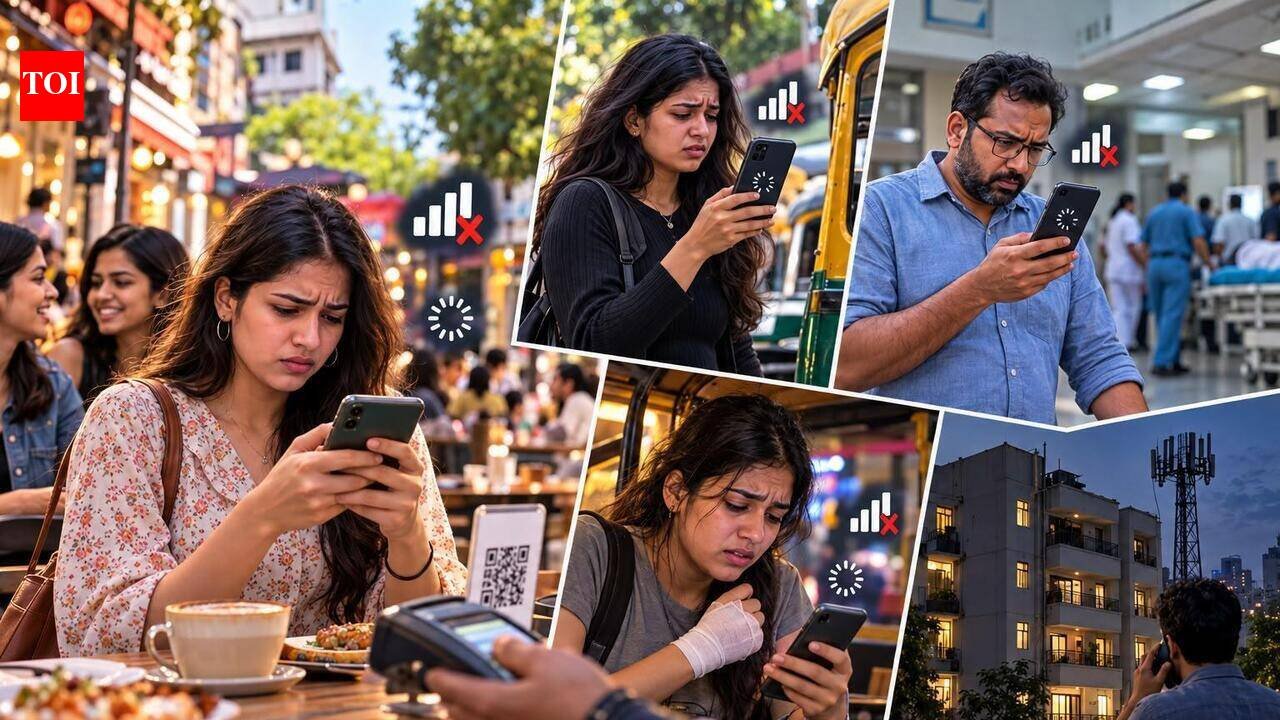
New Delhi: Shalini Sharma (31) is heading out with her friends to southeast Delhi’s Amar Colony market. The weather is pleasant, battery fully charged, with a 5G icon reassuring her.But as they hop from one cafe to another, trying out new food spots, a familiar frustration ruins the experience: the “5G” data isn’t what is promised.Despite her phone showing healthy network bars, every attempt to make a quick payment turns into a test of patience. The screen buffers, making a routine task agonisingly slow.Shalini’s experience isn’t an isolated glitch. It is a daily reality for hundreds of people navigating the dead zones in one of Delhi’s most popular markets.This is the digital infrastructure paradox that every Delhiite encounters daily. On paper, the 5G rollout is robust, but the ground reality paints a different picture.While Delhi has crores of 5G users, TOI observed that actual connectivity remains patchy and frequently lags across the city.The problem isn’t limited to crowded markets. It penetrates deep into residential blocks, basements and corporate buildings.Hridya Pathak (27), a resident of south Delhi’s Chhatarpur Phase-2, faces a similar connectivity ordeal during her daily commute. Inside her home, the 5G signal drops to a slow LTE+ connection, making calls or texts difficult without Wi-Fi.“I had to step out into the street just to book a cab because of the weak signal,” she said.“Once, while booking a cab, the connection was so weak that the driver had to drive around 2km away from my pickup point just to find a stable signal to enter the OTP.” For 15 minutes Hridya was completely off the grid in the middle of the city. “I couldn’t share my location, make calls, or be reached, which made me feel very unsafe,” she said.Some of the capital’s hospitals have the worst connectivity.When Saurabh Kumar (42) visited a hospital near Dilshad Garden for a friend’s medical emergency, the bad indoor network was what came in the way of caregiving.“I wanted to contact his family but couldn’t,” Ramesh said. “Even a simple UPI transaction took 7 to 10 minutes to process, forcing me to look for an ATM to pay in cash. I frequently had to leave my friend alone in the hospital and step out of the building just to make a phone call to his family.”For 21-year-old law student Suravi, bad connectivity was the last thing she needed when rushing to a hospital with a dog bite. “Around 7 pm, while heading to a hospital, with my hand throbbing in pain, I faced another problem: poor network. The auto driver handed me the scanner for payment, but the transaction would not process. Despite repeated attempts, nothing worked,” she said. She had to call a friend to make the payment, adding another 10-15 minutes to the painful situation.In a report titled “Recommendations on Ratings of Buildings or Areas For Digital Connectivity” released in 2023, Telecom Regulatory Authority of India (TRAI) has stated that users of residential buildings, offices or public places are forced to live with poor or compromised connectivity due to the non-availability or lack of upgrade by the infrastructure and telecom service providers (TSPs).The report also talked about how, in many govt and private multi-storey residential complexes, infrastructure upgrade has stalled because the RWAs are demanding higher costs or because contractual disputes between the RWAs and telecom service providers remain unresolved. In all these cases, TRAI said, “the ultimate sufferers are the end users.”TRAI recently released its independent drive test (IDT) findings for the Delhi licensed service area (LSA), conducted in Jan 2026. The tests were done across 249.1 km as a drive test, 8 hotspot locations and 9.6 km as a walk test, which included Airtel, MTNL, Jio and Vodafone Idea.In Call Setup Success rate, MTNL was in the last spot with 82.8%, while other telecom operators were close to 100%. This metric measures the percentage of call attempts that successfully connect to a dialled number.MTNL performed the worst with 6.3% drop call rate. MTNL didn’t respond to queries sent by TOI.For the call silence/mute rate, which measures silence in the calls because of lost data packets, VI was in the last spot with 6.6% mute rate.To cope with poor network reception, many residents have to rely on Wi-Fi calling. In a residential building in Sant Nagar, East of Kailash, every flat has its own Wi-Fi router because mobile signals disappear inside the building.“Having to pay for a Wi-Fi connection in addition to a regular voice and data plan is an unnecessary expense every month,” said a resident. He added that during power outages, when Wi-Fi services are disrupted, residents have to step outside the building to make calls.When asked about weak signals inside homes and buildings, an internet service provider (ISP) official said the problem is particularly bad in densely populated urban areas, where RWAs often do not allow service providers to install network towers, citing lack of space. Even when towers are installed outside residential areas, connectivity can vary within a society. One side of a residential complex may receive better network coverage than the other.The official added that users who want better 5G connectivity in crowded areas can also use ‘network slicing’. This allows certain users to be allocated a dedicated network slice, potentially providing more consistent and better network performance.However, Sanket Kaushal (32), a South Ex resident and user of network slicing technology, said he faces the same connectivity issues as users on regular networks. “I frequently face problems while making video or WhatsApp calls. The network often becomes weak, causing calls to either fail to connect or show a ‘poor network’ message. At times, I am unable to make a stable call even after repeated attempts using mobile data, forcing me to switch to Wi-Fi,” he said.
