



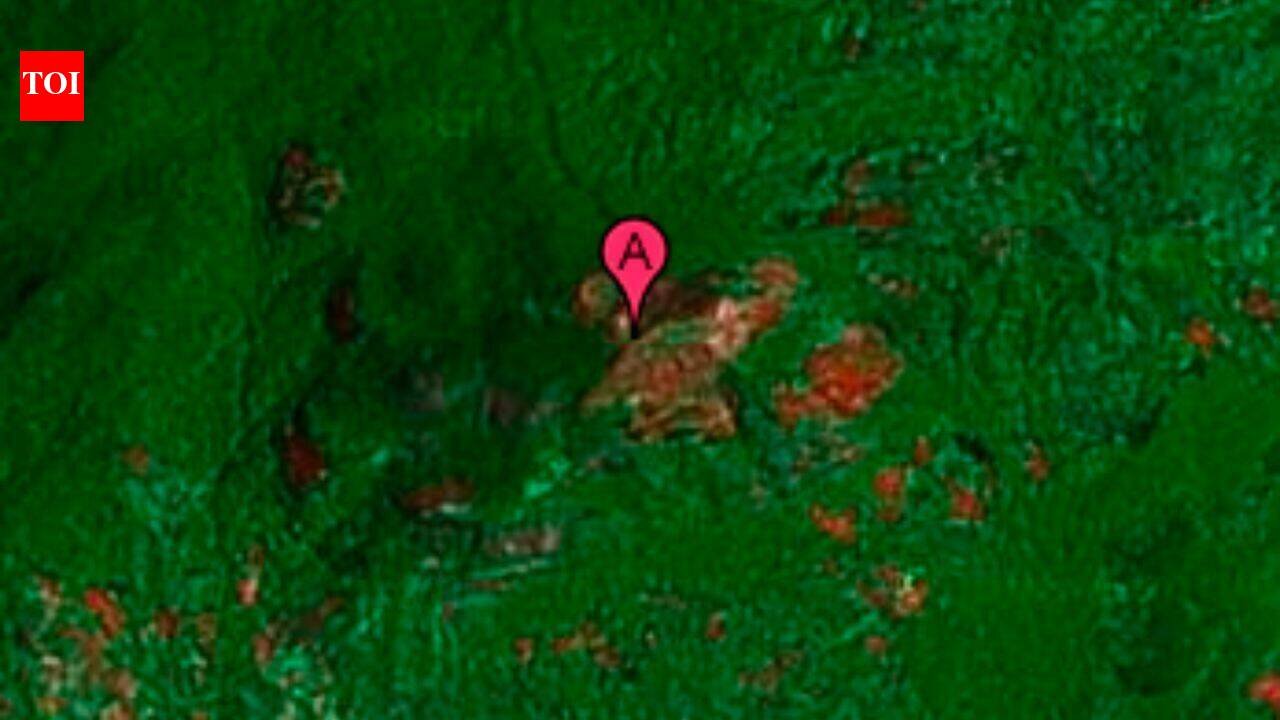
In 2005, conservation scientist Julian Bayliss was searching Google Earth for mountainous green areas in northern Mozambique when he noticed a large, unexplained patch of forest. The image suggested that the high-elevation area might receive enough rainfall to support an important ecosystem, but the forest was not properly mapped or widely known outside nearby communities. After reconnaissance trips to Mount Mabu, Bayliss and his colleagues confirmed that the green patch was a vast, largely untouched rainforest. In October and November 2008, a 28-scientist expedition entered the forest and documented remarkable biodiversity, including three previously unknown butterfly species and a new species of snake. NASA Science’s account of the discovery shows how satellite imagery, local knowledge and field research combined to reveal one of southern Africa’s important hidden habitats.A green patch on a digital mapThe discovery began with a search for possible conservation areas.Julian Bayliss was studying Landsat imagery of northern Mozambique through Google Earth in 2005. He was looking for mountainous regions near Malawi’s Mount Mulanje that might become part of future transfrontier conservation areas.At higher elevations, increased rainfall can create conditions suitable for forests. Bayliss noticed several green patches close to Mount Mulanje and began considering whether they might contain intact woodland.One patch stood out. It covered a large mountainous area that appeared greener and more extensive than expected. From a computer screen, it was impossible to know exactly what lay beneath the canopy, but the image suggested that the site deserved a closer look.Bayliss organised reconnaissance trips to the candidate locations. The exploration eventually took him to Mount Mabu, where he and his colleagues saw wet forest stretching into the distance.The view confirmed that the satellite image had revealed something significant. The area was not a small plantation or a few isolated trees. It was a vast natural forest that had remained largely outside modern maps and scientific surveys.Entering Mount MabuAfter reaching Mount Mabu, Bayliss and his colleagues observed a large area of wet forest in the distance. The following day, they trekked into it and found what NASA describes as a pristine forest in excellent condition.The forest’s condition was striking because it had escaped many of the pressures affecting other natural areas. There were no obvious signs of extensive logging, large-scale agriculture or major infrastructure.Bayliss returned to the Landsat imagery to estimate the size of the forest. From ground level, the canopy seemed to continue across the landscape, but satellite data helped researchers understand its broader extent.The imagery also made it possible to place the forest in relation to mountains, valleys and nearby communities. That information was essential for planning a larger scientific expedition.Mount Mabu was not simply a visually impressive landscape. Its isolation and varied elevations suggested that it could support species found nowhere else.Scientists knew that forests separated from other habitats for long periods often develop unusual communities. Plants and animals may evolve in specialised ways, adapting to particular slopes, streams, temperatures and food sources.Planning the expeditionThe discovery led the Royal Botanic Gardens, Kew, to organise an expedition with international partners.In October and November 2008, a team of 28 scientists and support staff from the United Kingdom, Mozambique, Malawi, Tanzania, Belgium and Switzerland travelled into Mount Mabu.The expedition was led by Kew and involved the Mozambique Agronomic Research Institute, BirdLife International and the Mulanje Mountain Conservation Trust in Malawi.A mission of this kind requires far more than simply walking into a forest. Researchers must organise transport, equipment, food, specimen storage, field notebooks and methods for documenting species.The team worked in difficult terrain, carrying supplies and scientific equipment through the mountainous landscape. They also needed to ensure that plants, insects, reptiles and birds could be studied without damaging the habitat they had come to understand.Because Mount Mabu had not been comprehensively surveyed, almost every observation had potential importance. Scientists were not visiting only to confirm the presence of known species. They were investigating a biological system that had remained largely unexplored.A forest full of discoveriesThe expedition found a remarkable range of wildlife.Researchers recorded pygmy chameleons, Swynnerton’s robin, numerous butterflies and several exotic plants. They also found a rarely seen orchid and collected more than 500 plant specimens for further study.Among the most significant discoveries were three new butterfly species and a previously undiscovered species of adder, or venomous snake.The discoveries demonstrated that the forest contained more than a large number of species. It held species that science had not formally documented at all.Some of the butterflies observed included the Small Striped Swordtail and Emperor Swallowtail. These known species existed alongside the newly identified butterflies, creating a community that reflected the forest’s varied habitats.Scientists also found pygmy chameleons, which are small reptiles adapted to particular forest environments. Their presence indicated that the ecosystem supported specialised species with narrow habitat requirements.The discovery of new species in a relatively short expedition also suggested that additional surveys could reveal more biological information. A first visit can record only a portion of the organisms living in a large rainforest.Why isolated forests produce unusual speciesMount Mabu’s biodiversity was linked to its isolation, elevation and climate.The mountain receives substantial rainfall, helping create a moist forest in a region where large areas of natural woodland have been reduced or fragmented. Its slopes contain different conditions as elevation changes, including variations in temperature, moisture, soil and vegetation.Those differences create multiple ecological niches. A niche is a particular combination of resources and conditions that allows a species to survive.One butterfly may depend on a specific plant for its caterpillars, while another may prefer a particular elevation or flowering season. A reptile may live in leaf litter or low vegetation that is found only in certain parts of the forest.Over long periods, populations separated by mountains, valleys or unsuitable habitat can evolve independently. Small differences accumulate, and eventually a population may become distinct enough to be recognised as a new species.The expedition leader, Kew botanist Jonathan Timberlake, described the diversity as extraordinary and noted how species appeared adapted to small ecological niches.Satellite imagery made the discovery possibleThe Mount Mabu story shows how satellite imagery can guide field conservation.Landsat satellites collect images of Earth’s surface across multiple wavelengths. Vegetation reflects and absorbs light in distinctive ways, allowing scientists to identify forest cover and changes in land use.In this case, Landsat imagery helped reveal a large green area that was not well known or properly represented on maps. Google Earth made the imagery accessible enough for Bayliss to explore the landscape virtually and identify potential conservation sites.The satellite image did not identify the butterfly species or show the hidden snake. It provided the clue that led researchers to the ground.That distinction is important. Remote sensing can reveal patterns and locations, but field scientists are needed to interpret what those patterns mean biologically.A green patch may indicate natural forest, plantation, regrowth or even dense shrubland. Ground surveys confirm the habitat type, document species and assess its condition.Mount Mabu became an example of technology and field science working together rather than replacing one another.A refuge shaped by historyThe forest’s survival was partly connected to Mozambique’s turbulent history.The country experienced a civil war that lasted from 1975 to 1992. Roads and buildings outside the forest were badly affected, while Mount Mabu remained difficult to reach.Its isolation, poor access and lack of widespread recognition helped protect it from intensive development. The forest also served as a refuge for local villagers during the conflict, according to the NASA account.The same factors that limited human access also limited scientific access. For decades, the forest remained largely unknown to researchers outside nearby communities.This created an unusual situation. A habitat can remain biologically rich not because it is formally protected, but because it is remote, difficult to reach or overlooked.However, that protection is not permanent. Once a road is built, a region becomes economically valuable or people return after conflict, previously isolated forests can face rapid pressure.The discovery therefore brought both excitement and concern. Scientists had found a natural treasure, but they also needed to consider how to protect it.The threat of developmentBy the time of the expedition, Mozambique’s economy was growing and local communities were returning to the area.That created potential pressure on Mount Mabu. Forests can be cleared for firewood, timber, charcoal or farmland. Even small-scale clearing can gradually fragment habitat and reduce the space available for specialised species.The forest’s value to local people also needed to be recognised. Conservation cannot succeed if communities are excluded from decisions or denied access to resources they depend on.Kew and its partners worked with the Mozambique government to identify priority areas for conservation. They also aimed to encourage local people to value the forest for its wildlife.Protecting plant life can help secure habitat for animals, insects and microorganisms. A forest is not a collection of individual species. Its trees, vines, fungi, pollinators, birds and soil organisms depend on one another.If the canopy is removed, the effects can spread through the entire ecosystem. Species that rely on shade, humidity or specific plants may disappear even if small patches of forest remain.The importance of local partnershipsThe expedition involved researchers from several countries and organisations, but the long-term future of Mount Mabu depends on local participation.Mozambican institutions can provide knowledge about the region, its communities and its practical conservation needs. Local people may know the location of streams, wildlife routes, useful plants and areas that have remained undisturbed.International scientists can contribute taxonomic expertise, equipment, funding and access to global research networks. Combining those strengths can produce more effective conservation than relying on outside researchers alone.Kew’s work also included building capacity with local partners so they could conduct similar research in the future.That approach helps ensure that knowledge remains in the country where the forest is located. It also supports local scientists and conservation workers who will continue monitoring the area after an international expedition has ended.The discovery of new species is exciting, but documenting them is only the beginning. Scientists must study their habitats, population sizes, behaviour and threats before effective protection strategies can be designed.More than three new butterfliesThe headline discoveries were three new butterfly species and a new snake, but the expedition’s importance extended far beyond those animals.The researchers collected more than 500 plant specimens. Some may represent species new to science, while others may reveal new information about plants already known from nearby regions.Plants form the structural foundation of the forest. They provide food, shelter and nesting sites for animals, stabilise soils and influence moisture and temperature.The team also documented birds, reptiles and insects that can help scientists understand the health of the ecosystem. Species such as Swynnerton’s robin may indicate the presence of suitable forest habitat, while pygmy chameleons can reflect specialised environmental conditions.Every species record adds to the scientific picture. A forest that appears uniform from a satellite image may contain many small habitats at ground level.The expedition helped transform Mount Mabu from an unexplained green patch into a documented centre of biodiversity.A lesson in looking closelyMount Mabu’s story began with someone noticing what a map did not explain.Julian Bayliss saw a green patch in satellite imagery and asked whether it could represent a forest. That question led to reconnaissance trips, an international expedition and the discovery of species that had escaped scientific description.The story demonstrates the value of curiosity in conservation. Technology provided the initial clue, but the breakthrough came because researchers were willing to leave the screen, climb the mountain and enter the forest.It also shows that important natural areas may still exist outside famous parks and well-known reserves. Some habitats remain hidden in plain sight because they are remote, poorly mapped or viewed only from a distance.NASA’s account of the discovery describes Mount Mabu as potentially one of the largest areas of medium-altitude forest in southern Africa, despite the fact that it was not widely recognised on maps before the expedition.Protecting a newly recognised forestThe discovery increased attention on Mount Mabu and strengthened the case for conservation.Scientists and partners worked with Mozambique’s government to identify areas that should receive priority protection. Conservation planning needed to consider biodiversity, local livelihoods, access and the possibility of future development.Protecting Mount Mabu would help preserve more than individual rare species. It would maintain the ecological processes that allow new species to survive.A butterfly cannot be protected by collecting it alone. Its host plants, nectar sources, breeding areas and forest climate must also remain intact. The same applies to a snake that depends on particular prey, shelter and moisture conditions.Effective conservation therefore focuses on habitat rather than only on the most remarkable discoveries.The forest’s value lies in its wholeness. The three new butterflies and new snake are important because they reveal the hidden complexity of an ecosystem that had remained largely undisturbed.What the discovery means todayThe Mount Mabu expedition is a vivid example of how modern conservation science works.Landsat imagery helped identify the forest. Google Earth made it possible to investigate the landscape remotely. Field researchers then confirmed its condition and documented wildlife. International and local partners worked together to consider protection.The sequence moved from image to landscape, from mystery to evidence and from discovery to conservation planning.The story also carries a warning. Finding a forest does not guarantee its survival. New roads, timber cutting, agriculture and changing economic conditions can threaten an ecosystem soon after it gains scientific attention.Mount Mabu’s future will depend on long-term partnerships, local support and protection that recognises both biodiversity and community needs.In 2005, the forest was an unexpected patch of green on a digital map. In 2008, it became the setting for an expedition that found three new butterfly species and a new snake. Its greatest discovery may be the reminder that Earth still contains places capable of surprising science, provided someone takes the time to look more closely.
