



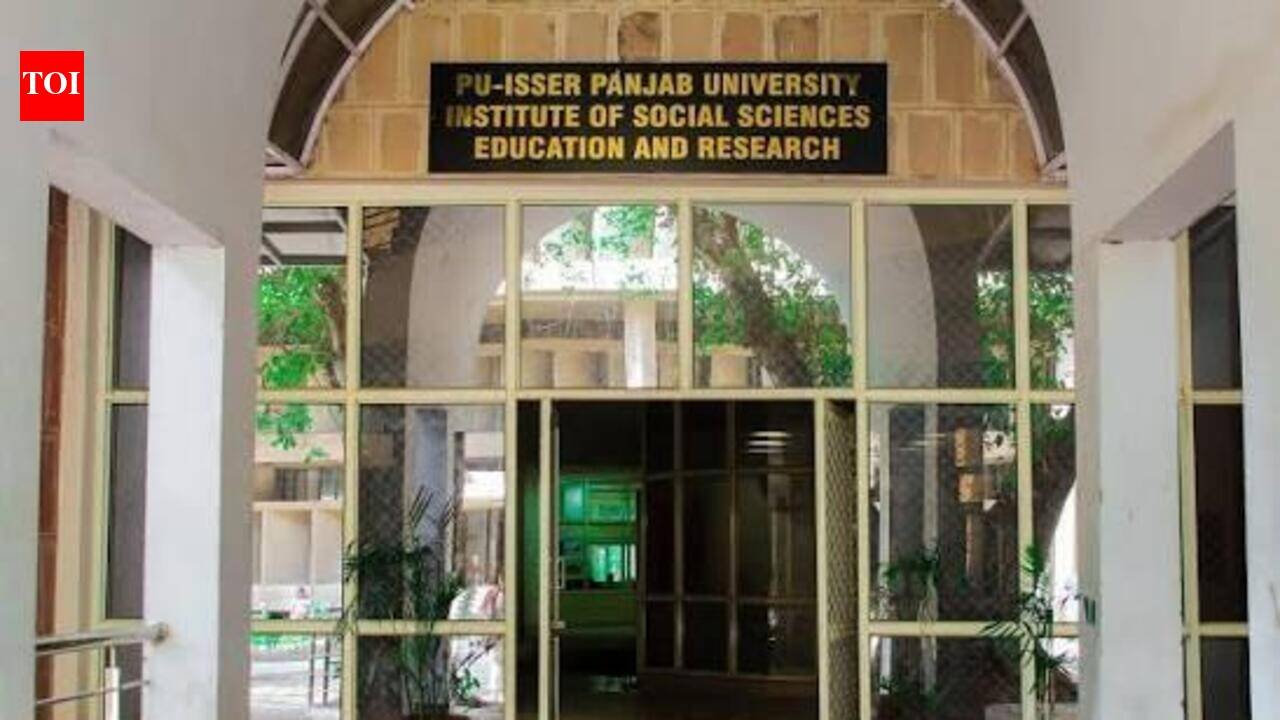
Chandigarh: Eleven years after Panjab University launched its Institute of Social Science Education and Research (ISSER) as an ambitious experiment in interdisciplinary education, the institute continues to run its undergraduate programme without a regular faculty of its own, relying on guest faculty and research scholars for much of its teaching.The institute currently has 11 guest faculty members, while the number of research scholars involved in teaching is also around 11, according to information available with the university and people familiar with its functioning. Though teachers from PU’s social sciences departments are also roped in to teach ISSER students, students and stakeholders say research scholars account for a substantial share of classroom teaching. There is no regular faculty member posted exclusively to the institute.The arrangement comes against the backdrop of an unusually ambitious idea with which ISSER was launched in 2015. It was envisaged as an integrated social sciences programme bringing students into contact with multiple disciplines before allowing them to specialise. The present programme offers majors in geography, history, economics, political science, psychology, public administration and sociology.The institute’s origins also go much further back than 2015. At its inauguration, then vice-chancellor Arun Kumar Grover traced the idea to a 1925 experiment at the University of Punjab in Lahore, where a broad-based Honours School covering disciplines including English, history, philosophy and economics had been attempted. The experiment could not be sustained, with PU subsequently highlighting the importance of strong individual departments and coordination for such an interdisciplinary programme.Grover argued in 2015 that Chandigarh offered a different setting, with PU already having established departments and experienced teachers in the relevant disciplines. The idea was to bring this expertise together under one programme and create an institutional space for interdisciplinary social-science education.But over the years, the institute has increasingly depended on teachers whose primary responsibilities lie elsewhere. With social-science departments themselves facing shortages, teachers are required to prioritise their parent departments, leaving guest faculty and research scholars to fill much of the teaching requirement.The consequences extend beyond classroom teaching. Since ISSER does not have a regular faculty cadre of its own, academic processes have also had to depend on teachers in the core social-science departments. Students and stakeholders say the arrangement has resulted in research scholars handling a significant amount of teaching despite the programme having been conceived as a flagship interdisciplinary initiative.The university continues to recruit guest faculty for the institute. Its official noticeboard carried an application notice for guest faculty in July 2026, even as admissions for the 2026-27 batch continued.ISSER was thus conceived as a permanent interdisciplinary academic space within PU, drawing on the university’s established strengths in individual social-science disciplines. Eleven years later, the disciplines remain available across the university but the institute created to bring them together still does not have a regular teaching faculty of its own.The contrast is particularly striking in light of the university’s own historical narrative. The Lahore experiment of 1925 was presented as an early attempt at bringing multiple disciplines together under one academic framework. More than a century later, PU’s Chandigarh experiment has survived but its teaching structure remains dependent on temporary faculty and research scholars.BOX- From Lahore to Chandigarh1925 : University of Punjab experiments with a combined Honours School covering subjects including English, History, Philosophy and Economics.2015 : PU launches ISSER as an interdisciplinary social-science programme, drawing on expertise from its established departments.2026 : ISSER has 11 guest faculty members and roughly the same number of research scholars involved in teaching, but no regular faculty of its own.The unfinished experiment: The original idea was to bring PU’s established social-science disciplines together in one dedicated academic space. More than a decade later, that space still depends substantially on teachers who are not regular ISSER faculty.
