



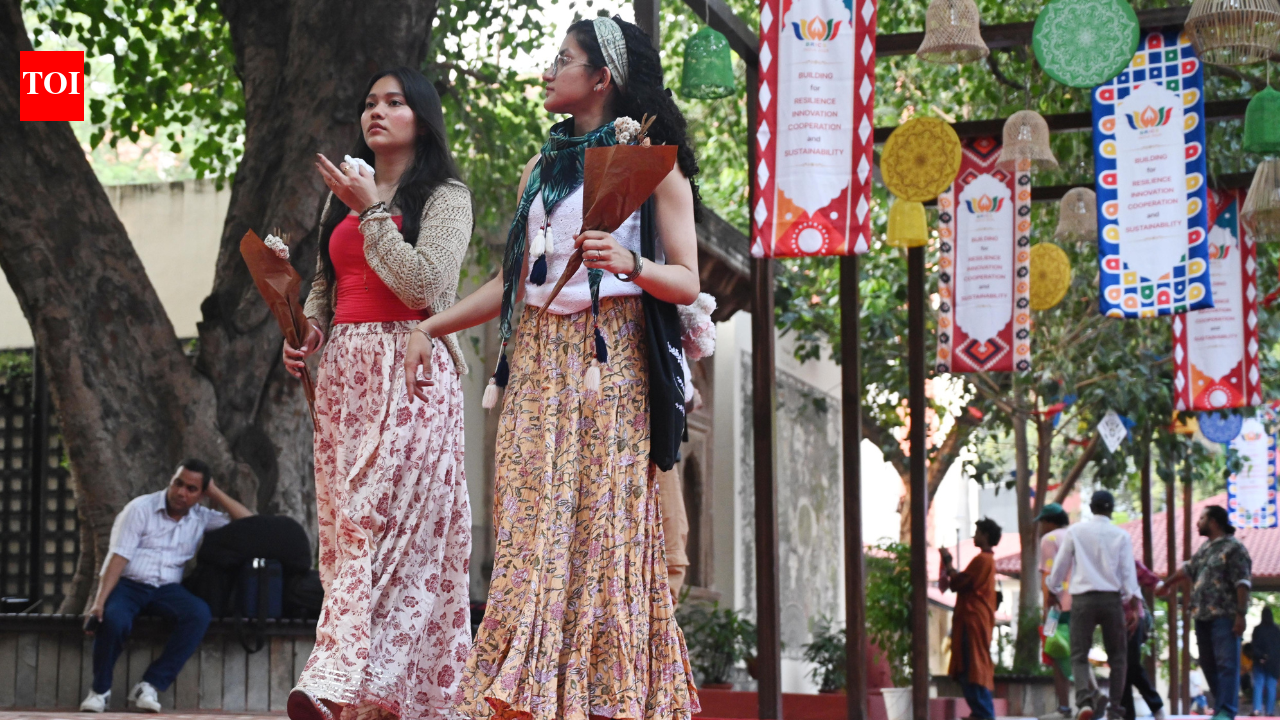
Against the backdrop of soft Indian instrumental music, the National Crafts Museum became a showcase of cultures from across the BRICS nations as the BRICS Bazaar brought together handicrafts, traditional art and artisans from participating countries. Hosted by the Ministry of External Affairs and the Ministry of Textiles, the exhibition drew visitors who explored crafts, interacted with artisans and experienced a slice of international culture in the city before concluding on Tuesday.
Patterns of unity at the entrance of the exhibition displayed patterns from 21 countries became a selfie spot
Craft, caught in the makingA highlight of the exhibition was the craft demonstrations, including lac bangles, traditional pottery and papier-mâché painting. Lac bangles are an ancient art practised in Rajasthan. Shadab Ahmed, a ninth-generation artisan who has been making these bangles for over 30 years, made them live to order during the demonstrations. Karan Singh, a terracotta potter from Rajasthan tells us, “The size of the smallest pot here is 3mm. They’re also used to customise the watches where we remove the mechanism of the watch and place handmade pots inside.” Kashmiri papier-mâché is synonymous with Srinagar, where boxes, plates and pots adorned with detailed floral patterns are sold as souvenirs. Artisan Riyaz Ahmad shares that some intricate designs are painted with a brush as thin as a strand of hair.
Lac bangles demonstration (L), a customised watch with clay pots (R )
Crossing borders, bridging cultures through craftAt the BRICS Bazaar, showcasing crafts and cultures from participating nations, a lively exchange unfolded as attendees browsed the stalls and interacted with artisans, using AI translation, gestures and handwritten notes to bridge the language gap. While Ethiopia served coffee with music, Iran introduced attendees to its embroidery traditions. India showcased Manipuri and Kashmiri handlooms, along with Mysore rosewood inlay and portrait weaving. Among the exhibitors was Vietnamese lacquer artist and university professor Tran Anh Tuan, who showcased paintings, vases, bowls and jewellery. He said, “I really like being here, the people are very friendly. I love Indian food, especially the curries!”Cuban artist Filiberto Mora Rosales, who has worked with papiermâché for over 40 years, said, “Being here is a magnificent experience. I sold out all the 30 items that I brought. Meeting artists from other countries is a very good experience.”
Cuban contemporary art (L) and papier-mache canvas (R )
‘Liked the diversity of handicrafts here’Appreciating the exhibition, first-year student Prashasti from Lucknow, who recently moved to Delhi, said, “I’m so happy to be in Delhi because we are able to experience international cultures. I particularly liked the Russian and Chinese artwork here. The artisans are really enthusiastic. I think younger people are leading with pictures and then moving to the art, but older people are absorbing the art more.”Another attendee, Keith Jackson from Manipur, shared, “It’s a wonderful experience learning about so many different weavings and embroideries. I learnt that Iranian and Kashmiri embroidery are only slightly different. I liked the diversity of handicrafts here and bought a lot of stuff!”
Ethiopian coffee served live at the country’s stall (L), Malaysian batik art (R )
Iran’s rashti and balochi embroidery were a hit at the bazaar (L), Belarus’ straw woven hats (R )
South African beadwork (L), Russian Ghzel pottery (R )
Kashmiri papier-mache is known for its intricate hand-painted designs
