



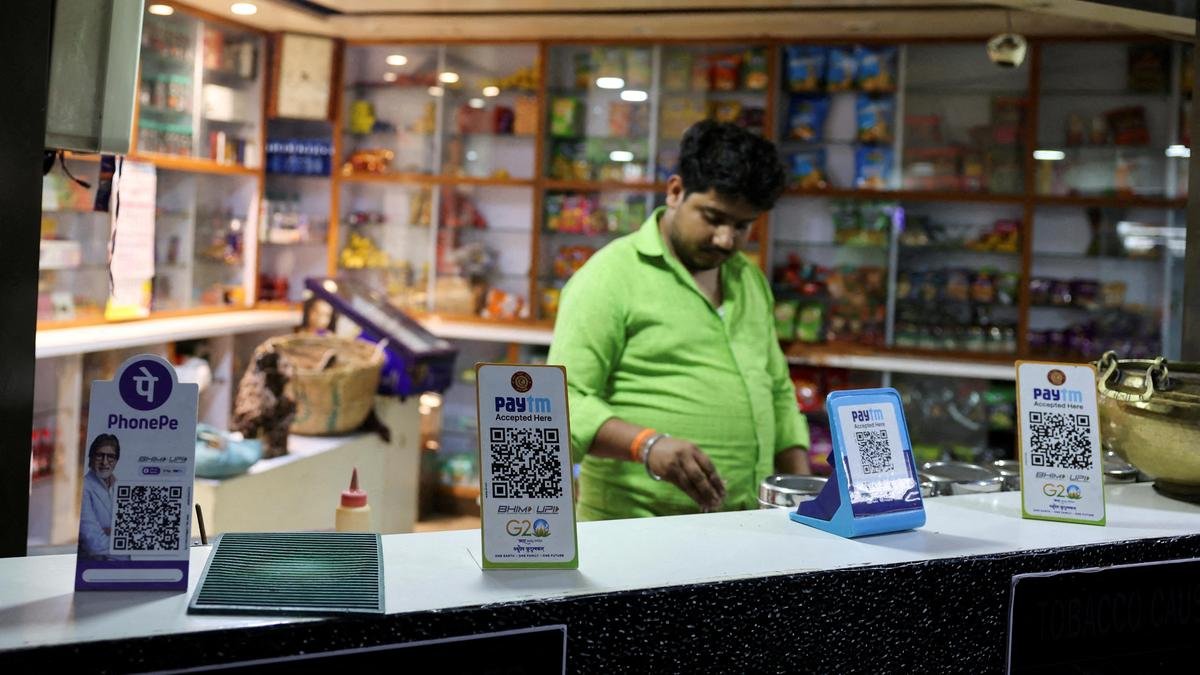
The story so far: After much speculation and debate, the National Payments Corporation of India (NPCI) has finally released its circular about the additional charges it will allow to be levied on certain UPI payments from October 15, 2026. While the Opposition has argued that this charge will increase prices for consumers, the government has argued that this will not happen, and that even the impact on merchants will be minimal.
Who will have to pay the MDR charge?
The Hindu has previously explained what the MDR charge is, in the context of UPI. In short, it is a fee for using UPI that will be paid by merchants to payment processors and banks. Consumers will not have to directly pay the MDR.
In its press release relating to the NPCI’s announcement, the Ministry of Finance on Tuesday (September 15, 2026) emphasised that banks have been advised to ensure that merchants do not pass MDR charges on to customers and that UPI application providers are expressly prohibited from imposing platform fees or hidden charges on users.
The MDR will have to be paid by mid- to large-sized merchants who receive UPI payments in excess of ₹2,000 per transaction. These merchants will have to pay a charge of 0.4%. For transactions of ₹75,000 and above, the MDR will be capped at ₹300 per transaction.
However, the rules change when it comes to essential sectors. Transactions of ₹2,000 or more in essential and thin-margin sectors, such as railways, telecommunications, insurance, fuel, and agricultural inputs, will attract a flat MDR of ₹5 per transaction.
According to the government, this flat charge will provide cost certainty for critical public services and businesses operating on narrow margins.
Further, capital market transactions such as payments to mutual funds, stockbrokers, dealers, and for equities will attract an MDR of 0.02%, capped at ₹300 per transaction. This lower rate, the government has argued, is aimed at supporting retail participation in formal financial markets.
One way to ascertain how widespread the charge will be is to look at the volumes of UPI transactions. An analysis by The Hindu of data provided by the NPCI shows that person-to-merchant (P2M) transactions above ₹2,000 make up just 2.5% of all UPI transactions by volume.
Who will not have to pay the MDR charge?
All Person-to-Person (P2P) transactions will remain free of charge, regardless of the amount being transferred. The government has specified that “no transaction fee, platform fee or other charge may be imposed on individuals for sending or receiving money through UPI”.
This is a significant exemption because P2P UPI transactions make up about 37% of the total UPI transaction volume.
Further, payments to merchants up to ₹2,000 will remain free of MDR. This makes up another 60.5% of all UPI transactions by volume. That means, in total, 97.5% of all UPI transactions will remain free.
In addition, the NPCI has mandated that small merchants including street vendors receiving up to ₹1 lakh per month through UPI QR codes under the Person-to-Person-Merchant (P2PM) category will also be exempt from MDR.
This means that the proportion of UPI payments that will attract a charge is actually even smaller than 2.5%.
Who stands to gain the most?
The government has said that the MDR will be shared among payment ecosystem participants, including banks, payment service providers, and UPI application providers.
The analysis of the NPCI data shows that the P2M transactions above ₹2,000 make up 20% of all UPI transactions by value. That is, while ₹29.8 lakh crore was transacted over UPI in August 2026, P2M transactions above ₹2,000 were ₹5.99 lakh crore.
This means that the absolute maximum that banks and payment processors can earn from MDR is about ₹2,400 crore a month (0.4% of Rs 5.99 lakh crore) or ₹28,000 crore a year. However, since there are multiple caveats, exemptions, flat rates, and caps imposed, the total amount receivable will be lower than this.
The way MDR works is that the bulk of the charge (about 40% of what is collected) goes to the payer’s bank since it holds the customer’s bank account, and bears the core authorisation, security, and settlement costs of the transaction.
Here, Yes Bank is the undisputed gainer, since it is the payer bank in more than 50% of all UPI transactions. The second largest is ICICI Bank at 18.3%.
Of the MDR collected, the merchant’s bank or receiving bank receives 30%. This is because they manage the merchant’s relationship, handle the QR code deployment, and process merchant settlements.
Here, too, Yes Bank is the payee in about 55% of all UPI transactions and so stands to earn the most from the MDR, followed by Axis Bank at about 19%.
Another 20% of the MDR goes to the UPI app or Third-Party Application Provider (TPAP). PhonePe and Google Pay stand to benefit from this, since PhonePe accounts for about 46% of UPI transactions by volume and Google Pay another 32%.
The final 10% of the MDR goes to the Payment Service Provider that connects the technology partner bank that connects the UPI application to the central network switches.
The government has also said that a dedicated fund will be established to promote UPI adoption among small merchants, with an amount equivalent to 5% of total MDR collections contributed to this fund. It does not specify from which of the payment system players this 5% will be taken.
Published – September 16, 2026 12:43 pm IST
