



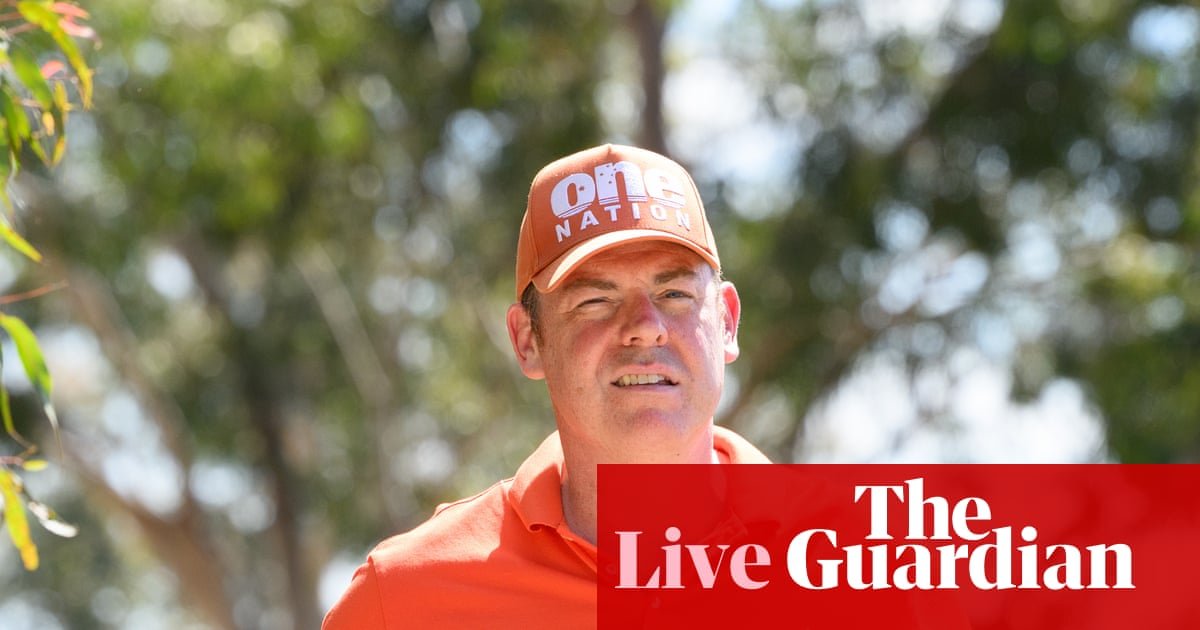
NSW One Nation leader clarifies abortion comments
Penry Buckley
The NSW One Nation leader and state election candidate, Mike Newman, has clarified comments he made in support of a bill to explicitly prohibit sex-selective abortions at a rally outside NSW parliament yesterday.
Yesterday, speaking alongside anti-abortion activist Joanna Howe, Newman said:
And what we want to say to those people in there, we want to support people who want to make sure that abortion rights, we want to stop it. We want to make sure that same-sex, sorry, abortion is stopped. We want to make sure that people have the right to life, and we will vote for you in favour of that.
After Guardian Australian contacted Newman, he said that “One Nation policy is clear” and the party’s platform opposed late-term and sex-selective abortions, but did not advocate for an outright ban on abortions.
There are already restrictions on sex-selection abortion for non-medical reasons in NSW, and the upper house voted to formally oppose the practice in 2019 when the state decriminalised abortion. Libertarian upper house member John Ruddick’s bill proposes to explicitly prohibit sex-selective abortion and introduce penalties for medical practitioners. A 2020 NSW Health review found the practice was exceedingly rare.
Guardian Australia understands the bill, in which government and opposition members have been allowed a conscience vote, does not have sufficient support to pass this evening.
Key events
Nick Visser
Stewart unsure when she’ll get back in the ocean after shark bite
Stewart said she is still adjusting to life with just one hand, saying her partner helps her with her hair most days.
I still don’t trust him, but I don’t have any other choice. At the beginning, I couldn’t brush my own teeth. And so my mum or [partner] Fernando brushed my teeth every day for me.
Stewart said she hopes to return to teaching, but is still deep in her recovery process. She’s planning to visit the school she worked at soon, where she will likely answer questions from students. She told 2GB:
I’d love to sort of give them some encouragement that you can get through hard things because for me, this felt impossible.
Fordham asked if Stewart planned to get back in the water. She said her leg is still healing after the shark took a large bite out of her body, saying the wound is still open and she recently had a skin graft.
Once my leg’s better, I’m locking in. I’m going to get stronger. I’m going to get better. I’m maybe not going in the ocean, but I would love to get back to swimming in a pool. …
I don’t know. If the drones are up and there’s a shark net. Yeah, potentially.
Nick Visser
Leah Stewart says she feels ‘truly lucky’ amid recovery from shark bite
Leaving politics for a moment, Leah Stewart, the woman who was bitten by a shark at Sydney’s Coogee beach, spoke this morning about her ongoing recovery following the incident.
Stewart told 2GB’s Ben Fordham:
You know, I’ve got a little baby daughter, and I feel like you don’t have any other choice. You’ve just got to keep going. … I’m just so happy to be home with her, and that’s just what I’m focusing on.
You can either think of yourself as really unlucky or really lucky. I truly, truly, truly think I’m lucky, because if I didn’t have those heroes on the beach … I wouldn’t be here.
She pointed to paddleboarder Charlie Verco and the doctor, Ian Ferguson, who was off-duty but at the beach that day, for helping save her life. Stewart said she didn’t know until two weeks ago that her heart stopped as she was transported from the beach to an ambulance.
I had seconds to live, and you’ve just got to focus on that. … They truthfully didn’t think I’d make it to the hospital and very nearly I didn’t.
Luca Ittimani
Guardian Australia warns copyright backdown means free access for AI companies
Guardian Australia has joined artists and creative organisations to condemn the Albanese governments’ leaked proposals to give AI companies free access to local content by default.
AI companies have sought to train their models on content and data online but cannot do so with Australian content due to local copyright rules.
Labor is considering letting big tech through this barrier if it makes enough deals with enough businesses or creative rights holder organisations, forcing smaller individual creators to proactively opt out. Backlash from musician and writer organisations is growing.
A Guardian Australia spokesperson said:
The growth of a domestic AI sector should not – and need not – occur at the expense of established cultural and publishing industries by weakening copyright laws.
As the most well-funded sector in history, the AI industry does not lack capital; it simply lacks the willingness to pay fairly.
The focus should be on encouraging commercial licensing deals, not on giving US tech giants free access to Australian content.
NSW One Nation leader clarifies abortion comments
Penry Buckley
The NSW One Nation leader and state election candidate, Mike Newman, has clarified comments he made in support of a bill to explicitly prohibit sex-selective abortions at a rally outside NSW parliament yesterday.
Yesterday, speaking alongside anti-abortion activist Joanna Howe, Newman said:
And what we want to say to those people in there, we want to support people who want to make sure that abortion rights, we want to stop it. We want to make sure that same-sex, sorry, abortion is stopped. We want to make sure that people have the right to life, and we will vote for you in favour of that.
After Guardian Australian contacted Newman, he said that “One Nation policy is clear” and the party’s platform opposed late-term and sex-selective abortions, but did not advocate for an outright ban on abortions.
There are already restrictions on sex-selection abortion for non-medical reasons in NSW, and the upper house voted to formally oppose the practice in 2019 when the state decriminalised abortion. Libertarian upper house member John Ruddick’s bill proposes to explicitly prohibit sex-selective abortion and introduce penalties for medical practitioners. A 2020 NSW Health review found the practice was exceedingly rare.
Guardian Australia understands the bill, in which government and opposition members have been allowed a conscience vote, does not have sufficient support to pass this evening.
Butler defends $5m sports club upgrade under invite-only scheme
Mark Butler has defended his office’s involvement in a $5m grant for a sports club upgrade in his electorate.
The ABC reported Butler’s office urged the City of Charles Sturt council to submit a $6m grant application to redevelop the Jubilee Reserve in his electorate as a permanent home for the Adelaide Jaguars women’s football club – before detailed costings or formal planning had been done.
Labor committed $5m for the project in the lead-up to the 2025 election, which was funded under the “invite-only” grants scheme.
But Butler says there were multiple discussions with the council about the redevelopment, what funds would be needed, and that the council provided a budget proposal.
He said in a statement provided to Guardian Australia:
My office had multiple discussions with the City of Charles Sturt Council about what a redevelopment of Jubilee Reserve would look like, and what federal funding would be needed to deliver the project. The Council outlined to us in a detailed budget proposal how much funding would be needed to develop Jubilee Reserve.
The Adelaide Jaguars are the largest female-only soccer club in South Australia, and their membership has more than tripled in the past five years. Yet, they didn’t have a home ground and had to turn away over 100 players … This terrific club deserved its own home.
Graham Readfearn
More than enough renewable projects to meet 2030 target, but not enough contracts being signed
Australia has more than enough wind and solar power projects “in the pipeline” to meet the government’s 2030 renewable energy target, but a large proportion are being held up because contracts to buy their electricity are not being signed, according to analysts.
Analysis from the Institute for Energy Economics and Financial Analysis and Green Energy Markets has revealed the gap and the pair blame a lack of power purchase agreements being signed, saying the government’s capacity investment scheme also isn’t enough to persuade proponents to start building.
Releasing a new renewable energy scorecard that will be updated quarterly, Johanna Bowyer, lead analyst for Australian electricity at IEEFA said:
The scorecard shows that, in aggregate across Australia’s main grids, developers are pursuing far more renewable and battery capacity than is needed to meet the 82% target, and a large share has already been fully approved.
Yet projects under construction still fall far short of what must be built by 2030 – in several states less than one tenth of the required new wind and solar capacity is currently being built, and even the strongest states have at most around one third of new capacity required currently under construction.
Tristan Edis, director of analysis and advisory at Green Energy Markets, said projects that were already connected or under construction would only get Australia’s main grids to 53% renewable energy by 2030.
He said power purchase agreements were not being signed because of uncertainty over when coal plants might close and whether state governments might step in to keep them open. He said:
Government underwriting schemes are helping, but on their own they don’t guarantee enough revenue certainty to get projects to financial close. Without more contracts from large energy users, too many fully approved projects will stay stuck.
‘I would love to see a plan’: Pocock rips into migration debate
David Pocock says the government needs to stop faffing about and actually deliver a plan and have a serious conversation about immigration.
Labor, for weeks, has stalled on a migration plan but it’s expected as soon as this week. The Coalition has also been mulling its own plan and been promising it’s also just weeks away.
Meanwhile, One Nation came out of the gates earlier this week to announce their plan for net-negative migration over three years, cutting temporary visas by 750,000 over that period.
Pocock says there needs to be a mature conversation, not starting with numbers, but what the country actually needs.
The big thing I would love to see is a plan. There’s this constant talk about numbers, about classes of visas. Rather than actually having the conversation as a country, what is our 10-year plan for migration? What are the skills that we need? What are the trade-offs when it comes to housing, impact on the environment?
How is it that as a country that is as wealthy as Australia, we rely on half of our new doctors to come from overseas, from countries that undoubtedly also desperately need doctors? What are we doing in terms of training? To me, that’s how you solve this issue: you actually have these hard conversations, then you say, ‘right, this is what it’s going to look like over the next 10 years’, rather than having this ridiculous fight over a number that raises all sorts of concerns for aged care, for healthcare, for farmers who are relying on backpackers. It just seems so unproductive.
Opt-out AI proposal for artists ‘throwing creators under the bus’
David Pocock, who has been on a crusade to protect the creative industry from being gobbled up by AI training models, says artists are being thrown under the bus if the government goes ahead with an opt-out model for their work.
Pocock tells RN Breakfast that these multibillion-dollar tech platforms should have to negotiate with copyright holders.
I really think this [proposal] is throwing creators under the bus that is a one-stop express bus to datacentres. And I think we should do better as a country.
You think of when you stream something on Spotify. Spotify has not done a deal with every single artist. They are going through collecting institutions. So it’s all set up for that.
We just have AI companies who refuse to actually sit down with them and negotiate to use their works. They want to steal them, they want to use them, and they want to then, who knows, on the one hand, replace a whole bunch of jobs. On the other hand, potentially end the world as we know it. Why are we just caving to these companies?
Asked about James Paterson’s point that these frontier AI models could have national security benefits, he says he’s sceptical.
Pocock says the major parties too often pull out the national security card because “they can’t win an argument on it’s merits” and use it as a “trump card” so they don’t have to reveal all the details to the public.
At the moment, it seems like there’s not many things where we’re willing to take on big US companies, and particularly ones that Trump doesn’t want touched.
Benita Kolovos
Victorian premier plans to expand police search powers to crack down on knife crime
No matter who wins the Victorian election, police will be given the power to stop and search people using a metal detector wand for knives.
The Victorian premier, Ben Carroll, will today announce plans to introduce Jack’s Law in the state if Labor is reelected – matching a commitment made by the Coalition in 2025.
Police would also be given 1,200 additional handheld metal detectors to search people “anywhere, anytime”, the police minister Paul Edbrooke said.
Currently in Victoria, police are only authorised to perform pat-down searches in “designated areas,” and the laws governing these searches are currently being challenged in federal court.
The law, introduced in Queensland in 2023 following the stabbing death of 17-year-old Jack Beasley in 2019, gives police the power to use metal detectors on people anywhere in the state to search for knives.
It’s a significant shift for Labor, who since the Coalition announced their plan to introduce Jack’s Law in 2025 have maintained there was no need.
But Carroll on Tuesday repeated the line that he was taking the state in a “new direction”. He said:
My priority is community safety – and stop and search powers for knives is the new direction I’m delivering. I stand with parents like Brett and Belinda, just like I stand with all Victorians who have had their lives destroyed by violence.
All aboard the frontier AI train, Paterson says
Australia should be pushing for access to the most advanced US frontier models of AI, says shadow defence minister James Paterson, despite concerns around copyright and protecting the work of creatives.
Paterson tells RN Breakfast frontier models (i.e. the latest most sophisticated AI models) have economic and national security benefits, and securing these training models “gets us a seat at the table”.
The ABC is this morning reporting leaked policy documents that reveal Labor is considering imposing a model where the work of artists could be made automatically available to AI companies unless creators actively take steps to opt-out.
Paterson is asked whether, if he’s so keen for those frontier models to be trained in Australia, that creatives just get thrown under the bus. He says he doesn’t think so.
We’re talking about hundreds of billions of dollars of investment, including some of the most advanced chips in the world, which we don’t really have access to now, coming to Australia … These technologies are incredibly important for intelligence collection, for cyber defence, and for modern warfare.
I think it’s very clear that people’s intellectual property, if it is used, should be paid for. I think what is open to being resolved is how they’re paid for, the mechanism that’s paid for.
Paterson says he’s open to how creatives are paid for their work, but stresses that time is of the essence and a decision needs to be made.
I am concerned about the timelines here because there are windows for investment that are closing. They will not be open forever, and Australia is not the only market in the world these companies are looking at. They’re looking at countries like the United Kingdom, New Zealand, Canada, Japan, and they could go elsewhere.
One Nation running ‘US-style Maga politics’, Hastie says
Andrew Hastie says the national tone has “taken a real dip” with One Nation making politics personal and “Maga-style”.
It’s certainly personal for Hastie with One Nation targeting his Western Australian seat of Canning, and Hastie and Pauline Hanson currently feuding over a cartoon video that labelled the former SAS captain a “traitor”. Hanson denied ever calling him a traitor.
Speaking to ABC News Breakfast, Hastie says he hasn’t spoken to Hanson in the last week.
The national tone has take a real dip of late and become quite personal, US-style Maga politics have been run by One Nation, and I have decided to push back. We want to win the next election as the Coalition and it’s a three-cornered contest and the Liberal party should be striving to be number one on the ballot. That’s what I’ve been arguing for.
It seems like a pretty clear message to his party to push back hard on Hanson and One Nation.
Asked more explicitly if he’d be comfortable with the Coalition joining with One Nation to form government, Hastie says the Liberals need to focus on themselves … at least for now.
Our primary vote is still very low compared to what it’s been in historic terms, we have to focus on being number one in terms of primary votes. Whatever happens after the election I don’t know. We’re fighting for our survival and we should be focused on that.
