



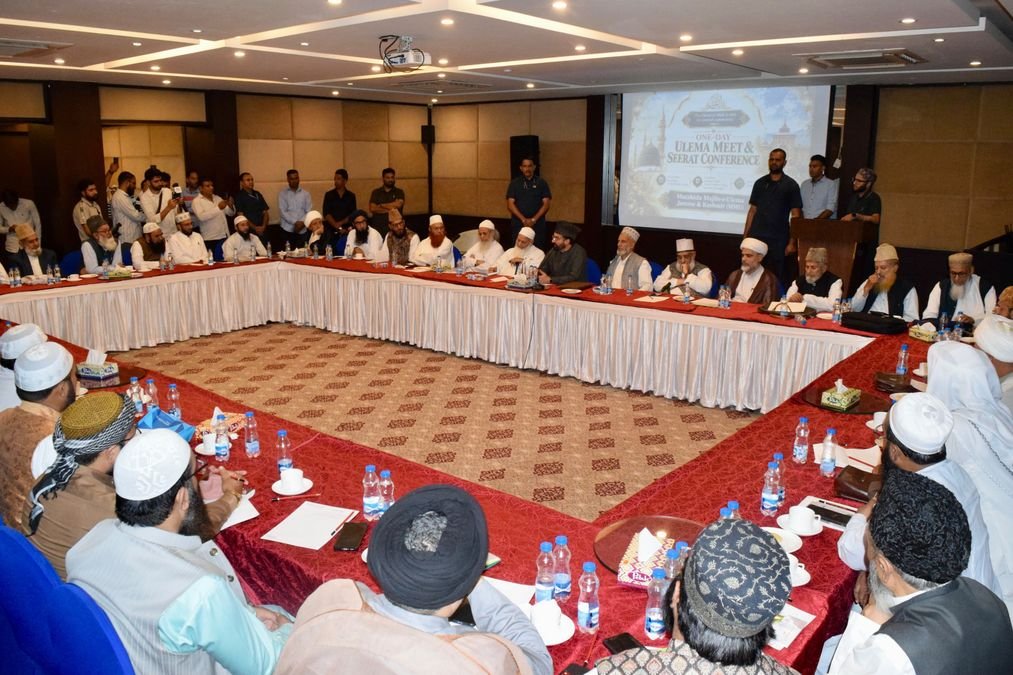
Srinagar, September 15, 2026: After a gap of more than two years, permission was granted by the authorities for the Mutahida Majlis-e-Ulema Jammu & Kashmir (MMU) to hold a major Ulema conference in Srinagar. The One-Day Ulema Meet and Seerat Conference, held today under the chairmanship of Mirwaiz Umar Farooq, brought together prominent Ulema and religious scholars from different parts of Jammu and Kashmir and Ladakh to deliberate upon the religious, moral and societal challenges confronting people here.
Those who attended came from different districts of Kashmir, while Ulema from Jammu, Poonch, Rajouri, Kargil and Doda specially travelled to Srinagar to participate in the conference, reflecting the need for greater interaction and coordinated action among religious scholars and institutions across the region.
The conference concluded with the adoption of two broad resolutions, one dealing with contemporary social challenges and the practical role of Ulema, mosques and madrasas, and the other focusing on unity within the Muslim Ummah, sectarian harmony and respect for differences of Maslak.
The first resolution expressed serious concern over drug and substance abuse, suicides and self-harm, mental and emotional distress among youth, irresponsible use of social media, weakening family bonds, moral decline and the increasing disconnect of young people from religious and community institutions, as well as environmental degradation and its serious consequences.
Particular concern was expressed over the growing incidence of suicide and self-harm, especially among young people. The conference stressed that condemnation or silence around the issue will not address the problem. Ulema, mosques and madrasas can play an important preventive and supportive role by creating safe spaces where young people and families are able to speak uninhibitedly about personal emotional distress, loneliness, anxiety, family pressures and other reasons, without fear of stigma.
It was emphasised that Imams and Ulema should sensitise communities about recognising signs of distress, encourage families to respond with compassion, and guide those in need towards appropriate professional counselling and mental-health support. Mosques and madrasas can increasingly serve as accessible centres of guidance, counselling and referral, while recognising that serious mental-health concerns require trained professional care.
The conference resolved that these issues should not remain confined to occasional seminars or speeches. It was decided that on designated Fridays, one common social issue would be taken up in Friday sermons across participating mosques, so that Ulema throughout Jammu and Kashmir and Ladakh speak collectively to highlight an issue requiring urgent societal attention and reform.
The MMU will also endeavour to hold regular meetings, preferably every month, in different districts and areas of Jammu and Kashmir, involving local Ulema, Imams, mosques and madrasas. Such meetings will provide an opportunity to understand local concerns and develop practical responses suited to each area.
The conference underlined that mosques and madrasas must increasingly become centres of guidance, counselling, youth engagement, family support and community welfare, alongside their primary religious and educational responsibilities. Their close connection and proximity to people’s homes gives them the ability to identify problems early and help families seek appropriate support.
On the issue of drug addiction, the conference stressed that all forms of addiction are harmful and must be addressed through a consistent social policy. While Ulema and civil society are being asked to work against narcotics and substance abuse, the conference expressed serious concern about the simultaneous normalisation of alcohol and its increasing availability.
The Ulema said that a campaign against drug addiction cannot yield the desired results if, at the same time, new liquor licences are issued and alcohol is promoted or expanded in the name of tourism. Such contradictory policies, they said, undermine efforts to protect young people from addiction. The conference called upon the government to reconsider this approach and to stop further promotion and expansion of alcohol availability.
The conference also recommended that Friday sermons and mosque-based programmes should sensitise people about their responsibility towards the environment. Ulema can play an important role in discouraging the use of plastic and polythene, littering and dumping garbage into rivers, lakes and other water bodies, and in creating awareness against encroachment and destruction of wetlands.
Concern was expressed over the condition, encroachments and protection of Dal Lake, Wular Lake, Nigeen Lake, wetlands and other water bodies, with the conference stressing that cleanliness, conservation of nature and protection of shared natural resources is also a moral and religious responsibility of being a Muslim.
The second resolution focused on unity within the Muslim Ummah and the responsibility of Ulema in maintaining mutual respect despite differences of Maslak and interpretation.
The conference acknowledged that different schools of thought and legitimate religious differences have existed within the Ummah and will continue to exist. Such differences, however, must never be allowed to become a source of hatred, hostility or division.
The Ulema unanimously emphasised that the Mimbar of the mosque is an Amanah — a sacred trust — and must never be used to promote sectarianism, ridicule another Maslak, spread hatred or deepen divisions among Muslims.
The conference called upon Ulema of different schools of thought to promote the Islamic ethics of disagreement, mutual respect, dialogue and brotherhood, and to focus religious discourse on the larger moral, spiritual and social responsibilities that Muslims share.
It was also felt that greater interaction among Ulema from different regions and schools of thought is essential. The proposed district-level meetings will therefore also seek to strengthen communication, mutual understanding and cooperation among religious scholars, mosques and madrasas across Jammu and Kashmir.
The participants observed that at a time when society faces serious challenges, the role of Ulema and religious institutions cannot remain confined to ritual matters alone. They must remain closely connected with the everyday concerns of people, particularly the anxieties, pressures and aspirations of the younger generation.
The MMU said that the conference should mark the beginning of a sustained process and not end with the adoption of resolutions alone. The aim will be to translate the suggestions and decisions into practical grassroots engagement, coordinated Friday sermons, district-level interaction, counselling and community awareness programmes across Jammu and Kashmir.
More than 70 Ulema and Mashaikh participated in the event. Prominent among those who attended were Moulana Rehmat-ullah Mir Qasmi, Mufti Azam Nasir ul Islam Farooqi, Mufti Nazir Ahmad Qasmi, Mufti Mohammad Yaqoob Baba Madani, Moulana Masroor Abbas Ansari, Moulana Showkat Hussain Keng, Mufti Enayat Ullah Jammu, Sheikh Mehboob Ali Wajdani, Kargil, Mufti Abdul Rashid Miftahi, Pir Rehmatullah Sahib, Moulana Syed Tayyub, Mufti Syed Sharief Ul Haq Bukhari, Mufti Ajaz ul Hassan Banday, Mufti Zia ul Haq Nazmi, Mufti Pirzada Reyaz Ahmad, Moulana Adnan Nadwi, Sibt Mohammad Shabir Qumi, Moulana Ghulam Rasool Noori, Moulana Ali Akbar, Moulana Syed Shah Waris Shah Bukhari and Pir Iftikhar Ahmad Kamli, among others.
