



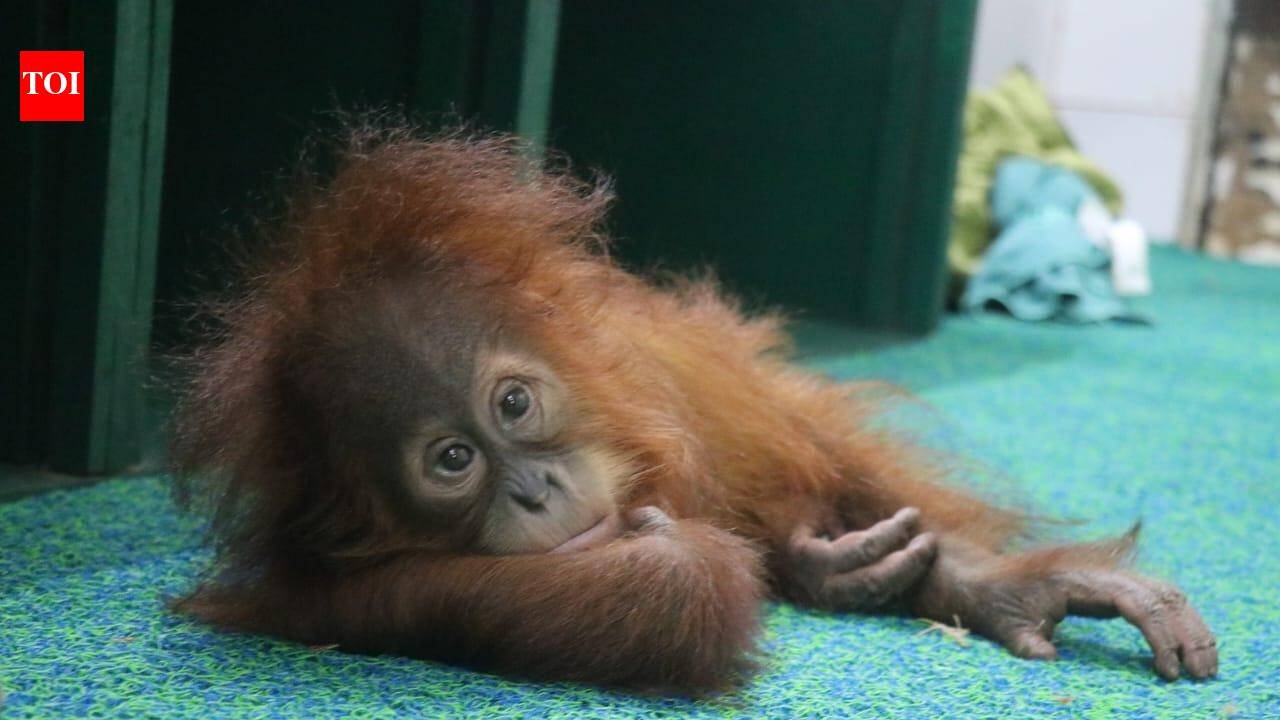
Bhubaneswar: Nandankanan Zoological Park authorities are considering allowing the five rescued infant orangutans access to an open-air enclosure as part of their stress-relief and enrichment programme. They will seek the opinion of the newly-constituted technical committee before taking the final decision. Meanwhile, officials on Monday confirmed that the orangutan suffering from persistent fever registered a normal body temperature.The proposed open-air facility is located adjacent to the Hand Rearing Centre (HRC), where the orangutans are currently being housed in a closed, air-conditioned room under round-the-clock monitoring. Zoo officials believe periodic exposure to a larger outdoor space will help improve the animals’ physical activity and psychological well-being by providing them with a more natural environment.“It is being planned to intermittently give open-air exposure to the rescued orangutans close to the facility where they are lodged now. The temperature issue of the lone orangutan has subsided now. The open-air facility can be used only after the technical committee gives a go-ahead,” said deputy director, Nandankanan, Pradeep Mirase. The development comes as zoo authorities reported encouraging signs in the health of the orangutans being closely monitored by veterinarians and animal keepers.To oversee welfare and long-term management of the rescued apes, Nandankanan has formed a five-member technical committee comprising experts from leading wildlife and veterinary institutions. The panel includes a veterinary officer from Chamarajendra Zoological Gardens, Mysuru; a representative of the director of the Wildlife Institute of India; the project coordinator of the Centre for Wildlife Health at OUAT; a veterinary officer nominated by the director of the National Zoological Park, New Delhi; and the director of Nandankanan, who will serve as member-convener.Forest officials said efforts are being made to gradually recreate conditions like the orangutans’ natural habitat so that the young animals can adapt comfortably. They added that creating a more natural environment would remain a priority until a final decision is taken regarding their long-term rehabilitation and future care.
