



There are places in India that are defined by their geography, and then there are places that seem to transcend it. Kashmir is one such place.
Its beauty has been immortalised in poetry for centuries. The timeless Kashmiri verse — “Agar firdaus bar rū-ye zamīn ast, hamīn ast-o hamīn ast-o hamīn ast” — reminds us that if paradise exists on earth, it is here.
But Kashmir’s story is not only one of beauty. It is also a story of resilience, aspiration and an enduring belief in the power of human connection.
It is against this backdrop that Paras Health Srinagar completed three years — a milestone that is about much more than the passage of time. It is about trust earned, lives touched, families supported and a healthcare institution becoming part of the social fabric of the community it serves.
That journey also reflects a much larger story unfolding across India: the transformation of healthcare from a predominantly metropolitan privilege into a more accessible, decentralised and community-oriented service.
From a Vision to a Healthcare Movement
When Paras Health began its journey in Gurugram in 2006, the proposition was both ambitious and deeply relevant: quality healthcare should not be restricted by geography or income.
Nearly two decades later, that proposition has grown into a healthcare network spanning cities including Gurugram, Patna, Ranchi, Panchkula, Udaipur, Kanpur, Darbhanga and Srinagar. The geography matters.
For years, India’s most sophisticated medical capabilities were concentrated in a handful of metropolitan centres. Patients from smaller cities and towns often had to travel long distances, leaving behind their families, livelihoods and familiar surroundings simply to access specialised treatment.
The emergence of healthcare institutions in newer geographies is changing that equation.
Paras Health’s expansion represents this broader shift — bringing specialised medical expertise, modern infrastructure and clinical capabilities closer to the people who need them.
The result is not merely greater convenience. It is greater confidence.
A family that once had to look hundreds of kilometres away for advanced medical care can increasingly find that care closer to home.
That is what makes healthcare infrastructure meaningful: not the size of a building, but the distance it removes between a patient and hope.
Healthcare Is Ultimately About Trust
India’s healthcare aspirations are changing rapidly. Patients today are more informed. They expect clinical excellence, but they also expect something equally fundamental — dignity. They want to be heard. They want transparency. They want accessibility. They want compassion.
Technology can make diagnosis faster. Infrastructure can make treatment more sophisticated. But neither can replace the human relationship at the centre of medicine.
A hospital, therefore, is not simply an institution where procedures are performed. It is where families arrive carrying anxiety, uncertainty and, often, their deepest fears.
The true measure of a healthcare institution lies in what happens next.
Does the patient feel cared for? Does the family feel supported? Does the institution remain compassionate when the situation becomes difficult?
This is where Paras Health’s philosophy of “Care Beyond Medicine” acquires significance. The phrase is not merely about clinical treatment. It speaks to the larger responsibility of healthcare — to make people feel that they are not alone.
The Courage to Go Beyond the Metros
There is an important lesson in Paras Health’s journey. Healthcare transformation cannot happen if excellence remains concentrated in India’s largest cities.
The country’s healthcare ecosystem can grow sustainably only when capacity expands outward — into emerging cities, regional centres and communities that have historically depended on metropolitan hospitals.
This is where institutions such as Paras Health can play a catalytic role. Every new hospital creates more than beds and operating rooms. It creates employment, develops clinical talent, strengthens allied healthcare services, encourages local medical ecosystems and gives patients a reason to seek advanced treatment closer to home. It can also reduce the enormous economic and emotional cost of medical travel. In that sense, the expansion of a healthcare network becomes part of the larger story of nation-building. India does not merely need more hospitals. It needs stronger healthcare ecosystems.
And ecosystems are built through connectivity — between doctors and institutions, technology and patients, expertise and geography, and most importantly, between healthcare and the communities it serves.
The Leadership Behind the Journey
At the centre of this journey stands Managing Director Dr. Dharminder Nagar, whose leadership has been shaped by a belief that hospitals are ultimately built on values.
Infrastructure can be constructed. Technology can be acquired. Systems can be replicated. Trust cannot. Trust has to be earned, often slowly and one patient at a time.
The decision to expand beyond established metropolitan markets requires a different kind of leadership — one willing to accept uncertainty, understand local needs and remain committed long enough for an institution to become part of the community.
The Paras Health story has been built in that spirit: patiently, persistently and with a long-term view. Brick by brick. Life by life. Trust by trust.
PARAS Health Srinagar: More Than a Hospital
Three years in Srinagar have given this philosophy a particularly meaningful context. Kashmir is a region where healthcare is intertwined with geography, accessibility and community confidence. Establishing advanced healthcare infrastructure here is therefore not simply a business decision; it carries a wider social significance.
Over these three years, Paras Health Srinagar has sought to establish itself not merely as a hospital, but as a dependable healthcare destination for patients and families. Every doctor who chooses service over convenience, every nurse who offers reassurance during a difficult moment, and every member of the support team who keeps the institution functioning contributes to that larger mission. The visible story of a hospital is often told through its buildings, technology and medical departments.
The invisible story is told through the people. Through the late-night calls. The anxious families. The difficult diagnoses. The small victories. The moments when a patient’s recovery brings an entire household back to hope. That is the real architecture of healthcare.
There is another, less discussed dimension to building healthcare ecosystems in India: institutions become part of the everyday life of the communities around them. A hospital does not exist in isolation. It supports doctors, nurses, technicians, pharmacists, ambulance services, diagnostic networks, hospitality teams, food and nutrition services, maintenance staff, local vendors and countless other allied sectors. Even something as simple as a patient’s meal carries a larger message.
Hospital food is not merely about calories. It is about nutrition, recovery, cultural familiarity and dignity. A thoughtfully prepared meal can become a small but powerful expression of care at a time when a patient may feel most vulnerable. From clinical expertise to nutrition, from technology to housekeeping, from emergency care to the cup of tea offered to an anxious attendant — healthcare is an ecosystem of thousands of human interactions. That ecosystem is precisely what India must continue to strengthen. And organisations such as Paras Health can contribute to that evolution not only by adding hospitals, but by creating platforms where medical talent, technology, employment, training and community healthcare can grow together.
The Next Frontier Is Human
India’s healthcare story is entering an exciting phase. Artificial intelligence, robotics, telemedicine, advanced diagnostics and digital health will undoubtedly reshape medicine. But the more healthcare becomes technologically sophisticated, the more important the human element may become. Because patients do not experience healthcare as data. They experience it as people. A doctor explaining a diagnosis. A nurse holding a hand. A family waiting outside an operating theatre. A reassuring voice at the other end of a phone. A meal served when someone is too tired to think about food. A hospital that makes a difficult day feel slightly less frightening. These moments rarely appear in annual reports, but they define healthcare more profoundly than statistics ever can. As Allama Iqbal wrote, “Sitaron se aage jahaan aur bhi hain” — there are worlds beyond the stars.
The thought is fitting for an institution that continues to look beyond the conventional boundaries of healthcare. The future is not simply about building more hospitals. It is about building greater trust. It is about making excellence accessible. It is about developing healthcare talent beyond the traditional centres of medicine. And it is about ensuring that geography does not determine the quality of care a person can receive.
From Paradise to Partnership
Kashmir has long been described as paradise. But paradise, in the modern sense, cannot be measured only by mountains, lakes and gardens. A truly healthy society is one in which people can access quality healthcare with dignity and confidence.
That is the larger promise of healthcare institutions that choose to invest beyond the metros. Three years of Paras Health Srinagar is therefore one chapter in a much bigger Indian story — a story about decentralising excellence, strengthening regional healthcare and bringing the promise of modern medicine closer to ordinary families. Perhaps the most appropriate way to describe that journey is not as a destination, but as a partnership. A partnership between doctors and patients. Between institutions and communities. Between technology and humanity. And between healthcare and the India that is steadily building a healthier future. The journey is far from over.
But if the first three years of Paras Health Srinagar are any indication, the next chapter can be measured not simply in infrastructure created or services delivered, but in something much more enduring; the number of lives that leave the hospital carrying not just treatment, but hope. And perhaps that is the finest definition of Care Beyond Medicine.
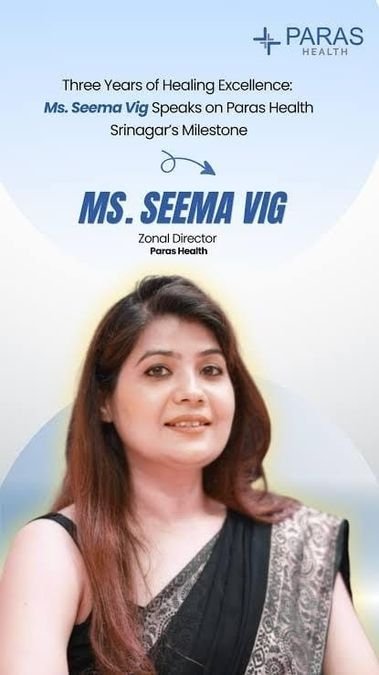
Seema Vig is a Senior Vice President and Regional Director, PARAS Health. She could be reached at [email protected]
