


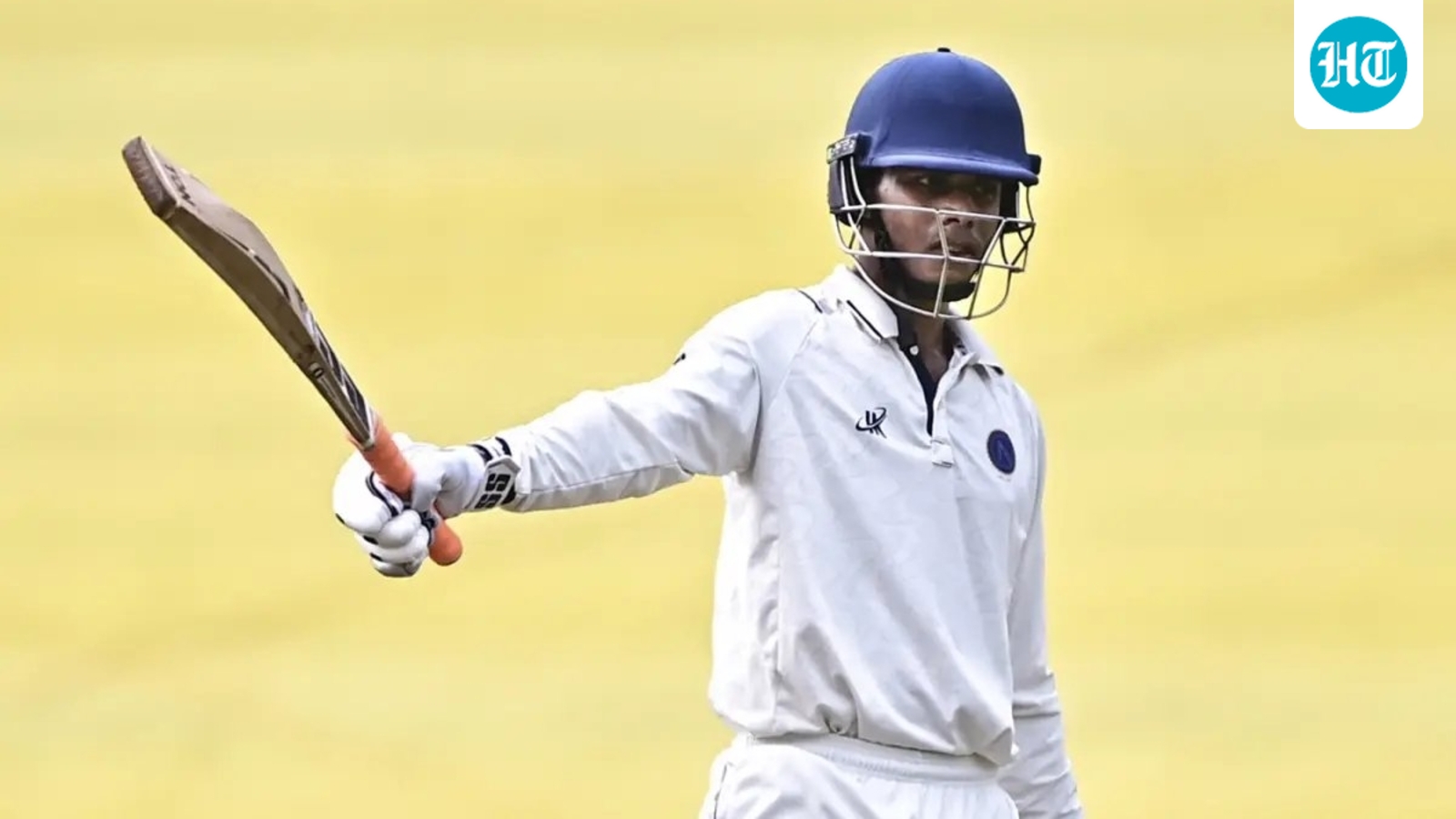
Vaibhav Sooryavanshi was supposed to be the young man everyone watched at Chepauk. At 15, already carrying a reputation that has grown far beyond domestic cricket, he walked out for East Zone in the Duleep Trophy final with cameras following almost every move. By the time tea arrived on the opening day, however, another young left-hander had quietly pushed himself to the centre of the conversation.
Unlike Sooryavanshi, he had not played a single match in East Zone’s run to the final. In fact, when the squad was originally announced, the 21-year-old from Jharkhand had been described as the reserve opener. Yet, given his first opportunity of the tournament in the biggest match of it, Shikhar Mohan produced an 85-run innings that gave East Zone’s imposing first-day start its substance.
There was still plenty of Sooryavanshi in the morning. Fresh from scores of 92 and 40 in the semifinal against Central Zone, where he also became the youngest player to score a Duleep Trophy fifty, the teenager attacked South Zone’s most accomplished fast bowler as though reputation meant little. Mohammed Siraj was cut for four, launched straight for six and then driven over long-off for another boundary in successive deliveries during one over. His first five overs eventually cost 41 runs.
Sooryavanshi and Abhimanyu Easwaran raced to a 100-run opening partnership in only 88 balls before Chama Milind finally found a response. A short ball climbed on Sooryavanshi as he attempted the pull, producing a top edge that substitute fielder Tanay Thyagarajan collected at deep square leg. The teenager departed for 44 off 37 balls, with five fours and a six. For a while, it appeared that Easwaran would simply take over the innings. Instead, the afternoon eventually belonged to someone playing his first Duleep Trophy match.
Shikhar Mohan turns opportunity into statement
Mohan’s introduction to the final could hardly have carried a greater contrast. Sooryavanshi had entered the tournament as East Zone’s vice-captain and one of its biggest attractions. Mohan had watched the previous rounds from outside the XI before coming in for the final as East reshuffled their batting order.
There was also nothing accidental about his selection. The Ranchi-born left-hander had forced himself into senior cricket after two prolific seasons at Under-23 level. He scored 623 runs in nine innings at an average of 77.88 in the 2023-24 CK Nayudu Trophy and followed that with 887 runs in 13 innings at 73.92 the next season. His performances earned him selection for the Rest of India against CK Nayudu Trophy champions Punjab in March 2025.
The transition to Ranji Trophy cricket was just as impressive. In his debut season for Jharkhand in 2025-26, Mohan amassed 613 runs from 12 innings at 55.73. That included two hundreds, three half-centuries and a highest score of 207. He then showed that his scoring was not restricted to the red-ball game, finishing the Vijay Hazare Trophy campaign with 391 runs from seven innings at 55.86.
At Chepauk, those numbers began to acquire greater meaning. Mohan initially played second fiddle to Easwaran, adding 33 for the second wicket before the experienced Bengal batter was run out for 72. South Zone then tightened their grip further when Tripurana Vijay removed Sudip Gharami for six, reducing East from the comfort of 133/1 to 147/3.
That was where Mohan’s innings changed character. Rather than trying to replace the momentum lost with Sooryavanshi and Easwaran, he absorbed the pressure. There were long stretches in which South’s bowlers controlled him, particularly when Vijay and Shreyas Gopal operated together. Mohan was prepared to defend, leave and wait. Of the 120 deliveries he eventually faced, 81 were dots — an unusually high 67.5 per cent. Yet he still finished with a strike rate above 70.
That apparent contradiction explained the innings. Mohan did not need to score from every over. When a bowler missed, he made the error expensive. Of his 85 runs, 54 came in boundaries. He struck nine fours and three sixes, shifting rapidly between long periods of restraint and sudden bursts of aggression.
Ishan Kishan partnership puts East back in control
The arrival of captain Ishan Kishan at 147/3 gave Mohan the partner he needed. Together, the two added 94 runs for the fourth wicket, turning what had briefly become South Zone’s opening back into an East Zone advantage. Mohan contributed 61 of those runs as the partnership steadily pushed the score past 200. There was a century available. Mohan moved into the eighties having survived the most testing phase of the afternoon, and with East firmly in command, a hundred on Duleep Trophy debut appeared increasingly possible.
It was not to be. Milind, who had earlier removed Sooryavanshi, returned to deny East’s other young left-hander as well. Mohan attempted to pull a short-of-length delivery, but the ball held slightly in the surface. He closed the bat face early, found the bottom edge and dragged it back onto his stumps. He stood momentarily looking towards the sky before walking off for 85 from 120 deliveries. East were 241/4.
The hundred had disappeared, but the opportunity had not. By tea, the curious story of the first day was that the teenager expected to dominate attention had provided the fireworks, while the reserve opener playing his first match of the tournament had played the bigger innings. Sooryavanshi’s 44 ensured everyone was watching. Mohan’s 85 ensured that, by the afternoon, they had another name to remember.
