


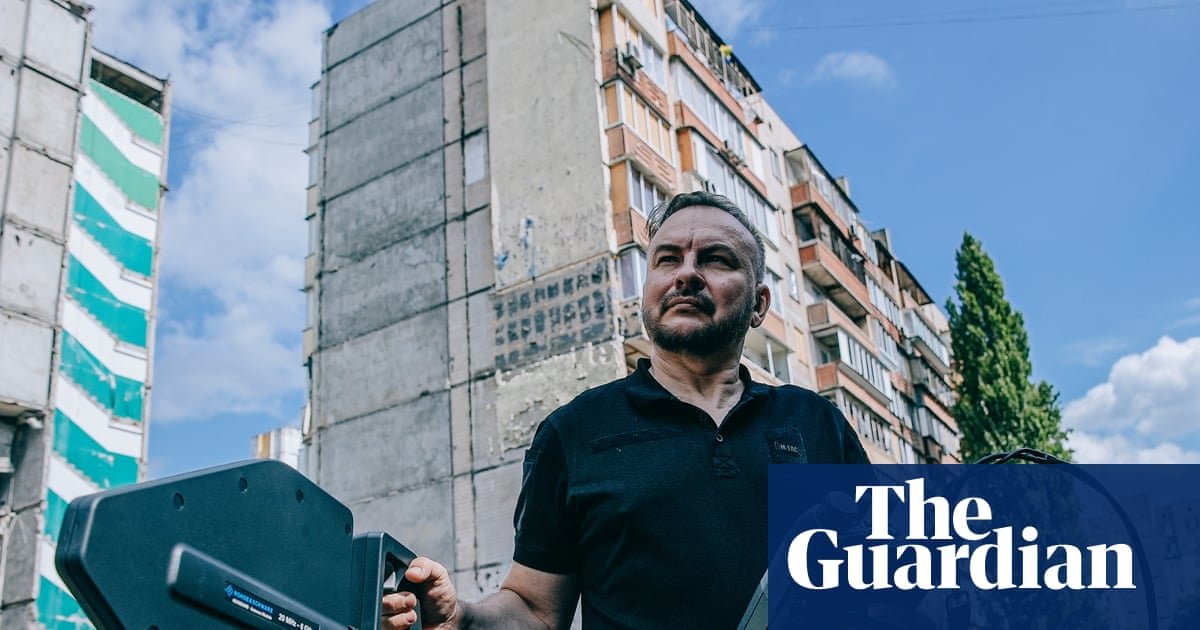
Russia and Ukraine are locked in an escalating war of long-range strikes with a growing risk to civilians in which neither side can entirely prevail, according to Volodymyr Zelenskyy’s defence technology adviser.
Serhii Beskrestnov, widely known by his call sign, Flash, said he was worried about the prospects for Kyiv this winter, and suggested elderly people should be evacuated in case Russian bombing were to knock out the capital’s energy supply.
However, the rapid wartime evolution also gave Ukraine the means to strike back, with plans to launch 1,000 drones a night to strike economic and military targets in Russia and halt its commercial air traffic, he said.
“Now, this is a war of cities, a war of infrastructure,” Beskrestnov told the Guardian, describing a conflict that is essentially deadlocked on the frontline, with civilians at increasing risk hundreds of miles away.
“In this war, nobody will win this game, because both countries, after the war, will have destroyed economics, infrastructures. So it’s stupid. We should stop this war. We proposed to Russia to stop this war, but Russia does not want to stop,” he said.
Beskrestnov, 51, a radio specialist, was first appointed by the former defence minister Mykhailo Fedorov as a technology adviser in January, before being taken on directly in July, after the latter’s dismissal.
The adviser, who survived a drone attack on his home in April, agreed that “attack had become more powerful than defence”, because both sides’ air defences could not keep up with the number of missiles and drones available.
Russia could engage in a sustained bombing of electricity, water and heating systems in Kyiv this winter with the high-speed ballistic missiles it was producing at a rate of more than 100 a month, Beskrestnov said.
Earlier this week, Vladimir Putin said Russia’s military had been “ordered to prepare and carry out mass strikes” on Ukraine’s energy facilities, showing no sign of halting the war.
“For me, it’s horrible,” Beskrestnov said. “We are talking about 2 to 3 million people, and Russia understands it can create a disaster in Kyiv.” City authorities should think about evacuating civilians in advance, particularly elderly people, he added, while emphasising he was not making an official statement.
Ukraine is desperately short of US Patriot air defence interceptors, the main weapon capable of halting ballistic missiles, and Beskrestnov said he was “not sure” that Zelenskyy could obtain enough from abroad to prevent a crisis. Last month, the president said he wanted to secure 300 Patriot interceptors for the winter.
Beskrestnov predicted Ukraine would “attack Russia more and more with deep strikes”, continuing a campaign that has resulted in factories, warehouses and oil refineries being bombed. “We have a target from our president to increase the quantity of attacks to 1,000 a day,” he said, rising from its current level of about 300.
Addressing Zelenskyy’s announcement this week that there would be a sustained attempt by Ukraine to halt civil aviation inside Russia with the drones, Beskrestnov said: “I think it’s very simple: it’s not necessary for us to attack an airport, it’s just enough for us to fly at the airport and the airport will be closed.”
Russia has also made a series of advances that have boosted its attack potential, including its first suspected use of artificial intelligence. Ukrainian investigators concluded that a simple Molniya drone that killed a person near a Zaporizhzhia gas station in July was being guided not by radio but by AI.
after newsletter promotion
“I’m just afraid what happens in the future because I think it’s just a question of time before Russia installs this technology in a Shahed,” he said, referring to the country’s standard long-range drone. It could render Ukraine’s “huge jamming network” obsolete without any radio communication to jam.
Beskrestnov said Ukraine was working on its own autonomous drones – “We have a prototype” – but that he believed Russia appeared to have more scale right now.
Russia has also developed a new wave of drones and missiles powered by Chinese-made jet engines that can fly at more than 200mph (320km/h), faster than the first generation of cheap Shahed interceptors that Ukraine has developed.
Moscow fired 2,500 jet-powered Shahed drones into Ukraine in August, up from 1,500 in July, and was planning to make “about 36,000 in 2027”, Beskrestnov said. It also planned to build another 30,000 of the slower piston-engine type next year.
Jet-powered Shaheds are already being used to threaten Kyiv and other big cities for hours at a time, but they will be complemented by another 10,000 cheap Banderol cruise missiles during 2027, plus a further 10,000 Dan-T missiles, boosting Russia’s ability to bomb Ukraine’s infrastructure.
Four to six Ukrainian companies were working on jet interceptors, Beskrestnov said, but they were “not ready for final production”, giving Moscow a window of advantage. The adviser would not give a timeframe for when the interceptors would be ready. At present, fighter jets take the lead in shooting down jet drones.
Civilian casualties have been rising as long-range attacks increase. According to the UN, 437 civilians were killed and 2,610 injured in Ukraine in July (the last month for which figures are available), the highest since March 2022. Accurate figures for Russia are not readily available.
Beskrestnov said the dismissal of Fedorov as defence minister after a clash with Zelenskyy was “a pity”, though the change in his own role meant the scope of his work had expanded beyond the armed forces to include the national guard and across government.
His role, he said, was technical and advisory and he sought to avoid becoming embroiled in personality clashes. “Don’t mix me with politics. Politics always has a part of garbage, rubbish,” he said.
