


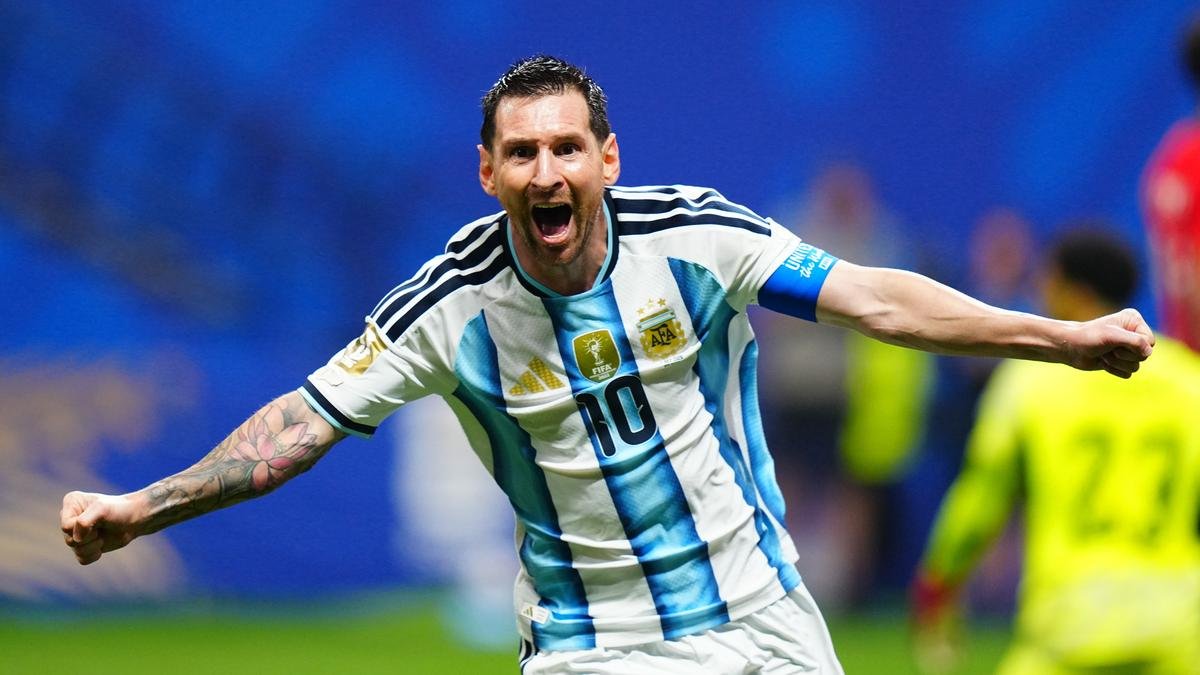
Tributes will keep pouring in. Highlights will be replayed on loop. Memories will linger for eternity.
But the magic of watching Lionel Messi in real time in Argentina’s iconic sky blue and white stripes, spreading immeasurable joy to millions around the globe, is now a thing of the past.
The forward, all of five feet and seven inches in height but a towering figure when it came to his deeds on the football turf, has walked into the sunset after 21 years of carrying the South American nation’s expectations with grace and grandeur. Through those years, whilst playing 207 times, scoring 125 goals and winning one World Cup and two Copa America titles, the 39-year-old’s ability to illuminate a game with his stardust stayed undiluted.
A little more of Messi’s genius — be it his nimble-footed manoeuvres, magnetic control of the ball, sudden burst of speed, 360-degree vision and wide range of passing — will be glimpsed in whatever is left of his contract with Major League Soccer (MLS) club Inter Miami. But it won’t be the same as when the Argentine demigod dazzled with the ball at his feet and carved a lasting legacy at the international level, much like how Diego Maradona did for Argentina and Pele for Brazil before him.
Nothing more to give
The exit, which was announced via a long and emotional Instagram post on Monday, came as no bolt from the blue. A little more than a month after losing to Spain in the World Cup final and a few weeks after his father Jorge’s passing away, Messi had no more to give by his own admission. That was telling, for the great man, even at 39, had not shied away over the summer in North America from putting his heart and soul into trying to win a second straight World Cup for his country. He came up only narrowly short as Spain dominated with its fluid, possession-heavy style to win 1-0 in the final, a reminder that perfect farewells tend to elude even perfectionists of Messi’s ilk.
Lionel Messi in action in the World Cup final against Spain.
| Photo Credit:
Getty Images
“Time is running short, chapters come to a close, and this is one that hurts me deeply. I love, have loved, and will always love being part of the national team. I’ve given everything I had; I have nothing left to give, and besides, there are some great young players coming up who deserve to be here,” Messi wrote.
As he revealed in his post, the retirement note was penned on July 21, two days after the conclusion of the World Cup. The death of his father and first coach, who had sacrificed the familiarity of life in Rosario to take his teenage son to Barcelona, on August 8 reinforced the feeling that the time was right to hang up his boots.
In a way, the fact that Messi’s time in the Argentine jersey concluded with heartbreak in the World Cup final was an apt encapsulation of his journey. The first half of his international career, which began with a sending-off on debut against Hungary in 2005, was far from a bed of roses after all. As he dribbled past defenders and netted a truckload of goals on his way to a wave of success with Barcelona at club level in the early years, a sense of alienation with fans in his homeland grew stronger. Having left for the famed surroundings of La Masia, Barcelona’s youth academy, at 13, Messi’s allegiances were routinely brought into question.
The Maradona shadow
That Messi was projected as the heir to the throne vacated by Maradona, the undisputed darling of the masses for his leading role in lifting the 1986 World Cup in Mexico, made the protege’s job all the more harder. As Argentina hurtled to an early exit in the 2010 World Cup in South Africa, incidentally under Maradona’s watch as coach, Messi, by now wearing No. 10 on his back, was the scapegoat that fans vented their ire towards.
The narrative received further ammunition even as Messi guided Argentina to the finals of the World Cup in 2014 and the Copa America in 2015 and 2016. The abyss was seemingly reached in the 2016 continental showpiece, when his penalty miss in the shootout of the summit clash against Chile in New Jersey condemned the proud nation to its third straight runner-up finish.
In the immediate aftermath, Messi, having grown weary of the relentless scrutiny, decided to quit altogether. “For me, the national team is over. I’ve done all I can. It hurts not to be a champion. I think this is best for everyone. First of all for me, and then for everyone else. There are many people who want that, who are not satisfied, as we are not satisfied, I suppose, with reaching the final and not winning it,” he anguished right after the Copa America final.
This was on June 26, 2016 — two days after he had turned 29.
If he hadn’t had a change of mind soon after, how his legacy would have been construed makes for an intriguing what-if. Yes, he would have still been feted for the trophies and individual accolades accomplished with Barcelona. But would he have stood atop the pantheon of all-time greats alongside Pele and Maradona?
In hindsight, the knee-jerk exit, which was reversed three months later, ended up galvanising the country in support of Messi. His future teammates, most notably Enzo Fernandez who made a desperate plea on social media for the superstar to rethink his decision, would enter the fray with the burning desire to assist the attacker in flipping the fortunes of the national team. The fans, previously ambivalent to the skipper, also came together behind their main protagonist.
It kicked off a period of dominance of the kind that Messi & Co. had been craving. They tasted blood with victory in the Copa America in 2021, putting an end to a 28-year drought for a marquee title at the senior level.
Winning the ultimate prize
Even then, the absence of a World Cup — the holy grail of sporting events — hovered like a dark cloud over the forward going into Qatar in 2022. Cold logic suggested that Messi, who was 35 and hadn’t succeeded in four previous attempts to hoist the ultimate prize, was well past his prime to spur Argentina to glory.
Lionel Messi celebrates Argentina’s quarterfinal win over Switzerland in the recent World Cup.
| Photo Credit:
Getty Images
The start to the campaign was disconcertingly shaky as Argentina went down to Saudi Arabia, but then Messi, a tad slower but no less sublime and skilful, showed his wondrous capability thereafter. The slow walk across the turf became something of a signature, but if there was a sliver of space to exploit, Messi, alert as ever to the movements of his opponents, would pounce and burst forward in a flash.
He scored seven goals in West Asia, but his assists were just as eye-catching. Remember the defence-splitting pass for Nahuel Molina to score against the Netherlands, or the confluence of power and panache with which he waltzed past a significantly younger Josko Gvardiol to tee up Julian Alvarez for Argentina’s third goal against Croatia.
Cut to the just-concluded global spectacle, Messi, as if untouched by the passage of time, was remarkably wielding the same influence for the defending champion. He scored as many as eight times, taking his overall tally in the World Cup to 21 goals.
In his propensity to produce a piece of magic out of thin air, Messi was unparalleled in the modern world. Others may go on to rack up the extraordinary numbers that he managed, but it is hard to envision anyone doing it with as much flair and elegance.
In his sentimental farewell note on Monday, Messi ensured to thank all those who lent a helping hand in his fulfilling journey. It will be grossly remiss of us to not reciprocate in kind. Gracias, Messi!
