


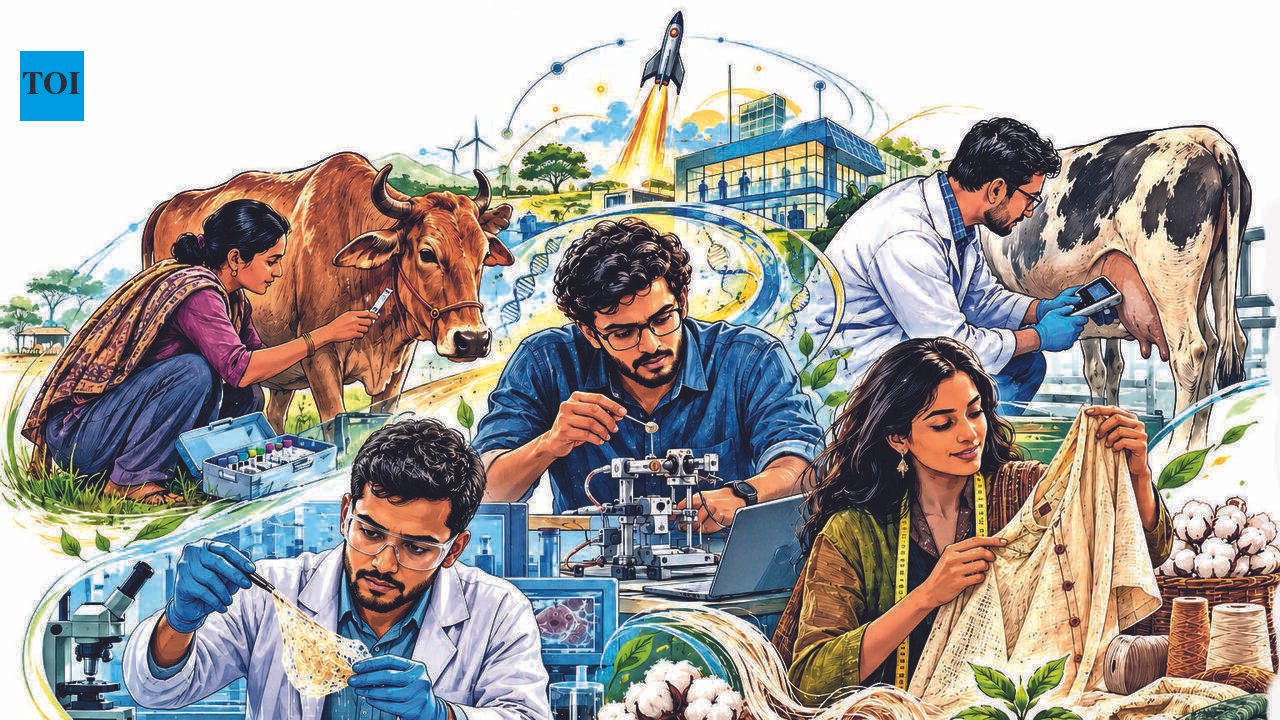
Gujarat’s start-up ecosystem is gaining momentum, with the central govt’s department of science and technology identifying promising ventures and supporting them with funding to turn innovative ideas into market-ready solutionsA simple Rs 220-kit for farmers to know if a cow is pregnantWhat if checking whether a cow is pregnant was as easy as taking a human pregnancy test—and cost just Rs 220?A Gujarat startup has turned that idea into a blood-based pregnancy test for livestock that has already been used on around 27,000 animals and reached 25,000-27,000 farmers.
Koumal Kalantri, founder of Bignano Ventures, with the pregnancy kit
The innovation has also taken Bignano Ventures founder Koumal Kalantri from Gujarat’s dairy belt to Rashtrapati Bhavan, where she was among 26 grassroots innovators recently felicitated in the presence of President Droupadi Murmu. Kalantri was the only innovator from Gujarat among the awardees and the only one recognised for a livestock-focused innovation.The one-time-use kit requires just a drop of blood and is designed to detect pregnancy in cows, buffaloes and goats 28-35 days after breeding, according to Kalantri. Conventional diagnosis can involve rectal examination by trained personnel and is generally carried out much later, some 90-120 days after breeding.For dairy farmers, the difference can be significant. Early confirmation can help them take timely decisions on breeding, feeding and herd management. It also eliminates the need to transport large animals to veterinary facilities, a particular challenge for small and marginal farmers in rural areas.The test can be conducted by farmers themselves using instructions or a demonstration video. Veterinarians and artificial insemination technicians are also using it, while Amul Dairy and Sumul Dairy have placed orders for 10,000 kits, with Sumul already procuring them.Kalantri, who spent about a decade in human diagnostics, identified a gap in livestock testing and sought to make diagnosis faster and more accessible.Supported by AIC Anand Foundation of Anand Agricultural University under the Innovation and Agri-Entrepreneurship Programme under Rashtriya Krishi Vikas Yojana, Bignano is now developing kits for foot-and-mouth disease, brucellosis, tuberculosis and mastitis. It is targeting a production capacity of 5 lakh kits.A 3-second test that could add another layer to milk safetyThe first line of defence in safety of milk may begin well before it reaches the kitchen —with a three-second test on a cow. MooRopan India Pvt Ltd, founded by dairy microbiologist Dr Ankita Singh and her former student Aryan Donga, has developed MastiSense, an electronic cow-side device designed to detect bovine mastitis at an early stage.
The device is designed to detect mastitis at an early stage and delivers results within seconds
The low-cost device requires no reagent and delivers a result in around three seconds. According to the founders, it can detect mastitis up to 10 days earlier compared to conventional methods, potentially giving farmers more time to intervene and reduce unnecessary dependence on antibiotics.The implications of mastitis go beyond cattle health. It can affect milk quality and composition, while treatment of infected animals raises concerns about antibiotic residues if milk is not withheld during the prescribed withdrawal period. The issue is particularly relevant where raw or unpasteurised milk is consumed.Dr Singh said late diagnosis of mastitis can reduce milk yield by around 40%, while early diagnosis could limit the reduction to about 10-15%.MastiSense has been validated by the National Dairy Research Institute (NDRI), Karnal, and a patent application has been filed.MooRopan is also working on cattle nutrition through SiloRopan, a bacterial formulation for converting maize fodder into silage. Its cultures are adapted to Indian climatic conditions and fodder varieties, with customised formulations for winter and summer. The company says its culture has already been used to prepare around 2,200 tonnes of silage.According to the startup, the resulting silage is BIS-compliant, has a shelf life of up to 1.5 years, remains stable for 20 days after opening and has recorded nil aflatoxin.The teacher-student venture was founded in 2023. Singh has over two decades of teaching and research experience and a PhD in dairy microbiology from NDRI, while Donga completed his BTech in artificial intelligence in 2025.The Anand-based startup has raised Rs 26 lakh in grants and received support from iHUB Gujarat, GIZ Germany, Anand Agricultural University and the Jubilant Bhartia Foundation/IIM Lucknow EIC Bharat Impact programme.Vadodara startup turns human tissue into a dressingFor patients with diabetic foot ulcers, trauma and other difficult-to-heal wounds, treatment can involve repeated interventions and, in severe cases, lead to amputation. A Vadodara medical-tech startup is working on a biological dressing made from human tissue that could offer a new approach to advanced wound care.OrthoGraft Pvt Ltd, founded by material scientist Dr Atharva Abhay Poundarik, is developing tissue-derived biological dressings using placenta-derived amniotic membrane processed through a proprietary technology.
OrthoGraft’s bone tissue substitute could be a breakthrough in wound care
The company, incorporated in 2018, grew out of Poundarik’s work in medical devices and biomaterials after he returned to Vadodara in 2017 following nearly a decade in the US. Its three partners are Poundarik, his wife Vishakha, who has a background in organisational psychology, and American equine orthopaedic surgeon and investor Rodney James Stewart.The company screens and processes human tissue under prescribed protocols before converting it into advanced biological materials. Its immediate focus is diabetic foot ulcers, trauma and infected wounds, alongside a synthetic-materials vertical exploring controlled drug release and infection-management applications.One of its key challenges is storage. Many tissue-derived products available globally require freezing or cryopreservation. OrthoGraft is working on processing the material so it can retain its quality while being shelf-stored for multiple years, potentially making it more practical for wider use.The startup has received Technology Development Board’s support under the department of science and technology for a project costing around Rs 5 crore, with TDB funding 70% and the company contributing the remaining 30%. The support is aimed at creating a platform for production of tissue-based advanced products.Instead of immediately investing in its own building, OrthoGraft has leased a clean room and laboratories at Savli STBI to control capital expenditure. It has also received seed support from Savli STBI under the SSIP programme.OrthoGraft has two granted US patents and is working with institutions including IIT Ropar, Parul University and tertiary-care hospitals as it moves towards clinical evaluation and commercial manufacturing.What if your worn-out clothes could return to the soil?A Vadodara clothing brand is asking a question few fashion labels address: what happens to a garment after it is worn out? LeelaLer has developed clothing designed such that the garment— and not just its fabric — can eventually return to the soil. The recently launched brand uses indigenous cotton, hand-spinning, hand-weaving and natural dyes, while replacing synthetic components wherever possible.
Secretary, ministry of textiles, Neelam Shami Rao and development commissioner (handlooms) Dr M Beena at LeelaLer’s stall at the Weave the Future 5.0 exhibition
Its approach has earned a national showcase. LeelaLer was selected as one of 30 sustainable fashion brands from across India for Weave the Future 5.0 at Handloom Haat, Delhi, organised under the ministry of textiles and the office of the development commissioner (handlooms). It was the only brand selected from Gujarat.The brand’s premise is that a garment made from natural fibre can still leave behind synthetic waste through polyester stitching, synthetic interlinings, plastic labels, elastics, trims and petroleum-based printing inks. LeelaLer therefore treats the entire garment as a material system.Its garments use 100% organic cotton sewing thread, biodegradable fusible interlining tested by Hohenstein Labs, coconut-shell buttons and natural-rubber-and-cotton elastic. Zippers have been avoided because the founders could not find a compostable alternative. Even packaging uses an in-house-developed natural iron-oak-gall ink.The brand works with rain-fed Kala Cotton from Kutch and naturally brown Vaidehi cotton from Vidarbha, with the latter’s natural colour reducing the need for dyeing.The company has also conducted composting tests on fabric, thread, elastic, interlining and dyed fabric, alongside soil tests before and after 12 weeks of composting.The venture was founded by Shaila Nambiar, a postgraduate in textile design from NID Ahmedabad, organic farmer Anshul Rajbanshi and fine arts graduate Sagar Deshpande.
